
Movie
Description
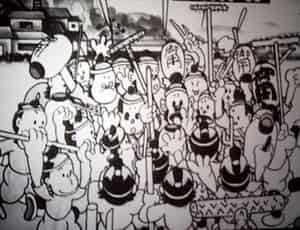
"Yowamushi Chinsengumi" is a comedic anime series that blends historical parody with modern sensibilities, set in a fictionalized version of Japan's Edo period. The story revolves around a group of misfit samurai who form the titular Chinsengumi, a bumbling and inept security force tasked with maintaining order in Kyoto. Despite their noble intentions, the group's incompetence and eccentric personalities often lead to chaotic and humorous situations.
The protagonist, Kanba Iwai, is a lazy and gluttonous young man who dreams of a life of leisure but is reluctantly thrust into the role of a samurai. His laid-back attitude contrasts sharply with the strict and disciplined image of a traditional warrior. Kanba is joined by a colorful cast of characters, including the hot-headed and impulsive Tetsunosuke, the overly serious and rule-bound Isami, and the enigmatic and mysterious Okita. Each member of the Chinsengumi brings their own quirks and flaws, contributing to the group's overall dysfunction.
The plot unfolds through a series of episodic adventures, with the Chinsengumi encountering various challenges and adversaries. These range from rival factions and criminal organizations to supernatural entities and absurd situations. Despite their lack of skill and coordination, the group often manages to stumble their way to success, usually through a combination of luck, improvisation, and sheer determination. The series frequently employs slapstick humor, exaggerated character reactions, and anachronistic elements, creating a lighthearted and irreverent tone.
Throughout the series, the Chinsengumi's antics are juxtaposed with moments of camaraderie and growth, as the characters gradually develop a sense of loyalty and purpose. While their primary goal is to protect Kyoto, their personal motivations and relationships often take center stage, adding depth to the otherwise comedic narrative. The interplay between the characters' individual struggles and their collective misadventures forms the core of the series, balancing humor with occasional moments of sincerity.
"Yowamushi Chinsengumi" also incorporates elements of Japanese history and culture, albeit in a highly exaggerated and fictionalized manner. The series playfully reimagines historical figures and events, blending them with modern references and comedic twists. This approach creates a unique and entertaining take on the samurai genre, appealing to both fans of historical fiction and those seeking a more light-hearted and unconventional story.
The protagonist, Kanba Iwai, is a lazy and gluttonous young man who dreams of a life of leisure but is reluctantly thrust into the role of a samurai. His laid-back attitude contrasts sharply with the strict and disciplined image of a traditional warrior. Kanba is joined by a colorful cast of characters, including the hot-headed and impulsive Tetsunosuke, the overly serious and rule-bound Isami, and the enigmatic and mysterious Okita. Each member of the Chinsengumi brings their own quirks and flaws, contributing to the group's overall dysfunction.
The plot unfolds through a series of episodic adventures, with the Chinsengumi encountering various challenges and adversaries. These range from rival factions and criminal organizations to supernatural entities and absurd situations. Despite their lack of skill and coordination, the group often manages to stumble their way to success, usually through a combination of luck, improvisation, and sheer determination. The series frequently employs slapstick humor, exaggerated character reactions, and anachronistic elements, creating a lighthearted and irreverent tone.
Throughout the series, the Chinsengumi's antics are juxtaposed with moments of camaraderie and growth, as the characters gradually develop a sense of loyalty and purpose. While their primary goal is to protect Kyoto, their personal motivations and relationships often take center stage, adding depth to the otherwise comedic narrative. The interplay between the characters' individual struggles and their collective misadventures forms the core of the series, balancing humor with occasional moments of sincerity.
"Yowamushi Chinsengumi" also incorporates elements of Japanese history and culture, albeit in a highly exaggerated and fictionalized manner. The series playfully reimagines historical figures and events, blending them with modern references and comedic twists. This approach creates a unique and entertaining take on the samurai genre, appealing to both fans of historical fiction and those seeking a more light-hearted and unconventional story.
Comment(s)
Staff
- DirectorKon Ichikawa