
Movie
Description
In 2007, Japanese director Mirai Mizue released Lost Utopia, a five-minute experimental short film that reinterprets the biblical story of Adam and Eve through purely visual and musical means. The film unfolds without dialogue, telling its story entirely through hand-drawn and 2D computer animation set to an original jazz score by Alice Nakamura.
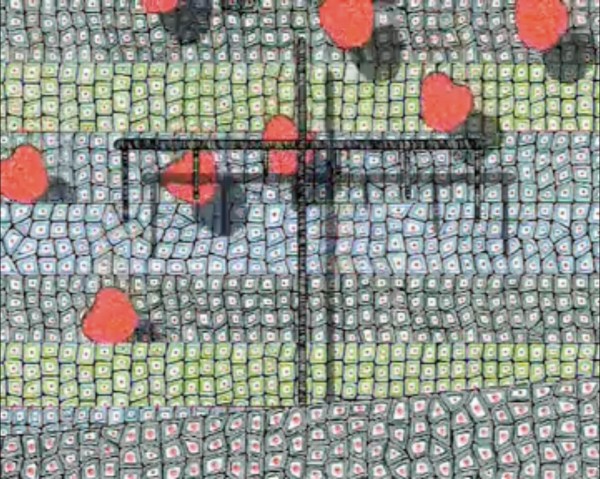
The setting is not a literal Garden of Eden but a fluid, abstract, and kaleidoscopic space created from roughly 5000 hand-drawn cells. In this world, forms are in constant motion, with creatures and human figures appearing translucent, as if seen through an X-ray or a microscope. The animation explores the moment of temptation and the acquisition of knowledge, symbolized by the appearance of an apple which the characters consume. This act represents the birth of desire and the emergence of sin as an inescapable part of human nature. The film visualizes the randomness of existence, the interconnection of all things, and the tension between order and chaos. It begins with a single cell dividing, and from this simple action, a complex world grows. The central narrative arc follows this progression from a state of unity to one of division and conflict, mirroring the expulsion from a perfect state. There are no named characters or voice actors; the archetypal figures of Adam and Eve are presented as abstract, fluid forms whose journey is conveyed through the metamorphosis of the animation itself. The film is a meditation on the invisible elements that make up humanity, such as sin, desire, and the soul, suggesting that humanity is an incomplete existence caught between order and chaos.
The setting is not a literal Garden of Eden but a fluid, abstract, and kaleidoscopic space created from roughly 5000 hand-drawn cells. In this world, forms are in constant motion, with creatures and human figures appearing translucent, as if seen through an X-ray or a microscope. The animation explores the moment of temptation and the acquisition of knowledge, symbolized by the appearance of an apple which the characters consume. This act represents the birth of desire and the emergence of sin as an inescapable part of human nature. The film visualizes the randomness of existence, the interconnection of all things, and the tension between order and chaos. It begins with a single cell dividing, and from this simple action, a complex world grows. The central narrative arc follows this progression from a state of unity to one of division and conflict, mirroring the expulsion from a perfect state. There are no named characters or voice actors; the archetypal figures of Adam and Eve are presented as abstract, fluid forms whose journey is conveyed through the metamorphosis of the animation itself. The film is a meditation on the invisible elements that make up humanity, such as sin, desire, and the soul, suggesting that humanity is an incomplete existence caught between order and chaos.
Comment(s)
Staff
- Director
- Original creator
- MusicAlice Nakamura
- Animation Director