
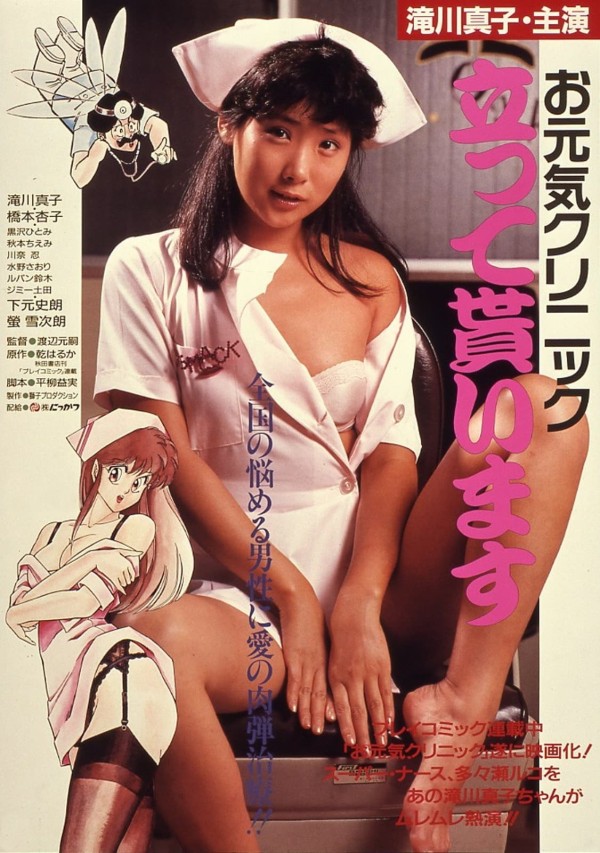
Live action TV
Description
In the late 1980s, a live-action film titled Welcome to the Ogenki Clinic was produced in Japan as an adaptation of Haruka Inui's popular erotic comedy manga. The story takes place within the walls of a specialized and unconventional medical facility simply known as the Ogenki Clinic, a practice devoted entirely to diagnosing and curing patients suffering from a wide range of sexual dysfunctions and peculiar intimate anxieties. The clinic is run by the quirky and perpetually energetic Doctor Sawaru Ogenki, a man whose unorthodox methods and seemingly insatiable personal appetites are matched only by his genuine, if crude, dedication to his patients' carnal well-being. He is assisted by his beautiful and enthusiastic nurse, Ruko Tatase, whose own considerable expertise and willingness to participate in demonstrations make her an indispensable part of the doctor’s therapeutic process. Together, this unusual pair treats a revolving door of clients with bizarre conditions, from those whose problems are psychologically devastating to those that are physically extraordinary, often employing surreal visual metaphors and absurd comedic scenarios as part of their cures. The film’s tone is one of broad, over-the-top farce, heavily reliant on slapstick, deliberate overacting, and a distinctly Japanese brand of grotesque and absurdist humor.
While the manga and subsequent anime OVA series feature an episodic structure showcasing a variety of patients, the live-action film, directed by Mototsugu Watanabe and released by Nikkatsu in 1988, focuses on a more centralized narrative arc. The plot is set in motion when Ruko is attacked by a group of would-be assailants and is rescued by a mild-mannered and sexually repressed man named Masao. Despite his heroism, Masao is deeply humiliated by women and suffers from a paralyzing lack of confidence in his own masculinity. Grateful for his intervention and seeing a worthy challenge, Ruko takes a personal interest in his case. The core of the film follows Ruko as she attempts to cure Masao through a bizarre and rigorous training regimen designed to awaken his dormant passions and overcome his psychological blocks. This primary storyline is interwoven with the clinic’s typical caseload, featuring various surreal sketches and parodies of other pinku eiga films, including a subplot where Masao embarks on a strange, dreamlike revenge spree against the women who have wronged him. The narrative builds toward a chaotic climax as the characters’ various sexual frustrations and comic misadventures collide, all rendered in a distinctive visual style that combines live-action with the exaggerated, impossible logic of its animated and printed source material.
While the manga and subsequent anime OVA series feature an episodic structure showcasing a variety of patients, the live-action film, directed by Mototsugu Watanabe and released by Nikkatsu in 1988, focuses on a more centralized narrative arc. The plot is set in motion when Ruko is attacked by a group of would-be assailants and is rescued by a mild-mannered and sexually repressed man named Masao. Despite his heroism, Masao is deeply humiliated by women and suffers from a paralyzing lack of confidence in his own masculinity. Grateful for his intervention and seeing a worthy challenge, Ruko takes a personal interest in his case. The core of the film follows Ruko as she attempts to cure Masao through a bizarre and rigorous training regimen designed to awaken his dormant passions and overcome his psychological blocks. This primary storyline is interwoven with the clinic’s typical caseload, featuring various surreal sketches and parodies of other pinku eiga films, including a subplot where Masao embarks on a strange, dreamlike revenge spree against the women who have wronged him. The narrative builds toward a chaotic climax as the characters’ various sexual frustrations and comic misadventures collide, all rendered in a distinctive visual style that combines live-action with the exaggerated, impossible logic of its animated and printed source material.
Cast
- Ruko TataseMako Takigawa
- SeikoChiemi Akimoto
- Madonna OkyōKyōko Hashimoto
- UsakoShinobu Kawana
- ShinozakiJimmy Tsuchida
- Yukijirō Hotaru
- Ona BirunoHitomi Kurosawa
- IshidaLupin Suzuki
- Masao MatsudairaShirō Shimomoto
- MariaSaori Mizuno
Comment(s)
Staff
- DirectorMototsugu Watanabe
- MusicTakashi Akutagawa
- Art DirectorToshihiro Sato
- Assistant DirectorTadami OharaTakahisa Zeze
- Color GradingYoshihiro Miyamoto
- EditingShōji Sakai
- Lighting DirectorIsao Tabata
- PublicistYasuhiko Higashi
- ScriptMasumi Hirayanagi
- Original MangaHaruka Inui
- Director of PhotographyYoichi Shiga
- Camera AssistantToshihiro Nakamatsu
- Development ProducerYutaka Tsunoda
- First Assistant DirectorTakaaki Hashiguchi
- Lighting TechnicianTakashi Kaneko
- Still PhotographyIchiro Tsuda
Production
- ProductionNikkatsu Corporation
- DistributorKitty Media
- Licensed byMedia Blasters