
TV-Series
Description
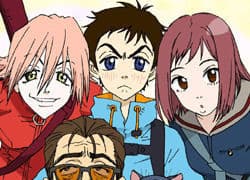
"FLCL" is a six-episode anime series that blends surrealism, coming-of-age themes, and science fiction into a fast-paced, chaotic narrative. The story centers on Naota Nandaba, a 12-year-old boy living in the mundane town of Mabase. Naota's life takes a dramatic turn when he is run over by a mysterious woman on a Vespa, Haruko Haruhara, who later strikes him with a bass guitar, causing a horn to grow from his forehead. This event triggers a series of bizarre occurrences, as robots begin to emerge from Naota's head, each tied to his emotional state and personal struggles.
Haruko, who claims to be an alien, inserts herself into Naota's life, working at his father's bakery and living in their home. Her true motives remain ambiguous, but she is revealed to be searching for a powerful entity known as Atomsk, the Pirate King. Haruko's presence disrupts Naota's relationships with those around him, including his older brother's ex-girlfriend, Mamimi Samejima, who clings to Naota as a substitute for his absent brother. Mamimi's own struggles with loneliness and self-worth are explored through her interactions with Naota and her fixation on a local bridge.
As the series progresses, Naota grapples with his feelings of inadequacy, jealousy, and the pressures of growing up. The robots that emerge from his head are often tied to his emotional turmoil, serving as metaphors for his internal conflicts. These robots are fought by Haruko and later by Naota himself, who begins to wield the same bass guitar that Haruko used on him. The battles are chaotic and symbolic, reflecting Naota's struggle to understand his place in the world and his relationships with others.
The narrative also delves into the dynamics of Naota's family, particularly his eccentric father, Kamon, who harbors unrequited feelings for Haruko, and his grandfather, who provides a grounding presence. The series explores themes of adolescence, identity, and the transition from childhood to adulthood, using its surreal and often absurd events to mirror the confusion and intensity of Naota's experiences.
By the end of the series, Naota begins to assert his independence, rejecting Haruko's manipulative influence and embracing his own agency. Haruko departs, continuing her search for Atomsk, leaving Naota to navigate the complexities of his life with a newfound sense of self-awareness. The series concludes on an open-ended note, emphasizing the ongoing nature of Naota's growth and the unresolved nature of Haruko's quest.
Haruko, who claims to be an alien, inserts herself into Naota's life, working at his father's bakery and living in their home. Her true motives remain ambiguous, but she is revealed to be searching for a powerful entity known as Atomsk, the Pirate King. Haruko's presence disrupts Naota's relationships with those around him, including his older brother's ex-girlfriend, Mamimi Samejima, who clings to Naota as a substitute for his absent brother. Mamimi's own struggles with loneliness and self-worth are explored through her interactions with Naota and her fixation on a local bridge.
As the series progresses, Naota grapples with his feelings of inadequacy, jealousy, and the pressures of growing up. The robots that emerge from his head are often tied to his emotional turmoil, serving as metaphors for his internal conflicts. These robots are fought by Haruko and later by Naota himself, who begins to wield the same bass guitar that Haruko used on him. The battles are chaotic and symbolic, reflecting Naota's struggle to understand his place in the world and his relationships with others.
The narrative also delves into the dynamics of Naota's family, particularly his eccentric father, Kamon, who harbors unrequited feelings for Haruko, and his grandfather, who provides a grounding presence. The series explores themes of adolescence, identity, and the transition from childhood to adulthood, using its surreal and often absurd events to mirror the confusion and intensity of Naota's experiences.
By the end of the series, Naota begins to assert his independence, rejecting Haruko's manipulative influence and embracing his own agency. Haruko departs, continuing her search for Atomsk, leaving Naota to navigate the complexities of his life with a newfound sense of self-awareness. The series concludes on an open-ended note, emphasizing the ongoing nature of Naota's growth and the unresolved nature of Haruko's quest.
Comment(s)
No entries available.
Relations
Anime overview
Manga overview
Music
Opening
- ?“"One Life"” - The Pillows (ep 1)
- 2-3“"Instant Music"” - The Pillows
- ?“"Happy Bivouac"” - The Pillows (ep 4)
- ?“"Runners High"” - The Pillows (ep 5)
- ?“"Carnival"” - The Pillows (ep 6)
Insert songs
- 6“"Another Morning"” - The Pillows
- 5“"Blues Drive Monster"” - The Pillows
- 4“"Crazy Sunshine"” - The Pillows
- 6“"Funny Bunny"” - The Pillows
- 2“"Hybrid Rainbow"” - The Pillows
- 6“"I Think I Can"” - The Pillows
- 6“"Last Dinosaur"” - The Pillows
- ?“"Little Busters"” - The Pillows