
Movie
Description
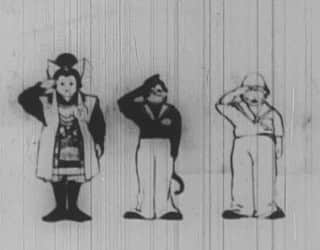
"Umi no Momotaro" is a 1945 Japanese animated short film directed by Mitsuyo Seo, often regarded as a significant work in the history of anime. The story is set during World War II and draws inspiration from the Japanese folktale of Momotaro, a boy born from a peach who grows up to become a heroic figure. In this adaptation, Momotaro is reimagined as a symbol of Japanese military strength and unity, leading a group of anthropomorphic animals on a mission to liberate an island from foreign forces.
The narrative begins with Momotaro, a young and courageous boy, rallying a team of animals—a monkey, a dog, a pheasant, and a bear—to join him in a naval expedition. These animals represent the diverse yet unified spirit of the Japanese people, each contributing unique skills to the mission. The group embarks on a journey across the sea, facing challenges that test their resolve and teamwork. Their destination is an island occupied by foreign forces, depicted as antagonistic and oppressive.
Upon arrival, Momotaro and his companions engage in a series of strategic battles, showcasing their ingenuity and bravery. The animals use their individual abilities to outmaneuver the enemy, with the monkey climbing trees to scout, the dog using its strength in combat, the pheasant flying to deliver messages, and the bear providing additional support. Momotaro, as the leader, demonstrates exceptional tactical prowess and inspires his team to persevere. The climax of the story involves a decisive confrontation where Momotaro and his allies successfully reclaim the island, restoring peace and order.
The film’s narrative is heavily influenced by its wartime context, serving as a piece of propaganda to bolster national morale. It emphasizes themes of unity, sacrifice, and the triumph of good over evil, aligning with the ideological messaging of the era. Despite its propagandistic nature, "Umi no Momotaro" is notable for its technical achievements in animation, including fluid motion and detailed backgrounds, which were groundbreaking for its time.
The characters are archetypal, with Momotaro embodying the ideal of a selfless and determined leader, while the animals represent collective strength and cooperation. The story’s straightforward structure and moral clarity reflect its intended purpose as an inspirational tale for wartime audiences. While its historical context is inseparable from its content, "Umi no Momotaro" remains a culturally significant work in the evolution of Japanese animation.
The narrative begins with Momotaro, a young and courageous boy, rallying a team of animals—a monkey, a dog, a pheasant, and a bear—to join him in a naval expedition. These animals represent the diverse yet unified spirit of the Japanese people, each contributing unique skills to the mission. The group embarks on a journey across the sea, facing challenges that test their resolve and teamwork. Their destination is an island occupied by foreign forces, depicted as antagonistic and oppressive.
Upon arrival, Momotaro and his companions engage in a series of strategic battles, showcasing their ingenuity and bravery. The animals use their individual abilities to outmaneuver the enemy, with the monkey climbing trees to scout, the dog using its strength in combat, the pheasant flying to deliver messages, and the bear providing additional support. Momotaro, as the leader, demonstrates exceptional tactical prowess and inspires his team to persevere. The climax of the story involves a decisive confrontation where Momotaro and his allies successfully reclaim the island, restoring peace and order.
The film’s narrative is heavily influenced by its wartime context, serving as a piece of propaganda to bolster national morale. It emphasizes themes of unity, sacrifice, and the triumph of good over evil, aligning with the ideological messaging of the era. Despite its propagandistic nature, "Umi no Momotaro" is notable for its technical achievements in animation, including fluid motion and detailed backgrounds, which were groundbreaking for its time.
The characters are archetypal, with Momotaro embodying the ideal of a selfless and determined leader, while the animals represent collective strength and cooperation. The story’s straightforward structure and moral clarity reflect its intended purpose as an inspirational tale for wartime audiences. While its historical context is inseparable from its content, "Umi no Momotaro" remains a culturally significant work in the evolution of Japanese animation.
Comment(s)
Staff
- ScreenplayChūzō Aoji
- StoryChūzō Aoji
Production
- ProductionYokohama Cinema Shōkai