Live action TV
Description
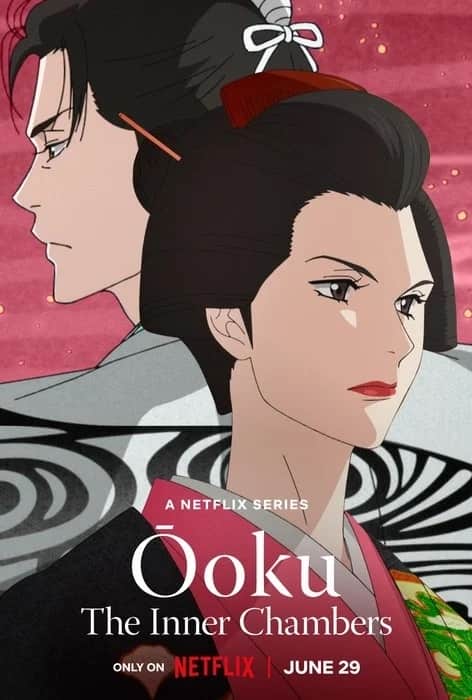
In early 18th century Japan, a devastating plague known as the redface pox has killed nearly three-quarters of the male population, creating an alternate history where women have assumed all roles of labor, governance, and leadership. Within Edo Castle, the Shogun is now a woman, and the Ooku, once a harem of women, has been transformed into the Inner Chambers, where hundreds of the nation's most beautiful men are kept as consorts, forbidden to leave and existing solely for the Shogun's pleasure and the hope of producing a male heir. The narrative unfolds across three distinct shogunates, each exploring different facets of this gender-inverted society.
The story begins with the reign of the eighth Shogun, Yoshimune, a pragmatic and reform-minded ruler who is frustrated by the Ooku's exorbitant cost and archaic traditions. A young, impoverished samurai named Mizuno Yūnoshin enters the Inner Chambers in exchange for a dowry to secure a husband for his beloved sister, leaving behind his own childhood sweetheart. Mizuno rises through the ranks, catching Yoshimune's attention with his honesty. When the Shogun chooses him as her first consort, a position that traditionally leads to execution to protect her purity, Yoshimune instead stages a fake beheading. After secretly releasing him to marry his sweetheart, Yoshimune begins dismantling the Ooku's excesses. Her curiosity about why women in power adopt male names leads her to the ancient Chief Scribe, who entrusts her with a secret chronicle titled The Chronicle of the Dying Day, a text that reveals the true, hidden history of the Ooku.
The chronicle rewinds the narrative to the era of the third Shogun, Iemitsu, decades earlier when the plague was still new. The handsome Buddhist abbot Arikoto is forcibly taken from his temple and inducted into the Ooku by the powerful and ruthless Lady Kasuga. He is shocked to discover that the real Shogun Iemitsu died of the plague, and the person on the throne is a traumatized, illegitimate daughter now passing as a male Shogun. Forced to serve as her primary consort, the gentle and intellectual Arikoto becomes the confidant of the volatile young ruler, whose mother was murdered by Lady Kasuga. Despite their genuine love, Arikoto is sterile. Lady Kasuga secures other men to impregnate the female Iemitsu, who produces three daughters before dying at the young age of twenty-seven. On her deathbed, the Shogun asks Arikoto to guide her eldest daughter, cementing the new matrilineal succession.
The chronicle also explores the reign of the fifth Shogun, Tsunayoshi, a beautiful but politically erratic ruler who has a notoriously wild sex life. She is dominated by her father and surrounded by scheming consorts vying to produce an heir. The aging but clever nobleman Emonnosuke is brought to the Ooku and, rather than becoming a consort, becomes the General Director of the Inner Chambers. He helps Tsunayoshi navigate the treacherous politics of reproduction and break free from her father's control. As she ages past menopause without a stable successor, her retainers grow desperate. Her chief lady-in-waiting, Yoshiyasu, confesses a secret love for Tsunayoshi before smothering the dying Shogun to allow a peaceful transition of power.
Throughout these arcs, the series depicts a society where men are precious commodities used for breeding, often prostituted or coddled into effeminacy, while women adopt male personas to maintain a crumbling patriarchal political structure. The Ooku itself is portrayed as a gilded prison of political intrigue, sexual violence, and psychological manipulation. The narrative concludes with Yoshimune reading the chronicle, understanding that the gender reversal has not dismantled the old power structures but merely inverted them, with women now trapped in the same cycles of power and tradition as the men who came before. The borders of Japan remain sealed, not only from Christianity but from a foreign world that must never learn of the nation's mortal weakness.
The story begins with the reign of the eighth Shogun, Yoshimune, a pragmatic and reform-minded ruler who is frustrated by the Ooku's exorbitant cost and archaic traditions. A young, impoverished samurai named Mizuno Yūnoshin enters the Inner Chambers in exchange for a dowry to secure a husband for his beloved sister, leaving behind his own childhood sweetheart. Mizuno rises through the ranks, catching Yoshimune's attention with his honesty. When the Shogun chooses him as her first consort, a position that traditionally leads to execution to protect her purity, Yoshimune instead stages a fake beheading. After secretly releasing him to marry his sweetheart, Yoshimune begins dismantling the Ooku's excesses. Her curiosity about why women in power adopt male names leads her to the ancient Chief Scribe, who entrusts her with a secret chronicle titled The Chronicle of the Dying Day, a text that reveals the true, hidden history of the Ooku.
The chronicle rewinds the narrative to the era of the third Shogun, Iemitsu, decades earlier when the plague was still new. The handsome Buddhist abbot Arikoto is forcibly taken from his temple and inducted into the Ooku by the powerful and ruthless Lady Kasuga. He is shocked to discover that the real Shogun Iemitsu died of the plague, and the person on the throne is a traumatized, illegitimate daughter now passing as a male Shogun. Forced to serve as her primary consort, the gentle and intellectual Arikoto becomes the confidant of the volatile young ruler, whose mother was murdered by Lady Kasuga. Despite their genuine love, Arikoto is sterile. Lady Kasuga secures other men to impregnate the female Iemitsu, who produces three daughters before dying at the young age of twenty-seven. On her deathbed, the Shogun asks Arikoto to guide her eldest daughter, cementing the new matrilineal succession.
The chronicle also explores the reign of the fifth Shogun, Tsunayoshi, a beautiful but politically erratic ruler who has a notoriously wild sex life. She is dominated by her father and surrounded by scheming consorts vying to produce an heir. The aging but clever nobleman Emonnosuke is brought to the Ooku and, rather than becoming a consort, becomes the General Director of the Inner Chambers. He helps Tsunayoshi navigate the treacherous politics of reproduction and break free from her father's control. As she ages past menopause without a stable successor, her retainers grow desperate. Her chief lady-in-waiting, Yoshiyasu, confesses a secret love for Tsunayoshi before smothering the dying Shogun to allow a peaceful transition of power.
Throughout these arcs, the series depicts a society where men are precious commodities used for breeding, often prostituted or coddled into effeminacy, while women adopt male personas to maintain a crumbling patriarchal political structure. The Ooku itself is portrayed as a gilded prison of political intrigue, sexual violence, and psychological manipulation. The narrative concludes with Yoshimune reading the chronicle, understanding that the gender reversal has not dismantled the old power structures but merely inverted them, with women now trapped in the same cycles of power and tradition as the men who came before. The borders of Japan remain sealed, not only from Christianity but from a foreign world that must never learn of the nation's mortal weakness.
Cast
- Matsushima
- YoshimuneLilli Manzini
Comment(s)
Staff
- Original creator
Production
- ProductionMainichi Broadcasting SystemHakusenshaShochikuAsmik Ace Entertainment, Inc.Dentsu Inc.Tokyo Broadcasting SystemChubu-Nippon Broadcasting Co., Ltd.Yahoo! JapanRKB Mainichi BroadcastingJ Storm, Inc.Shizuoka Broadcasting System
Relations
Anime overview