
Manga
Description
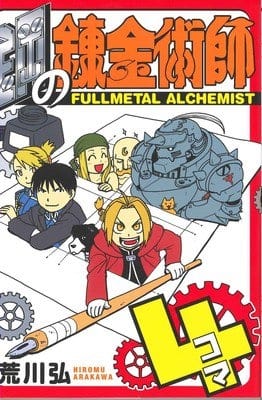
"Fullmetal Alchemist: The Complete Four-Panel Comics" is a spin-off collection of comedic four-panel strips based on the original "Fullmetal Alchemist" manga by Hiromu Arakawa. The series parodies the characters, events, and themes of the main story, presenting them in a lighthearted and humorous format. The narrative retains the core elements of the original series but reimagines them through exaggerated, absurd, and often slapstick scenarios.
The story revolves around the Elric brothers, Edward and Alphonse, who are central to the original manga. Edward, the older brother, is a talented alchemist with a prosthetic arm and leg, while Alphonse’s soul is bound to a suit of armor after a failed alchemical experiment. Their quest to restore their bodies remains a recurring theme, but the four-panel format shifts the focus to comedic interactions and misunderstandings. The brothers’ dynamic is amplified for humor, with Edward’s short temper and Alphonse’s calm demeanor often leading to exaggerated conflicts.
Other key characters from the original series, such as Winry Rockbell, Roy Mustang, Riza Hawkeye, and the Homunculi, appear in these strips, each reimagined with comedic traits. Winry’s mechanical expertise and occasional violent outbursts are played up for laughs, while Mustang’s leadership and alchemical prowess are often undercut by his vanity or incompetence in humorous situations. The Homunculi, typically menacing antagonists, are depicted in absurd or mundane scenarios, subverting their original roles.
The plotlines in the four-panel comics are episodic and self-contained, often satirizing iconic moments from the main series. For example, the brothers’ encounters with alchemical challenges or their battles with enemies are reimagined as farcical misadventures. The humor frequently derives from breaking the fourth wall, exaggerating character quirks, or placing the cast in anachronistic or nonsensical situations. Despite the comedic tone, the strips maintain a connection to the original story’s themes of sacrifice, brotherhood, and the consequences of human ambition, albeit in a more lighthearted manner.
The art style mirrors Arakawa’s original work but simplifies and exaggerates expressions and actions to enhance the comedic effect. The four-panel structure ensures concise, punchy storytelling, with each strip delivering a quick joke or gag. The collection serves as a companion piece to the main series, offering fans a humorous reinterpretation of familiar characters and events while remaining accessible to new readers.
The story revolves around the Elric brothers, Edward and Alphonse, who are central to the original manga. Edward, the older brother, is a talented alchemist with a prosthetic arm and leg, while Alphonse’s soul is bound to a suit of armor after a failed alchemical experiment. Their quest to restore their bodies remains a recurring theme, but the four-panel format shifts the focus to comedic interactions and misunderstandings. The brothers’ dynamic is amplified for humor, with Edward’s short temper and Alphonse’s calm demeanor often leading to exaggerated conflicts.
Other key characters from the original series, such as Winry Rockbell, Roy Mustang, Riza Hawkeye, and the Homunculi, appear in these strips, each reimagined with comedic traits. Winry’s mechanical expertise and occasional violent outbursts are played up for laughs, while Mustang’s leadership and alchemical prowess are often undercut by his vanity or incompetence in humorous situations. The Homunculi, typically menacing antagonists, are depicted in absurd or mundane scenarios, subverting their original roles.
The plotlines in the four-panel comics are episodic and self-contained, often satirizing iconic moments from the main series. For example, the brothers’ encounters with alchemical challenges or their battles with enemies are reimagined as farcical misadventures. The humor frequently derives from breaking the fourth wall, exaggerating character quirks, or placing the cast in anachronistic or nonsensical situations. Despite the comedic tone, the strips maintain a connection to the original story’s themes of sacrifice, brotherhood, and the consequences of human ambition, albeit in a more lighthearted manner.
The art style mirrors Arakawa’s original work but simplifies and exaggerates expressions and actions to enhance the comedic effect. The four-panel structure ensures concise, punchy storytelling, with each strip delivering a quick joke or gag. The collection serves as a companion piece to the main series, offering fans a humorous reinterpretation of familiar characters and events while remaining accessible to new readers.
Comment(s)
Staff
- Story & Art