
Description
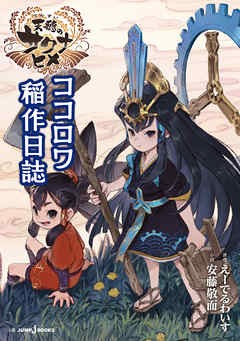
Hinoe Island is a place where gods and humans once joined forces to drive away demons, filling the land with the bounty of rice harvests. Even after the final battle that resolved the main conflict, the harvest goddess Sakuna Hime continues to live on this island, dedicating herself to rice cultivation alongside the human companions who were exiled with her. However, a shadow now watches over her work. This is Kokorowa Hime, the high-ranking goddess who presides over wheels, inventions, and all manner of mechanical devices. As Sakuna's best friend from the Lofty Realm, Kokorowa has always stood in contrast to her companion, being calm and collected where Sakuna is brash and carefree.
Due to certain circumstances in the celestial capital, Kokorowa finds herself forced to leave her workshops and join Sakuna on Hinoe Island. For the goddess of invention, who has spent her existence creating automatons to guard the Mihashira Capital and writing romance novels under the pen name Koushi Oborozuki, the rough labor of manual farming presents an entirely foreign challenge. Unlike Sakuna, who has grown into her role as a harvester deity through hardship, Kokorowa must learn from scratch how to till the earth, plant seedlings, and manage the intricate cycles of rice growth. The narrative follows her struggles with this unfamiliar work, her observations of the close-knit community that includes the serious farmer Tauemon, the craftsman Kinta, the kind-hearted Myrthe, the young Kaimaru, and the pragmatic Yui, and her deepening friendship with Sakuna as they labor side by side.
The story explores the contrast between the two goddesses. Where Sakuna initially disdained work but grew through communal life, Kokorowa approaches rice farming as an intellectual puzzle and a source of material for her next book, yet finds herself humbled by the physical and spiritual demands of agriculture. The island itself, known for its demonic inhabitants and harsh conditions, serves as the backdrop for this tale of patience, invention, and the unexpected wisdom found in simple, repetitive labor. Through the planting season, Kokorowa adapts her inventive mind to create tools that might ease the burden of farming, blending her divine domain over wheels and mechanisms with the ancient traditions of rice cultivation. The light novel serves as a direct sequel to the main story, focusing entirely on Kokorowa's perspective as she learns that even a goddess of invention cannot shortcut the patient work of growing food from the earth.
Due to certain circumstances in the celestial capital, Kokorowa finds herself forced to leave her workshops and join Sakuna on Hinoe Island. For the goddess of invention, who has spent her existence creating automatons to guard the Mihashira Capital and writing romance novels under the pen name Koushi Oborozuki, the rough labor of manual farming presents an entirely foreign challenge. Unlike Sakuna, who has grown into her role as a harvester deity through hardship, Kokorowa must learn from scratch how to till the earth, plant seedlings, and manage the intricate cycles of rice growth. The narrative follows her struggles with this unfamiliar work, her observations of the close-knit community that includes the serious farmer Tauemon, the craftsman Kinta, the kind-hearted Myrthe, the young Kaimaru, and the pragmatic Yui, and her deepening friendship with Sakuna as they labor side by side.
The story explores the contrast between the two goddesses. Where Sakuna initially disdained work but grew through communal life, Kokorowa approaches rice farming as an intellectual puzzle and a source of material for her next book, yet finds herself humbled by the physical and spiritual demands of agriculture. The island itself, known for its demonic inhabitants and harsh conditions, serves as the backdrop for this tale of patience, invention, and the unexpected wisdom found in simple, repetitive labor. Through the planting season, Kokorowa adapts her inventive mind to create tools that might ease the burden of farming, blending her divine domain over wheels and mechanisms with the ancient traditions of rice cultivation. The light novel serves as a direct sequel to the main story, focusing entirely on Kokorowa's perspective as she learns that even a goddess of invention cannot shortcut the patient work of growing food from the earth.
Comment(s)
Staff
- StoryKeiji Andō
- IllustrationRyōta Murayama