
Manga
Description
A high school student named Neji Yamato is troubled by questions that circle endlessly through his mind without ever reaching a satisfactory answer. His core dilemma, the question of who he is when he feels like nothing at all, is given a strange physical form by a literal screw protruding from his head. The story follows Neji as he navigates daily life in his contemporary Japanese high school, where a mysterious classmate takes an interest in him, setting the stage for a series of encounters that force him and those around him to confront complex ideas.
The narrative is structured as a series of episodic philosophical investigations rather than a single continuous plot. Early chapters establish the core conflict by having Neji wrestle with fundamental questions of existence and identity, such as why he is here at all and the nature of his own consciousness, directly engaging with concepts like cogito ergo sum and the antinomy of pure reason. As the story progresses, it uses the school setting to explore a wide range of philosophical topics. One arc examines the nature of truth, while another delves into the concepts of being and beinghood. The series later applies these frameworks to social and psychological structures, with arcs dedicated to the ego and the id, the dynamics of crowd psychology, and the controlling mechanisms of a panopticon. Further arcs critique moral systems by exploring slave morality and question the very idea of free will and existence with a chapter titled The Cell Precedes Existence.
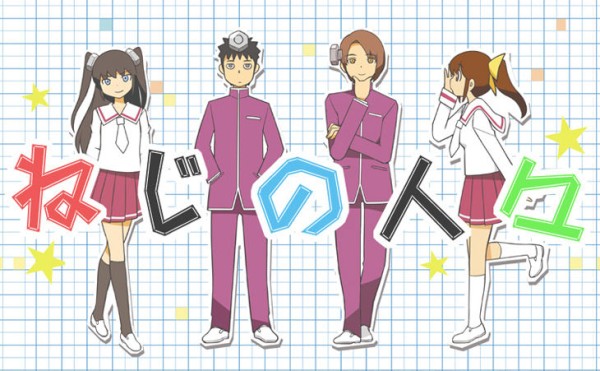
Neji Yamato is an expressionless and simple young man whose literal screw is a visual manifestation of his obsessive, looping thoughts. He is contrasted with a mysterious classmate who approaches him and seems to understand or share his unusual perspective. The supporting cast includes other students and teachers who represent different ways of thinking, from those who blindly follow the majority to those who enforce or rebel against systems of control. In its final chapters, the manga directly addresses its central themes. An arc titled The Non-Screw People introduces characters who do not share Neji's burden, while a two-part academic advising session and a three-part arc on morality titled The Good, The Bad, and the Right bring the philosophical discussions into practical, school-based scenarios. The story concludes with chapters titled The Answer is Blowin in the Wind and Climb Every Mountain, suggesting that the resolution is not a simple answer to Neji's initial question but an acceptance of the ongoing journey.
The narrative is structured as a series of episodic philosophical investigations rather than a single continuous plot. Early chapters establish the core conflict by having Neji wrestle with fundamental questions of existence and identity, such as why he is here at all and the nature of his own consciousness, directly engaging with concepts like cogito ergo sum and the antinomy of pure reason. As the story progresses, it uses the school setting to explore a wide range of philosophical topics. One arc examines the nature of truth, while another delves into the concepts of being and beinghood. The series later applies these frameworks to social and psychological structures, with arcs dedicated to the ego and the id, the dynamics of crowd psychology, and the controlling mechanisms of a panopticon. Further arcs critique moral systems by exploring slave morality and question the very idea of free will and existence with a chapter titled The Cell Precedes Existence.
Neji Yamato is an expressionless and simple young man whose literal screw is a visual manifestation of his obsessive, looping thoughts. He is contrasted with a mysterious classmate who approaches him and seems to understand or share his unusual perspective. The supporting cast includes other students and teachers who represent different ways of thinking, from those who blindly follow the majority to those who enforce or rebel against systems of control. In its final chapters, the manga directly addresses its central themes. An arc titled The Non-Screw People introduces characters who do not share Neji's burden, while a two-part academic advising session and a three-part arc on morality titled The Good, The Bad, and the Right bring the philosophical discussions into practical, school-based scenarios. The story concludes with chapters titled The Answer is Blowin in the Wind and Climb Every Mountain, suggesting that the resolution is not a simple answer to Neji's initial question but an acceptance of the ongoing journey.
Comment(s)
Staff
- Story & Art