
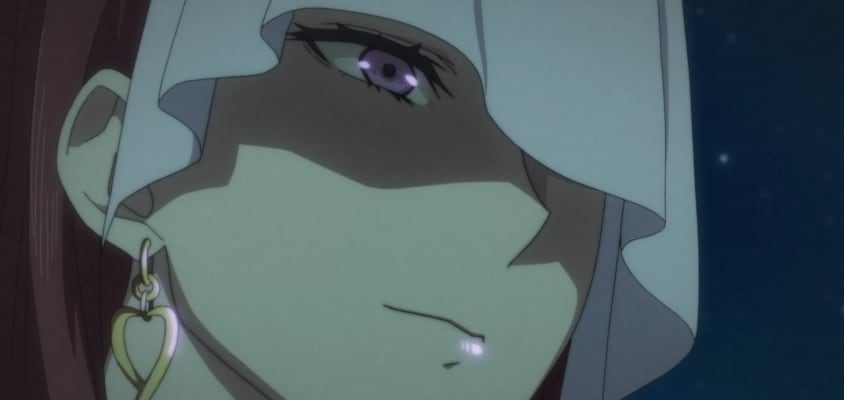
Image: yoruhashi/マッグガーデン・「はめつのおうこく」製作委員会
AMBot | 11/11/2023 | Reading Time: 3 Min.
The episode begins with a dramatic shift in the power dynamics between humans and witches. After Adonis refuses to resurrect his mentor Chloe, he declares his intention to hunt humans himself, distancing himself from the witches' plans. This decision becomes the starting point for a series of fierce confrontations and strategic maneuvers.
Amid this escalating conflict, the National Security Bureau (NSB) prepares for a decisive battle against the witches. Director Yamato, equipped with cutting-edge magic-suppression technology, leads the charge. The battle is brutal, and both sides suffer heavy losses. The witches, led by Madam Ophelia, fight valiantly to protect their sanctuary, Lunamilia, but face the overwhelming might of the NSB forces.
A pivotal moment arrives with the destruction of the sacred Mito Tree, the source of the witches' power. This devastating blow marks the end of the witches' ability to regenerate and birth new witches, sealing their fate.
Amid the chaos, a love spell cast by the witch Doroka plays a crucial role. The spell, affecting Director Yamato, leads to a temporary ceasefire. Doroka attempts to negotiate peace, urging Yamato to order a retreat. However, the truce is short-lived, as tensions and deep-seated hatred between humans and witches flare up once again.
The episode takes a dark turn as Emperor Goethe, driven to madness by his annihilation obsession, celebrates the apparent victory over the witches. His unstable mental state is evident in his erratic behavior and delusions of grandeur. The scene in the royal palace in the capital, New Nightmare, reveals the extent of his insanity and the fragility of his rule.
In a shocking twist, the episode ends with the staged death of Emperor Goethe, orchestrated by the witch Dorothea. This act of vengeance marks the end of Goethe's reign and paves the way for a new era in the empire.
Amid this escalating conflict, the National Security Bureau (NSB) prepares for a decisive battle against the witches. Director Yamato, equipped with cutting-edge magic-suppression technology, leads the charge. The battle is brutal, and both sides suffer heavy losses. The witches, led by Madam Ophelia, fight valiantly to protect their sanctuary, Lunamilia, but face the overwhelming might of the NSB forces.
A pivotal moment arrives with the destruction of the sacred Mito Tree, the source of the witches' power. This devastating blow marks the end of the witches' ability to regenerate and birth new witches, sealing their fate.
Amid the chaos, a love spell cast by the witch Doroka plays a crucial role. The spell, affecting Director Yamato, leads to a temporary ceasefire. Doroka attempts to negotiate peace, urging Yamato to order a retreat. However, the truce is short-lived, as tensions and deep-seated hatred between humans and witches flare up once again.
The episode takes a dark turn as Emperor Goethe, driven to madness by his annihilation obsession, celebrates the apparent victory over the witches. His unstable mental state is evident in his erratic behavior and delusions of grandeur. The scene in the royal palace in the capital, New Nightmare, reveals the extent of his insanity and the fragility of his rule.
In a shocking twist, the episode ends with the staged death of Emperor Goethe, orchestrated by the witch Dorothea. This act of vengeance marks the end of Goethe's reign and paves the way for a new era in the empire.
This article was originally published in German. It was translated with technical support and editorially reviewed before publication.
Comment(s) 0