TV-Series
Description
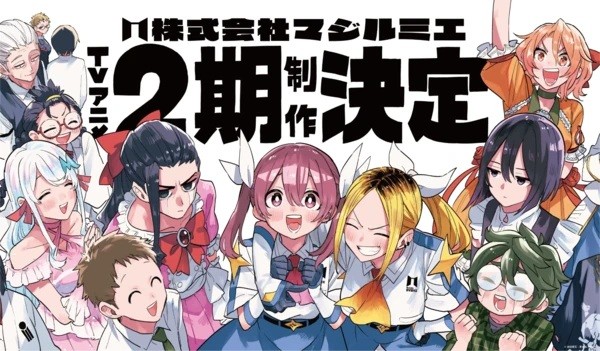
In a world where supernatural creatures known as Kaii frequently appear and cause destruction, the profession of combating them has become a respected and well-compensated career. Rather than being chosen heroines with secret identities, magical girls are now employees of licensed corporations, with over five hundred companies competing in this specialized industry.
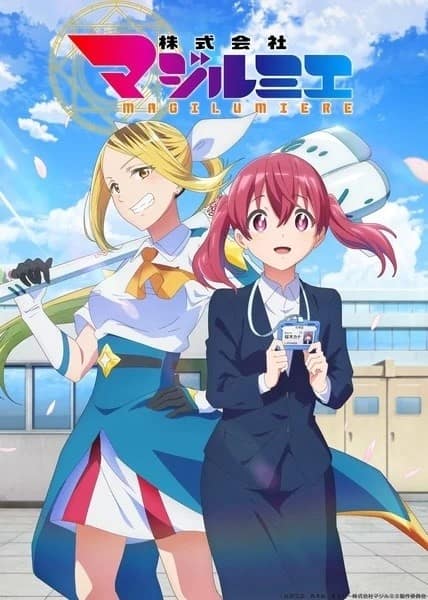
The story centers on Kana Sakuragi, a studious college graduate whose job hunt has been a series of rejections. During yet another failed interview, a Kaii attacks the building. The responding magical girl, Hitomi Koshigaya from the small startup Magilumiere Inc., finds herself struggling against the monster. Using her exceptional memory and quick thinking, Kana assists Hitomi in subduing the threat. Impressed by her potential, Hitomi offers Kana a job on the spot, and the young woman accepts, becoming the company’s second magical girl.
Magilumiere is a quirky, close-knit team operating on a shoestring budget. Its president is Kouji Shigemoto, a middle-aged man who is such an enthusiast of magical girls that he wears their frilly uniforms at work. The staff includes Kazuo Nikoyama, a bashful but brilliant magic engineer who designs spells, and Kaede Midorikawa, who handles sales and client relations. The company also employs Hana Ginji, a child prodigy who invented their BROOM flying devices.
The setting’s magic is technologically driven. Spells are created as software on computers and uploaded to devices, and magical girls activate them using programming terms like execute function rather than mystical incantations. This corporate framework brings practical concerns into monster hunting: insurance, collateral damage, contracts, and efficiency metrics.
The first major arc introduces this workplace dynamic. Kana’s first mission involves a historic shopping center whose fragile structures cannot withstand standard magical attacks. Using her methodical nature and habit of reading manuals, she helps devise a custom, low-impact solution. This showcases Magilumiere’s unique philosophy of creating tailored spells for each situation, minimizing damage through teamwork between the field agents and office engineers. This approach contrasts sharply with the industry leader, AST Corporation, which prioritizes raw power and standardized procedures.
A central tension emerges between Magilumiere and AST, led by President Kei Koga. Koga dismisses Shigemoto’s focus on aesthetics and personalized service as inefficient idealism, though their history suggests a past friendship or close working relationship. This ideological conflict is rooted in an unexplained disaster that occurred fifteen years prior, an event that fundamentally shaped both men’s approaches to magical girl work and continues to haunt the industry.
The narrative arc follows Kana’s growth from a dejected job-seeker into a capable magical girl. Her natural observational skills and photographic memory prove invaluable as she learns to assess situations and support Hitomi in the field. The season also explores the wider magical girl industry. Kana shadows Lily Aoi, a magical girl employed by a luxury cosmetics company, to learn different corporate cultures. At a magical technology expo, Magilumiere must handle a mutated Kaii that breaks loose during a demonstration, forcing them to improvise a solution when other companies hesitate due to contractual concerns.
As the season progresses, the Kaii begin to mutate and evolve in unpredictable ways, suggesting that the magic used to fight them might be creating more resilient threats, similar to pesticide resistance. This escalation culminates in Magilumiere confronting a particularly powerful mutated Kaii. The finale reveals lingering mysteries about the origin of the Kaii and the past tragedy, ending with President Shigemoto attending a meeting of the Council of Magical Organizations, setting the stage for larger conflicts to come.
The story centers on Kana Sakuragi, a studious college graduate whose job hunt has been a series of rejections. During yet another failed interview, a Kaii attacks the building. The responding magical girl, Hitomi Koshigaya from the small startup Magilumiere Inc., finds herself struggling against the monster. Using her exceptional memory and quick thinking, Kana assists Hitomi in subduing the threat. Impressed by her potential, Hitomi offers Kana a job on the spot, and the young woman accepts, becoming the company’s second magical girl.
Magilumiere is a quirky, close-knit team operating on a shoestring budget. Its president is Kouji Shigemoto, a middle-aged man who is such an enthusiast of magical girls that he wears their frilly uniforms at work. The staff includes Kazuo Nikoyama, a bashful but brilliant magic engineer who designs spells, and Kaede Midorikawa, who handles sales and client relations. The company also employs Hana Ginji, a child prodigy who invented their BROOM flying devices.
The setting’s magic is technologically driven. Spells are created as software on computers and uploaded to devices, and magical girls activate them using programming terms like execute function rather than mystical incantations. This corporate framework brings practical concerns into monster hunting: insurance, collateral damage, contracts, and efficiency metrics.
The first major arc introduces this workplace dynamic. Kana’s first mission involves a historic shopping center whose fragile structures cannot withstand standard magical attacks. Using her methodical nature and habit of reading manuals, she helps devise a custom, low-impact solution. This showcases Magilumiere’s unique philosophy of creating tailored spells for each situation, minimizing damage through teamwork between the field agents and office engineers. This approach contrasts sharply with the industry leader, AST Corporation, which prioritizes raw power and standardized procedures.
A central tension emerges between Magilumiere and AST, led by President Kei Koga. Koga dismisses Shigemoto’s focus on aesthetics and personalized service as inefficient idealism, though their history suggests a past friendship or close working relationship. This ideological conflict is rooted in an unexplained disaster that occurred fifteen years prior, an event that fundamentally shaped both men’s approaches to magical girl work and continues to haunt the industry.
The narrative arc follows Kana’s growth from a dejected job-seeker into a capable magical girl. Her natural observational skills and photographic memory prove invaluable as she learns to assess situations and support Hitomi in the field. The season also explores the wider magical girl industry. Kana shadows Lily Aoi, a magical girl employed by a luxury cosmetics company, to learn different corporate cultures. At a magical technology expo, Magilumiere must handle a mutated Kaii that breaks loose during a demonstration, forcing them to improvise a solution when other companies hesitate due to contractual concerns.
As the season progresses, the Kaii begin to mutate and evolve in unpredictable ways, suggesting that the magic used to fight them might be creating more resilient threats, similar to pesticide resistance. This escalation culminates in Magilumiere confronting a particularly powerful mutated Kaii. The finale reveals lingering mysteries about the origin of the Kaii and the past tragedy, ending with President Shigemoto attending a meeting of the Council of Magical Organizations, setting the stage for larger conflicts to come.
Cast
Comment(s)
Staff
- Original creator
- ScriptMichiko Yokote
- Chief Animation DirectorMasahiro Fujii
- DirectorRiki Fukushima
- MusicMakoto Miyazaki
Production
- Animation ProductionJ.C. Staff
Relations
Anime overview
Manga overview