Book / Novel
Description
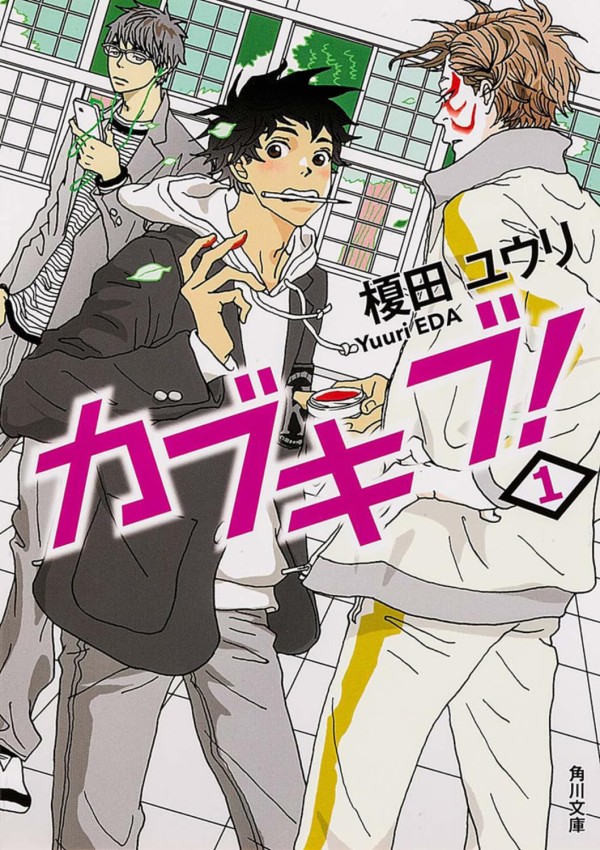
Kurogo Kurusu is a high school freshman who loves kabuki with an intensity that borders on obsessive. Inspired by his grandfather, he has spent years absorbing the traditional Japanese theater form and dreams of performing it as part of a school club. The problem is that his high school has no kabuki club. Rather than give up, Kurogo decides to create one himself. He enlists the help of his quiet, tech-savvy best friend Tonbo Murase and sets out to recruit enough members to form a club.
The setting is a modern Japanese high school, where most students view kabuki as a distant, stuffy tradition rather than something a teenager would do for fun. Kurogo’s strategy is to drop the intimidating kanji for kabuki and write it in katakana instead, hoping to make it feel more approachable. He calls the group the Kabuki Interest Circle, a lower-status stepping stone toward official club recognition.
The first members Kurogo recruits are a deliberately mismatched group of personalities. Kaoru Asagi is a tall, princely girl who is the star of the school’s drama club and has a devoted fan club of her own. Hanamichi Niwa is a hulking, intimidating-looking boy who secretly studied traditional Japanese dance and has a gentle, almost feminine side. Maruko Janome is a quiet girl who is a master costume designer, active in the cosplay community. Shin Akutsu is a wannabe rock vocalist who cannot sing but does have some background in kabuki-style movement. Together, this unlikely five-person circle begins to learn the basics of putting on a kabuki performance.
The major narrative arc of the first volume follows their struggle to go from a barely tolerated interest circle to a group capable of staging an actual show. Kurogo’s enthusiasm is infectious, but his inexperience as a performer becomes a serious problem. When the group gets its first chance to perform at a charity event at a nursing home, Kurogo freezes on stage and proves to be a shockingly bad actor. The performance is saved by a mysterious last-minute substitute who turns out to be Jin Ebihara, a cold and aloof classmate who comes from a prominent kabuki family and has been dismissive of Kurogo’s amateur efforts from the start. This rescue sets up a rivalry and a potential alliance that drives much of the series.
Over the course of the seven-volume series, the kabuki circle faces a series of escalating challenges. They must secure a faculty advisor, deal with the existing drama club’s territorial resentment, and prepare for the school cultural festival where they hope to officially debut as a full club. The narrative balances the technical details of kabuki performance, including the specific plays they rehearse such as Sannin Kichisa and the famous bento kozo speech, with the personal growth of each member. Each character brings a distinct skill to the group, and the story explores how they learn to combine their talents into a cohesive production. The central conflict throughout is whether a group of passionate amateurs can earn the respect of traditionalists, including Jin and his family, and whether Kurogo can overcome his own shortcomings as a performer to become a worthy leader. The final volume concludes with the club’s major performance at the cultural festival and a resolution of the tensions between Kurogo and Jin.
The setting is a modern Japanese high school, where most students view kabuki as a distant, stuffy tradition rather than something a teenager would do for fun. Kurogo’s strategy is to drop the intimidating kanji for kabuki and write it in katakana instead, hoping to make it feel more approachable. He calls the group the Kabuki Interest Circle, a lower-status stepping stone toward official club recognition.
The first members Kurogo recruits are a deliberately mismatched group of personalities. Kaoru Asagi is a tall, princely girl who is the star of the school’s drama club and has a devoted fan club of her own. Hanamichi Niwa is a hulking, intimidating-looking boy who secretly studied traditional Japanese dance and has a gentle, almost feminine side. Maruko Janome is a quiet girl who is a master costume designer, active in the cosplay community. Shin Akutsu is a wannabe rock vocalist who cannot sing but does have some background in kabuki-style movement. Together, this unlikely five-person circle begins to learn the basics of putting on a kabuki performance.
The major narrative arc of the first volume follows their struggle to go from a barely tolerated interest circle to a group capable of staging an actual show. Kurogo’s enthusiasm is infectious, but his inexperience as a performer becomes a serious problem. When the group gets its first chance to perform at a charity event at a nursing home, Kurogo freezes on stage and proves to be a shockingly bad actor. The performance is saved by a mysterious last-minute substitute who turns out to be Jin Ebihara, a cold and aloof classmate who comes from a prominent kabuki family and has been dismissive of Kurogo’s amateur efforts from the start. This rescue sets up a rivalry and a potential alliance that drives much of the series.
Over the course of the seven-volume series, the kabuki circle faces a series of escalating challenges. They must secure a faculty advisor, deal with the existing drama club’s territorial resentment, and prepare for the school cultural festival where they hope to officially debut as a full club. The narrative balances the technical details of kabuki performance, including the specific plays they rehearse such as Sannin Kichisa and the famous bento kozo speech, with the personal growth of each member. Each character brings a distinct skill to the group, and the story explores how they learn to combine their talents into a cohesive production. The central conflict throughout is whether a group of passionate amateurs can earn the respect of traditionalists, including Jin and his family, and whether Kurogo can overcome his own shortcomings as a performer to become a worthy leader. The final volume concludes with the club’s major performance at the cultural festival and a resolution of the tensions between Kurogo and Jin.
Comment(s)
Staff
- Story
- Cover ArtAya Isino