Description
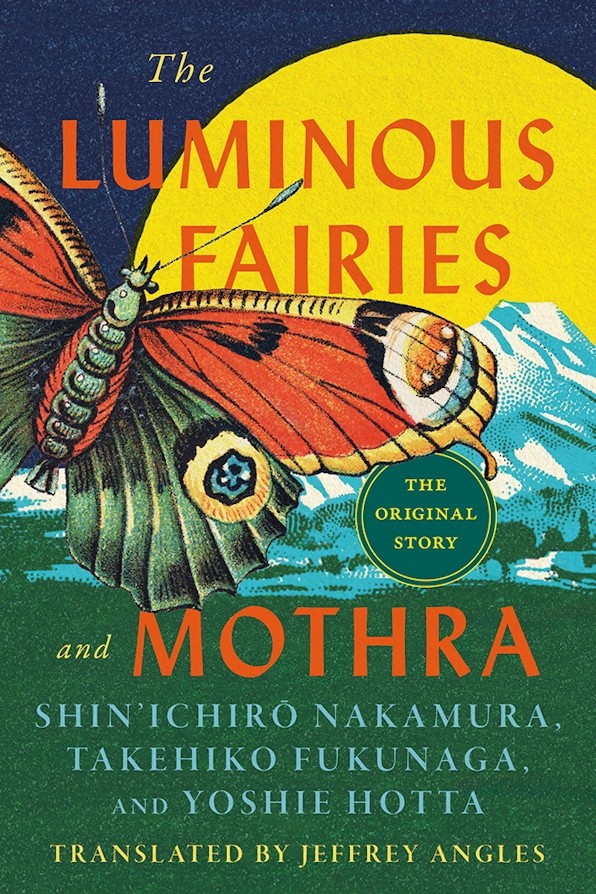
A joint scientific expedition from Japan and the fictional superpower Rosilica travels to a remote South Pacific island called Infant Island, a location previously used as a hydrogen bomb testing ground and thought to be uninhabited. The team, which includes a linguist named Chujo, makes a startling discovery: the island is home to a native population and several tiny, luminous fairies known as the Airenas, who live in peace and worship a colossal, divine entity they call their goddess, Mothra. An unscrupulous Rosilican entrepreneur named Nelson, part of the expedition, seizes the fairies, kidnapping them and taking them away to be exploited for public performances in the glittering metropolis of New Wagon City. The theft of the Airenas awakens the slumbering goddess, Mothra, who hatches from a giant egg at the heart of the island.
The story is told in three distinct acts by different authors. The first act, focused on the discovery of the island and the fairies, centers on Chujo, who becomes captivated by the tiny beings. The second act introduces a resourceful Japanese reporter, Fukada, who is determined to uncover the island's secrets. Stowing away on the expedition, he learns the island's creation myth from the native people, which tells of divine lovers who created Mothra and the four Airenas who serve as her guardians. The narrative then shifts to its climactic final act, which follows Mothra's journey of rescue and revenge. The goddess travels from the South Pacific to Japan, where she undergoes a dramatic metamorphosis into her giant adult imago form, using a major national landmark, the National Diet Building, as her cocoon. From there, Mothra flies to Rosilica, where she annihilates the city holding the fairies captive. After successfully rescuing them, she returns to her island to live out her remaining days in peace.
The novella is notable for its collaborative creation and its pointed political subtext, reflecting anxieties about the Cold War and Japan's position between larger global powers, a theme that was softened in the subsequent film adaptation. The human cast is rounded out in the final section by a student activist named Michiko, who becomes a prospective love interest for Chujo and whose anti-establishment chants of Nelson, go home directly mirror the real-world protests against the American military presence in Japan during the early 1960s.
The story is told in three distinct acts by different authors. The first act, focused on the discovery of the island and the fairies, centers on Chujo, who becomes captivated by the tiny beings. The second act introduces a resourceful Japanese reporter, Fukada, who is determined to uncover the island's secrets. Stowing away on the expedition, he learns the island's creation myth from the native people, which tells of divine lovers who created Mothra and the four Airenas who serve as her guardians. The narrative then shifts to its climactic final act, which follows Mothra's journey of rescue and revenge. The goddess travels from the South Pacific to Japan, where she undergoes a dramatic metamorphosis into her giant adult imago form, using a major national landmark, the National Diet Building, as her cocoon. From there, Mothra flies to Rosilica, where she annihilates the city holding the fairies captive. After successfully rescuing them, she returns to her island to live out her remaining days in peace.
The novella is notable for its collaborative creation and its pointed political subtext, reflecting anxieties about the Cold War and Japan's position between larger global powers, a theme that was softened in the subsequent film adaptation. The human cast is rounded out in the final section by a student activist named Michiko, who becomes a prospective love interest for Chujo and whose anti-establishment chants of Nelson, go home directly mirror the real-world protests against the American military presence in Japan during the early 1960s.
Comment(s)
Staff
- Story
- TranslationJeffrey Angles
- ArtWasuke Abe
Recommendations
Empfehlungen auf Basis gemeinsamer Kategorien.