Manga
Description
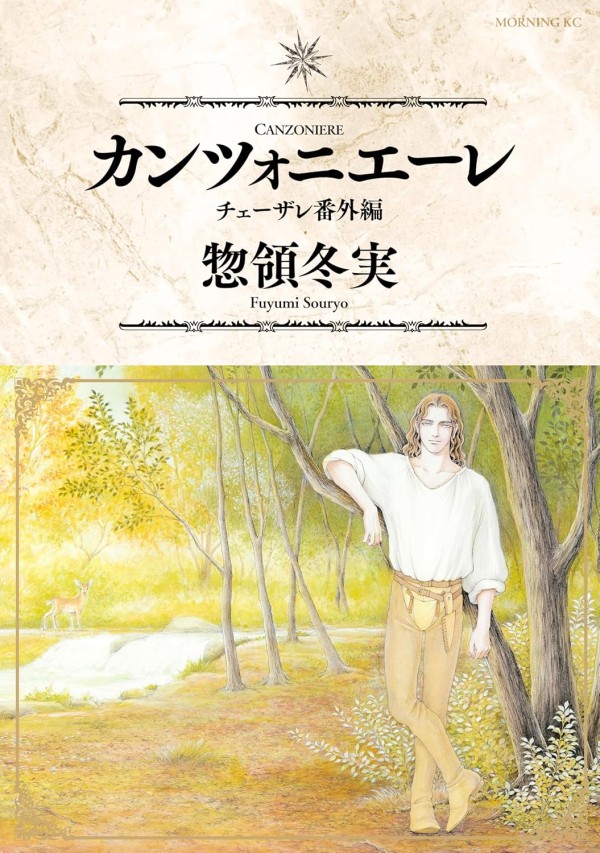
In late 15th century Italy, the infamous Cesare Borgia, a cardinal and military leader whose name became synonymous with ruthless political intrigue, finds himself entangled in what is described as his first and last love. This narrative forms the core of Canzoniere, a spin-off of Fuyumi Soryo's acclaimed historical manga Cesare - Il creatore che ha distrutto. While the original series follows a young Florentine student who observes the rise of Cesare Borgia within the political and academic circles of Pisa, Canzoniere shifts its focus entirely to the private, emotional life of its controversial central figure.
The story departs from the main series' broader canvas of Renaissance power struggles to explore a specific, intimate chapter of Borgia's youth. Promoted as an extra or side story, the manga seeks to humanize the often-demonized historical figure by examining the romantic relationship that marked him before his ascent to becoming a papal military commander. The title itself, Canzoniere, alludes to a collection of poems, suggesting a narrative told with lyrical and sentimental overtones rather than pure political strategy.
The main cast is anchored by Cesare Borgia, portrayed here not just as a Machiavellian prince but as a young man vulnerable to passion. Opposite him is the mysterious figure who inspires this love, a character whose identity and fate are central to the plot's tragic promise that this romance will be both his first and his last. The setting remains the rich, detailed tapestry of the Italian Renaissance, likely moving between the influential cities of the period such as Rome, under the shadow of his father Pope Alexander VI, and the University of Pisa, a key location from the original series where Cesare's intellectual and political formation began.
The primary narrative arc is linear, focusing on the trajectory of this singular love affair. It begins with the initial encounter, follows its development against the backdrop of the Borgia family's dynastic ambitions, and moves inexorably toward its destined conclusion. Because the manga is billed as depicting both the first and final love of Cesare Borgia, the story inherently carries a sense of melancholy and foreboding, suggesting that external political forces or the dark necessities of his career ultimately consume this personal relationship. Rather than rewriting history, Canzoniere uses the gaps in the historical record to propose an emotional truth about a man often viewed solely as a monster, framing his political ruthlessness as perhaps the consequence of a profound personal loss.
The story departs from the main series' broader canvas of Renaissance power struggles to explore a specific, intimate chapter of Borgia's youth. Promoted as an extra or side story, the manga seeks to humanize the often-demonized historical figure by examining the romantic relationship that marked him before his ascent to becoming a papal military commander. The title itself, Canzoniere, alludes to a collection of poems, suggesting a narrative told with lyrical and sentimental overtones rather than pure political strategy.
The main cast is anchored by Cesare Borgia, portrayed here not just as a Machiavellian prince but as a young man vulnerable to passion. Opposite him is the mysterious figure who inspires this love, a character whose identity and fate are central to the plot's tragic promise that this romance will be both his first and his last. The setting remains the rich, detailed tapestry of the Italian Renaissance, likely moving between the influential cities of the period such as Rome, under the shadow of his father Pope Alexander VI, and the University of Pisa, a key location from the original series where Cesare's intellectual and political formation began.
The primary narrative arc is linear, focusing on the trajectory of this singular love affair. It begins with the initial encounter, follows its development against the backdrop of the Borgia family's dynastic ambitions, and moves inexorably toward its destined conclusion. Because the manga is billed as depicting both the first and final love of Cesare Borgia, the story inherently carries a sense of melancholy and foreboding, suggesting that external political forces or the dark necessities of his career ultimately consume this personal relationship. Rather than rewriting history, Canzoniere uses the gaps in the historical record to propose an emotional truth about a man often viewed solely as a monster, framing his political ruthlessness as perhaps the consequence of a profound personal loss.
Comment(s)
Staff
- Story & ArtFuyumi Sōryō
Recommendations
Empfehlungen auf Basis gemeinsamer Kategorien.