
Manga
Description
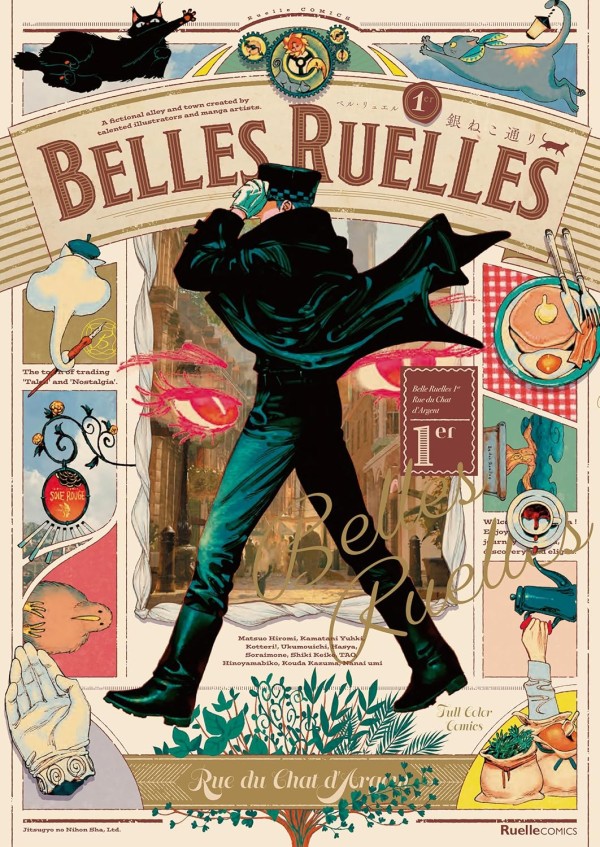
In the fictional European city of Eufemia, a place that prides itself on being a city that sells stories and memories, a collective of diverse creators has brought to life a series of interconnected tales. The project's name, Belles Ruelles, is French for beautiful alleys, and it is within these picturesque, narrow streets that the narrative unfolds. Eufemia is a coastal town that has preserved its old-world charm, with ivy-covered walls and a vibrant community of shopkeepers and residents from various walks of life. The story is not linear but is instead a tapestry of moments, where each contributor illustrates a unique store or facility, and the lives touched by them, all coexisting in the same shared space regardless of a strict chronological timeline.
The first volume is centered on Maurilian Street, commonly known as Silver Neko Street. Here, readers are introduced to eleven distinct locations. These include a hostel called The Bird Perch Hostel, a clock shop named Paradiso, a photo studio named Jubilee, a museum called The Whale, a spice shop named Spice UU, an American diner called The Old Moon Diner, a lamp shop named St. Elmo, a combined laundromat, cafe, and public bath named Eupolon Building, a bonsai shop named Kei, a boutique named Soie Rouge, and a bakery named Bakery Cado. The stories woven into this street are varied; one tale follows a blind man who converses with a painting in a gallery, while another depicts a touching scene of a woman who seeks a commemorative photograph with her deceased father, and a different narrative shows a restaurant welcoming homeless orcs, indicating that the world subtly blends reality with fantasy.
The second volume shifts its focus from Silver Neko Street to the old quarter near the seaside, known as Kamome Street or Seagull Street. This volume continues the graphicomiX format, where illustrations and short comics combine, and explores the lives of the residents as time progresses through the day. The roster of establishments and their contributors changes, offering fresh stories within the same universe. New locations include a bookshop called The Story No One Remembers, a handyman service named IRODORI, a gelateria named Perla, a magic shop called Molly’s Pot, the Seagull Street Police Box, a love hotel named HOTEL NEW FEMIA, a Chinese restaurant named Kowloon, and a central public square known as Horologium Plaza. One notable story in this collection follows a young assistant at a spice shop who learns about the dedication and care the owner puts into crafting her products, while another details a college student experiencing the luxury of trying on a traditional kimono for the first time. The cast of characters is large and varied, featuring everyone from shopkeepers and police officers to magical beings and everyday customers, all contributing to the feeling that Eufemia is a living, breathing town.
Key contributors to this anthology include Hiromi Matsuo, Yuki Kamaya, Koteri, Ukumunu Ukumo, Hasha, Sora Mone, Yoshiko Shiki, TAO, Hinoyamabiko, Koda, Nanai Umi, Den, Tokiwaharo, Jose, GAS, Haruyo Higashi, Kashiko no Saru, and Boukyaku Zukan. Each artist brings their unique artistic style and narrative sensibility, but they all work within a cohesive framework that maintains the town’s specific aesthetic, described as a fantasy European setting reminiscent of Studio Ghibli films. The overarching plot is not a single hero's journey but a slice-of-life exploration of community, memory, and the small, magical interactions that occur when people run and visit local shops. Through these shared alleys, the series builds a rich, emotional world where the daily routines and personal dramas of the inhabitants create a gentle, immersive experience.
The first volume is centered on Maurilian Street, commonly known as Silver Neko Street. Here, readers are introduced to eleven distinct locations. These include a hostel called The Bird Perch Hostel, a clock shop named Paradiso, a photo studio named Jubilee, a museum called The Whale, a spice shop named Spice UU, an American diner called The Old Moon Diner, a lamp shop named St. Elmo, a combined laundromat, cafe, and public bath named Eupolon Building, a bonsai shop named Kei, a boutique named Soie Rouge, and a bakery named Bakery Cado. The stories woven into this street are varied; one tale follows a blind man who converses with a painting in a gallery, while another depicts a touching scene of a woman who seeks a commemorative photograph with her deceased father, and a different narrative shows a restaurant welcoming homeless orcs, indicating that the world subtly blends reality with fantasy.
The second volume shifts its focus from Silver Neko Street to the old quarter near the seaside, known as Kamome Street or Seagull Street. This volume continues the graphicomiX format, where illustrations and short comics combine, and explores the lives of the residents as time progresses through the day. The roster of establishments and their contributors changes, offering fresh stories within the same universe. New locations include a bookshop called The Story No One Remembers, a handyman service named IRODORI, a gelateria named Perla, a magic shop called Molly’s Pot, the Seagull Street Police Box, a love hotel named HOTEL NEW FEMIA, a Chinese restaurant named Kowloon, and a central public square known as Horologium Plaza. One notable story in this collection follows a young assistant at a spice shop who learns about the dedication and care the owner puts into crafting her products, while another details a college student experiencing the luxury of trying on a traditional kimono for the first time. The cast of characters is large and varied, featuring everyone from shopkeepers and police officers to magical beings and everyday customers, all contributing to the feeling that Eufemia is a living, breathing town.
Key contributors to this anthology include Hiromi Matsuo, Yuki Kamaya, Koteri, Ukumunu Ukumo, Hasha, Sora Mone, Yoshiko Shiki, TAO, Hinoyamabiko, Koda, Nanai Umi, Den, Tokiwaharo, Jose, GAS, Haruyo Higashi, Kashiko no Saru, and Boukyaku Zukan. Each artist brings their unique artistic style and narrative sensibility, but they all work within a cohesive framework that maintains the town’s specific aesthetic, described as a fantasy European setting reminiscent of Studio Ghibli films. The overarching plot is not a single hero's journey but a slice-of-life exploration of community, memory, and the small, magical interactions that occur when people run and visit local shops. Through these shared alleys, the series builds a rich, emotional world where the daily routines and personal dramas of the inhabitants create a gentle, immersive experience.
Comment(s)