
Manga
Description
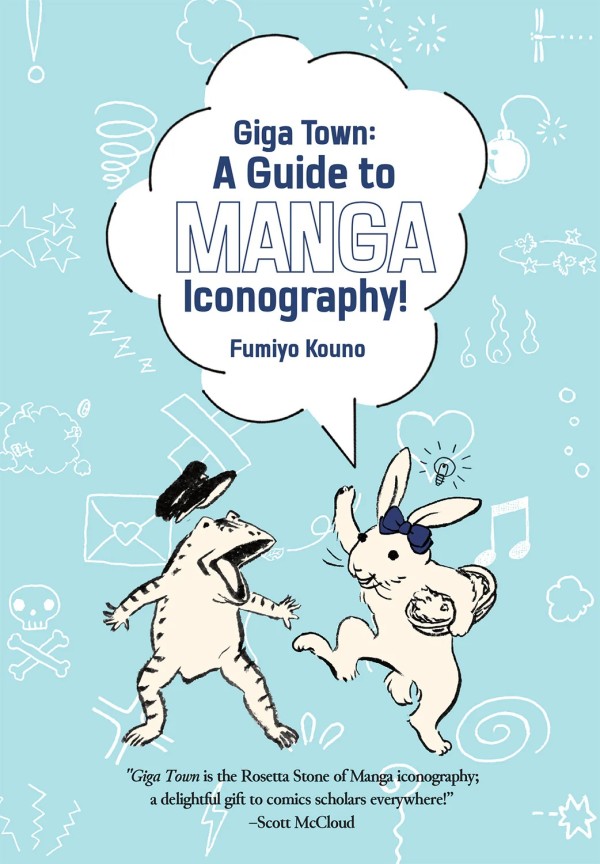
The Choju-jinbutsu-giga, a set of 12th-century Japanese picture scrolls often cited as an early ancestor of manga, comes to life as a cast of anthropomorphic rabbits, frogs, and monkeys become the guides to their own visual language. The characters, who include a school-aged frog, rabbit, and monkey sometimes named Ears, Greenie, and Keysie, along with a small rabbit family and their animal neighbors, inhabit a pastoral setting reminiscent of rural Japan in the mid-20th century. They wear simple identifying clothing such as aprons, bows, and hats, and go about the ordinary routines of daily life, attending school, visiting friends, and helping with household chores.
Within this tranquil community, each page or spread functions as a self-contained lesson on manpu, the symbolic icons used throughout manga, such as the sweatdrop of nervousness, a popping vein of anger, or a line drawn through the eyes to express bewilderment. The book does not follow a single linear narrative. Instead, a sequence of short, four-panel vignettes illustrates approximately one hundred different icons, grouping into standalone symbols, those shown alongside objects, and those expressing character emotions. The interactions between the animals provide the context for each comic demonstration, as simple events like a spilled drink, a surprise visit, or a misunderstanding are visually punctuated by a particular symbol. Occasional brief sequences flow together, but each vignette primarily exists to explain a specific icon. An introduction by a manga scholar provides historical context for the Choju scrolls and the development of manpu, while a concluding afterword offers basic instruction on how to read manga panels, serving as a primer for new readers.
Within this tranquil community, each page or spread functions as a self-contained lesson on manpu, the symbolic icons used throughout manga, such as the sweatdrop of nervousness, a popping vein of anger, or a line drawn through the eyes to express bewilderment. The book does not follow a single linear narrative. Instead, a sequence of short, four-panel vignettes illustrates approximately one hundred different icons, grouping into standalone symbols, those shown alongside objects, and those expressing character emotions. The interactions between the animals provide the context for each comic demonstration, as simple events like a spilled drink, a surprise visit, or a misunderstanding are visually punctuated by a particular symbol. Occasional brief sequences flow together, but each vignette primarily exists to explain a specific icon. An introduction by a manga scholar provides historical context for the Choju scrolls and the development of manpu, while a concluding afterword offers basic instruction on how to read manga panels, serving as a primer for new readers.
Comment(s)
Staff
- Story & Art