
Manga
Description
Jouichirou Hashiya is the young leader of the Sadorigumi, a yakuza family operating in the Kanto region. To his subordinates, he is the ideal aniki: tough, cool, deeply loyal, and respected by all. Kurume Maki, a devoted underling, idolizes him absolutely. That world shatters when Hashiya is shot by an unknown assailant and survives, but wakes up with total amnesia. The commanding boss is gone; in his place is a blank, almost childlike man with no memory of his life as a yakuza. Left incompetent and vulnerable, the once-feared aniki now depends entirely on Kurume.
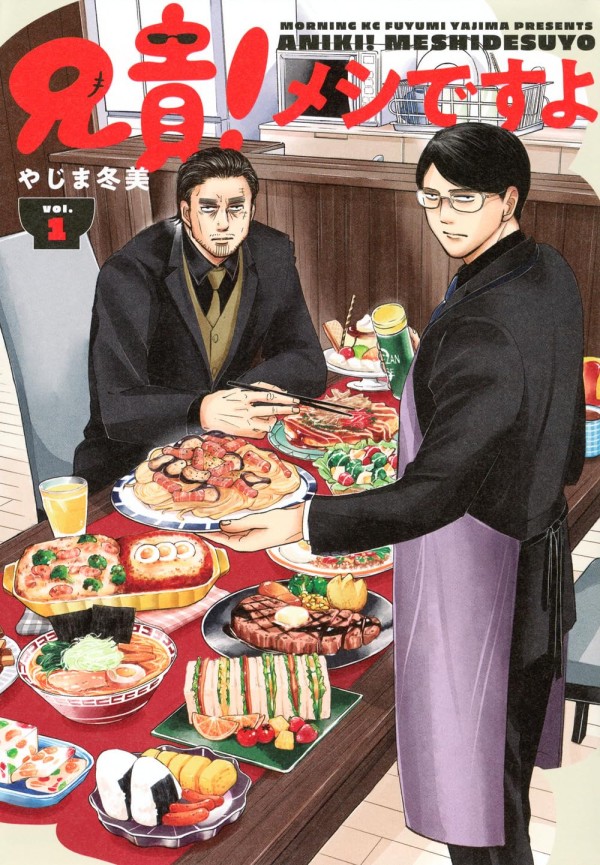
Rather than resorting to violence or intimidation, Kurume chooses an unusual path to restore his memory: home cooking. He begins preparing simple, everyday meals—curry made in two days, salad chicken, and other hearty homemade dishes—hoping that familiar flavors will unlock the past. As Kurume cooks and Hashiya eats, each meal becomes a key to a buried memory. The narrative mixes the gritty tension of the yakuza underworld with the warmth of domestic cooking, treating each dish as a tangible link to Hashiya’s true self. Meanwhile, the power vacuum in the Sadorigumi creates new threats, and the two men must navigate both the kitchen and the criminal world.
Kurume, nicknamed Macky, takes on the role of caretaker and chef, his quiet devotion contrasted with his boss’s unpredictable behavior. Hashiya, now called “ahoniki” (foolish aniki) for his vacant state, slowly rediscovers fragments of his past—fierce loyalty, hidden kindness, and the ruthless instincts that made him a leader. The story unfolds in episodic arcs centered on specific recipes, each one tied to a memory: a meal shared with a fallen comrade, a childhood comfort food, or a dish that once sealed a dangerous deal. The overarching conflict is twofold: unlocking all of Hashiya’s memories before the organization descends into chaos, and uncovering who shot him and why. The series blends yakuza drama, restaurant-style dish depiction, and gentle comedy, balancing moments of violence with the simple pleasure of a well-made meal.
Rather than resorting to violence or intimidation, Kurume chooses an unusual path to restore his memory: home cooking. He begins preparing simple, everyday meals—curry made in two days, salad chicken, and other hearty homemade dishes—hoping that familiar flavors will unlock the past. As Kurume cooks and Hashiya eats, each meal becomes a key to a buried memory. The narrative mixes the gritty tension of the yakuza underworld with the warmth of domestic cooking, treating each dish as a tangible link to Hashiya’s true self. Meanwhile, the power vacuum in the Sadorigumi creates new threats, and the two men must navigate both the kitchen and the criminal world.
Kurume, nicknamed Macky, takes on the role of caretaker and chef, his quiet devotion contrasted with his boss’s unpredictable behavior. Hashiya, now called “ahoniki” (foolish aniki) for his vacant state, slowly rediscovers fragments of his past—fierce loyalty, hidden kindness, and the ruthless instincts that made him a leader. The story unfolds in episodic arcs centered on specific recipes, each one tied to a memory: a meal shared with a fallen comrade, a childhood comfort food, or a dish that once sealed a dangerous deal. The overarching conflict is twofold: unlocking all of Hashiya’s memories before the organization descends into chaos, and uncovering who shot him and why. The series blends yakuza drama, restaurant-style dish depiction, and gentle comedy, balancing moments of violence with the simple pleasure of a well-made meal.
Comment(s)
Staff
- Story & ArtFuyumi Yajima