
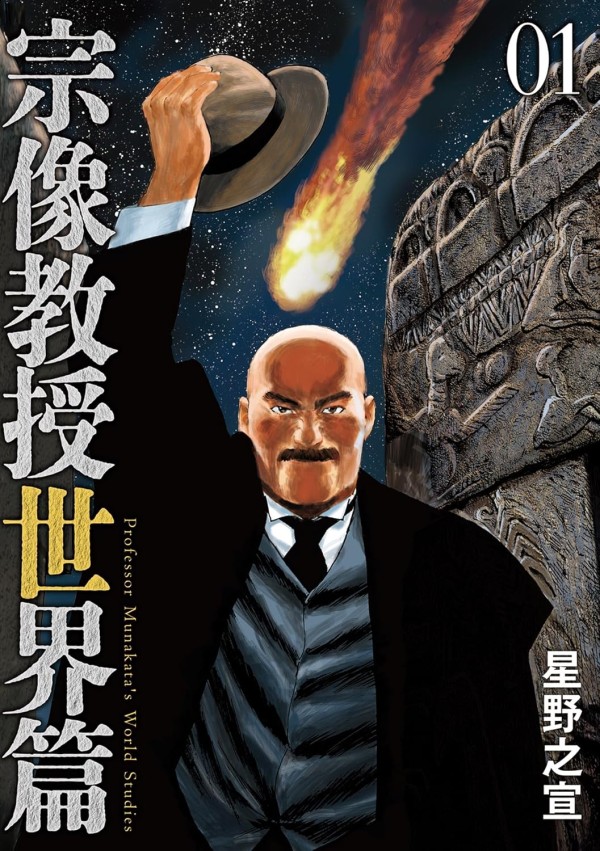
Manga
Description
Mutual colleague Imibe Kanna has died. This revelation, delivered by her brother, the dubious historian Imibe Shōichirō, greets Professor Munakata—a towering, bald, mustachioed folklore scholar at Tōa Bunka University—upon his return to Japan after teaching at a British university. Kanna, a brilliant and passionate historical researcher who had been Munakata’s rival and later his quiet love, left behind unfinished work. Her final journey, a research trip taken after Munakata gently sent her home ahead of him, now demands explanation. Munakata, already known for his daring hypotheses that connect ancient myths, archaeological finds, and forgotten migrations across Japan, now expands his focus to the entire world. Accompanied by the newly humbled Shōichirō, he follows Kanna’s trail, which leads him to the lost clues of a nomadic group he calls the Yūtetsumin, or Iron-Wandering People, whose search for iron ore drove them across Eurasia and into the Japanese archipelago. The narrative unfolds as a series of self-contained but linked investigations. Munakata deciphers decorated ancient tombs in Kyushu to link comet impacts with Japanese creation myths. He traces shared white-bird legends from Siberia’s Buryatia to Japan, positing them as the cultural echo of ancient migrations. He probes the origins of the Himiko and Yamatai mystery by following Kanna’s old connections among the Mononobe clan descendants. Volcanic myths lead him to compare the Norse god Thor and the Japanese god Susanoo, while the strange, snake-shaped iron sword from the Tomio Maruyama burial mound in Nara becomes another piece of the Yūtetsumin puzzle. The scope widens further to include the Himalayan Skeleton Lake, the history of Amazon warriors, the ruined city of Pompeii, the megalithic temple of Göbekli Tepe in Anatolia, and even the submerged tomb of Cleopatra off the coast of Alexandria. New recurring figures enter Munakata’s orbit: Serizawa, a forceful editor with an eyepatch, and her large, physically powerful subordinate Saotome, both former university wrestling club members, who press Munakata into accepting lecture invitations and writing assignments, thereby anchoring the professor’s far-flung travels to the mundane demands of his academic life. Each stop unearths evidence for Munakata’s central thesis: that the foundation myths of Japan are interwoven with a far older, global story of migration, metallurgy, and the transmission of sacred narratives across continents. The series is driven by Munakata’s calm but relentless reasoning, the melancholy of a partially resolved loss, and the continuing revelation of a hidden history connecting ancient Japan to the wider world.
Comment(s)
Staff
- Story & Art