Manga
Description
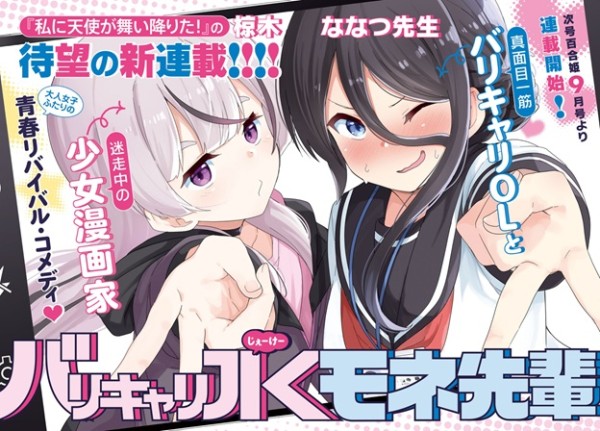
Barikyari JK Mone-senpai follows two adult women whose lives intersect in unexpected ways. One is a driven, career-focused office worker known as Mone-senpai, a high-performing professional who throws herself into work with relentless energy. The other is a manga creator, equally dedicated to her craft but struggling to find her own direction. The story centers on how these two women navigate their professional ambitions, personal insecurities, and the slow-burn relationship that develops between them as they try to figure out their own paths.
The setting is contemporary Japan, primarily the workplace and the manga creator's studio, with the narrative shifting between the ordered, high-pressure environment of the office and the more chaotic, introspective world of manga creation. Mone-senpai presents a polished, competent exterior at work, but beneath the surface she grapples with the loneliness and exhaustion that come from pouring everything into her career. The manga creator, by contrast, is more openly expressive but faces her own creative blocks and doubts. Their interactions gradually peel back those facades, leading to a warm, sometimes awkward connection that blurs the line between mentorship and something deeper.
Key narrative arcs explore the tension between societal expectations and personal fulfillment, the meaning of success, and the quiet discovery of intimacy and support. As the two women share meals, late-night work sessions, and vulnerable conversations, they learn to lean on each other and redefine what "career woman" or "high schooler" (JK) might mean in a new context. The manga balances gentle comedy with sincere emotional beats, characteristic of creator Nanatsu Mukunoki's style, and unfolds in the yuri genre with a focus on adult relationships rather than school-age drama.
The setting is contemporary Japan, primarily the workplace and the manga creator's studio, with the narrative shifting between the ordered, high-pressure environment of the office and the more chaotic, introspective world of manga creation. Mone-senpai presents a polished, competent exterior at work, but beneath the surface she grapples with the loneliness and exhaustion that come from pouring everything into her career. The manga creator, by contrast, is more openly expressive but faces her own creative blocks and doubts. Their interactions gradually peel back those facades, leading to a warm, sometimes awkward connection that blurs the line between mentorship and something deeper.
Key narrative arcs explore the tension between societal expectations and personal fulfillment, the meaning of success, and the quiet discovery of intimacy and support. As the two women share meals, late-night work sessions, and vulnerable conversations, they learn to lean on each other and redefine what "career woman" or "high schooler" (JK) might mean in a new context. The manga balances gentle comedy with sincere emotional beats, characteristic of creator Nanatsu Mukunoki's style, and unfolds in the yuri genre with a focus on adult relationships rather than school-age drama.
Comment(s)
Staff
- Story & Art