
Manga
Description
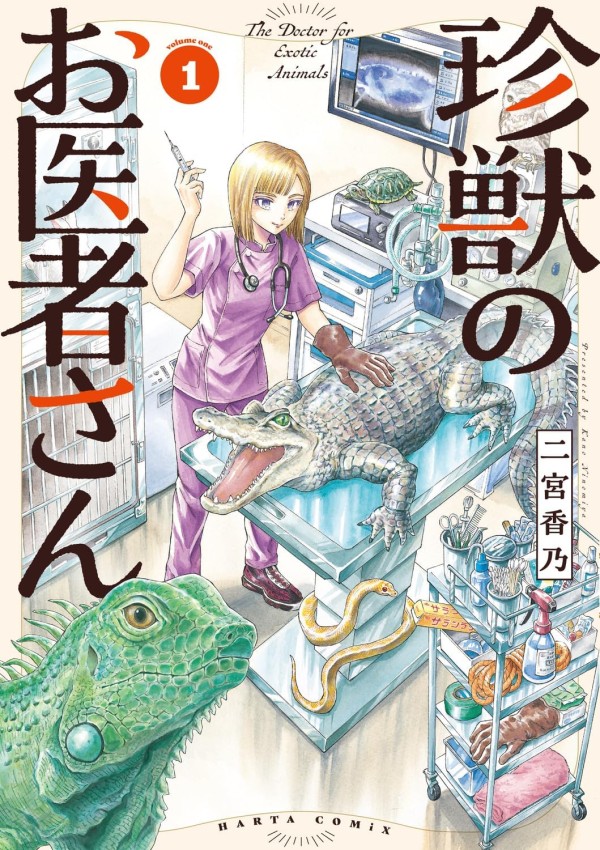
At Gekko Animal Hospital, the patients are anything but ordinary. Here, the term "exotic animal" refers to any pet that is not a dog or cat—rabbits, lizards, hamsters, tarantulas, snakes, birds, and even crocodiles. The hospital exists at the forefront of pet medicine, taking in the kinds of cases most other clinics turn away: a tortoise with a shell split in two, a tarantula suffering from anemia, a snake with severe burns.
The story follows Kanna, a young veterinarian who wanted to work with animals but developed a severe allergy to dogs. After being fired from his first job, he lands a position at the Gekko Animal Hospital as a last resort. He knows nothing about exotic animals and initially struggles with the unfamiliar creatures and techniques. Under the guidance of the hospital's director, Dr. Gekko, a calm, knowledgeable, and mysterious young woman with a motorcycle and a past of her own—she also switched to exotic medicine after developing a dog and cat allergy—Kanna begins to learn the specialized skills required. Alongside him is the quick-thinking veterinary technician Hoshi, whose reflexes and bug-raising hobby prove surprisingly useful.
Each episode presents a new patient and a fresh challenge: learning how to properly restrain a snake (a technique called "holding"), treating a rabbit whose owner mistakenly applied dog-care logic, diagnosing an eye problem in a caiman that could bite off a hand if handled badly, or caring for a parakeet that requires a transfer to a bird specialist. Through these cases, the manga explores not only the biology and treatment of exotic animals, but also the realities of modern pet ownership—the growing diversity of companion animals, the responsibilities and misunderstandings of their owners, and the serious limitations of veterinary medicine for creatures that are still poorly understood.
As Kanna gains confidence, he faces more dangerous scenarios, such as a house-call to treat a crocodile with an eye infection, where a mistake could mean serious injury. He also begins to appreciate the deeper lesson that exotic medicine is not just about medical knowledge but about building trust with animals that communicate very differently from dogs and cats.
The series combines real veterinary education with human drama, showing the satisfaction and heartbreak of saving lives that no one else would attempt. It is an ongoing story of growth, respect for all living things, and the ever-expanding frontier of veterinary care.
The story follows Kanna, a young veterinarian who wanted to work with animals but developed a severe allergy to dogs. After being fired from his first job, he lands a position at the Gekko Animal Hospital as a last resort. He knows nothing about exotic animals and initially struggles with the unfamiliar creatures and techniques. Under the guidance of the hospital's director, Dr. Gekko, a calm, knowledgeable, and mysterious young woman with a motorcycle and a past of her own—she also switched to exotic medicine after developing a dog and cat allergy—Kanna begins to learn the specialized skills required. Alongside him is the quick-thinking veterinary technician Hoshi, whose reflexes and bug-raising hobby prove surprisingly useful.
Each episode presents a new patient and a fresh challenge: learning how to properly restrain a snake (a technique called "holding"), treating a rabbit whose owner mistakenly applied dog-care logic, diagnosing an eye problem in a caiman that could bite off a hand if handled badly, or caring for a parakeet that requires a transfer to a bird specialist. Through these cases, the manga explores not only the biology and treatment of exotic animals, but also the realities of modern pet ownership—the growing diversity of companion animals, the responsibilities and misunderstandings of their owners, and the serious limitations of veterinary medicine for creatures that are still poorly understood.
As Kanna gains confidence, he faces more dangerous scenarios, such as a house-call to treat a crocodile with an eye infection, where a mistake could mean serious injury. He also begins to appreciate the deeper lesson that exotic medicine is not just about medical knowledge but about building trust with animals that communicate very differently from dogs and cats.
The series combines real veterinary education with human drama, showing the satisfaction and heartbreak of saving lives that no one else would attempt. It is an ongoing story of growth, respect for all living things, and the ever-expanding frontier of veterinary care.
Comment(s)
Staff
- Story & ArtKano Ninomiya