Movie
Description
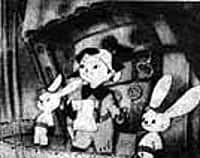
"Momotaro's Sea Eagle" is a 1943 Japanese animated short film produced during World War II. The narrative centers on a military operation led by Momotaro, a folkloric hero from Japanese legend, reimagined here as a commander of a naval force. The story unfolds as Momotaro and his anthropomorphic animal companions—a monkey, a dog, and a pheasant—embark on a mission to attack an enemy stronghold on a distant island. The animals represent various branches of the military, with the monkey symbolizing the navy, the dog the army, and the pheasant the air force.
The plot begins with Momotaro and his team preparing for their mission, showcasing the strategic planning and coordination involved in the operation. The group boards a seaplane carrier, which serves as the central hub for their mission. The film emphasizes the technological prowess and discipline of the Japanese military, with detailed depictions of aircraft, ships, and weaponry. As the team approaches the enemy island, they encounter resistance but overcome it through teamwork and superior tactics. The climax features a coordinated aerial and naval assault on the enemy base, culminating in its destruction.
The characters are portrayed as brave and determined, embodying the ideals of loyalty, courage, and unity. Momotaro is depicted as a wise and capable leader, while his animal companions each contribute their unique skills to the mission. The film’s narrative is straightforward, focusing on the execution of the military operation rather than delving into complex character development or moral dilemmas. Its primary purpose is to serve as wartime propaganda, promoting nationalistic pride and support for the war effort.
The animation, while limited by the technology of the time, effectively conveys the action and scale of the mission. The film’s pacing is brisk, with a clear emphasis on the procedural aspects of the operation. "Momotaro's Sea Eagle" stands as a significant piece of animation history, reflecting the cultural and political context of its era.
The plot begins with Momotaro and his team preparing for their mission, showcasing the strategic planning and coordination involved in the operation. The group boards a seaplane carrier, which serves as the central hub for their mission. The film emphasizes the technological prowess and discipline of the Japanese military, with detailed depictions of aircraft, ships, and weaponry. As the team approaches the enemy island, they encounter resistance but overcome it through teamwork and superior tactics. The climax features a coordinated aerial and naval assault on the enemy base, culminating in its destruction.
The characters are portrayed as brave and determined, embodying the ideals of loyalty, courage, and unity. Momotaro is depicted as a wise and capable leader, while his animal companions each contribute their unique skills to the mission. The film’s narrative is straightforward, focusing on the execution of the military operation rather than delving into complex character development or moral dilemmas. Its primary purpose is to serve as wartime propaganda, promoting nationalistic pride and support for the war effort.
The animation, while limited by the technology of the time, effectively conveys the action and scale of the mission. The film’s pacing is brisk, with a clear emphasis on the procedural aspects of the operation. "Momotaro's Sea Eagle" stands as a significant piece of animation history, reflecting the cultural and political context of its era.
Comment(s)
Staff
- DirectorMitsuyo Seo
- ScriptArishige Kurihara
Production
- ProductionGeijotsu Eigasha
Relations
Recommendations based on shared tags.