Description
"Death March to the Parallel World Rhapsody" is a manga adaptation of the light novel series written by Hiro Ainana and illustrated by Shri. The story centers on Ichirou Suzuki, a 29-year-old programmer who finds himself transported to a fantasy world resembling the game he had been debugging. Initially, he believes he is dreaming, but the vividness of the experience and the passage of time convince him otherwise. Upon arrival, he discovers he has been granted immense power, including access to high-level skills and abilities, which he uses to navigate this unfamiliar world.
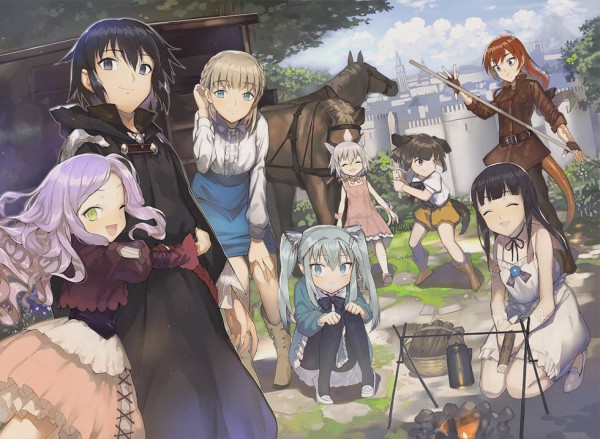
The narrative begins with Ichirou, now using the alias Satou, embarking on a journey across the parallel world. His primary goal is to explore and understand the new environment, but he quickly becomes entangled in various events and encounters. Along the way, he meets a diverse cast of characters, including Arisa, a former noble girl enslaved by bandits, and Liza, a lizardman warrior. Satou rescues them and forms a party, taking on the role of a protector and mentor. His actions often lead to unintended consequences, as his overwhelming power disrupts the balance of the world.
The world-building in "Death March to the Parallel World Rhapsody" is expansive, featuring a mix of traditional fantasy elements such as magic, monsters, and multiple races, alongside game-like mechanics such as levels, skills, and item crafting. Satou’s programming background occasionally influences his approach to problem-solving, allowing him to exploit the system in creative ways. Despite his immense power, he maintains a laid-back and pragmatic demeanor, often prioritizing the well-being of his companions over grand ambitions.
The story balances episodic adventures with an overarching narrative. Satou’s journey takes him through various regions, each with its own unique challenges and cultures. He frequently encounters political intrigue, ancient mysteries, and powerful entities, all while maintaining a facade of being an ordinary traveler. His interactions with other characters, particularly the younger members of his party, highlight themes of responsibility, mentorship, and the ethical use of power.
The manga adaptation effectively captures the light-hearted tone of the original light novels, blending humor, action, and moments of introspection. Satou’s relationships with his companions evolve over time, adding depth to the narrative. While the series occasionally delves into darker themes such as slavery and exploitation, it generally maintains a hopeful and optimistic outlook, emphasizing the importance of kindness and cooperation in overcoming adversity. The story’s pacing allows for both episodic adventures and gradual progression, making it accessible to readers who enjoy a mix of slice-of-life and fantasy elements.
The narrative begins with Ichirou, now using the alias Satou, embarking on a journey across the parallel world. His primary goal is to explore and understand the new environment, but he quickly becomes entangled in various events and encounters. Along the way, he meets a diverse cast of characters, including Arisa, a former noble girl enslaved by bandits, and Liza, a lizardman warrior. Satou rescues them and forms a party, taking on the role of a protector and mentor. His actions often lead to unintended consequences, as his overwhelming power disrupts the balance of the world.
The world-building in "Death March to the Parallel World Rhapsody" is expansive, featuring a mix of traditional fantasy elements such as magic, monsters, and multiple races, alongside game-like mechanics such as levels, skills, and item crafting. Satou’s programming background occasionally influences his approach to problem-solving, allowing him to exploit the system in creative ways. Despite his immense power, he maintains a laid-back and pragmatic demeanor, often prioritizing the well-being of his companions over grand ambitions.
The story balances episodic adventures with an overarching narrative. Satou’s journey takes him through various regions, each with its own unique challenges and cultures. He frequently encounters political intrigue, ancient mysteries, and powerful entities, all while maintaining a facade of being an ordinary traveler. His interactions with other characters, particularly the younger members of his party, highlight themes of responsibility, mentorship, and the ethical use of power.
The manga adaptation effectively captures the light-hearted tone of the original light novels, blending humor, action, and moments of introspection. Satou’s relationships with his companions evolve over time, adding depth to the narrative. While the series occasionally delves into darker themes such as slavery and exploitation, it generally maintains a hopeful and optimistic outlook, emphasizing the importance of kindness and cooperation in overcoming adversity. The story’s pacing allows for both episodic adventures and gradual progression, making it accessible to readers who enjoy a mix of slice-of-life and fantasy elements.
Comment(s)
Staff
- Story
- FrontispieceMegumi Nagahamashri
- TranslationAndrew CunninghamJade WillisJenny McKeon
- EditingPayton Campbell
- Cover Artshri
- Text IllustrationsMegumi Nagahamashri
- DesignAndy SwistJane Sohn
Recommendations
Empfehlungen auf Basis gemeinsamer Kategorien.