Manga
Description
On a quiet coastal street stands Unreal, a peculiar shop filled with beautiful antiques and an otherworldly atmosphere. The shop sells something far more intangible than ordinary goods: it deals in human "thoughts" and desires. Customers who feel drawn to the store inevitably find themselves picking up an item with a mysterious allure, only to discover that each product comes with strict, unbreakable rules that must be followed. The consequences of breaking these rules are dire.
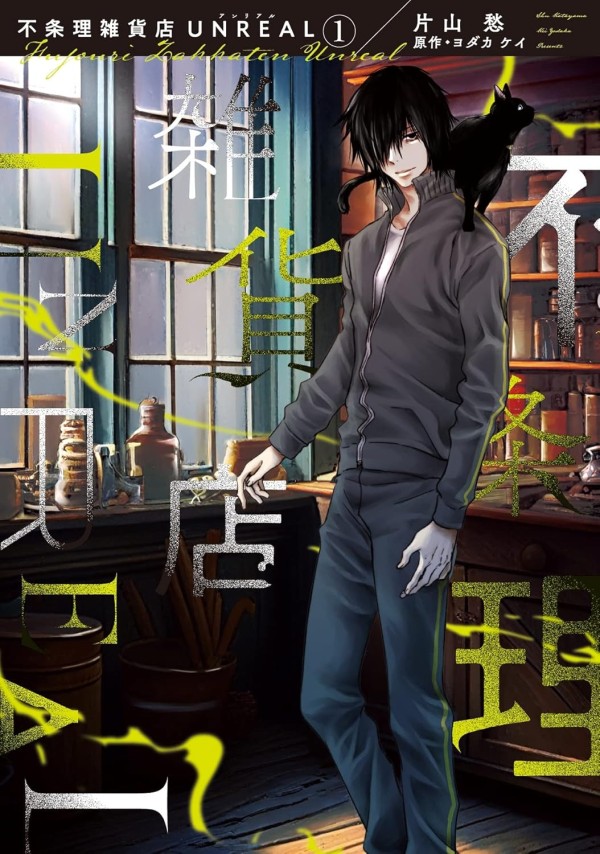
The shop is presided over by Yagio, a mysterious owner whose casual tracksuit is conspicuously out of place among the elegant antiques. Behind his cold gaze as he watches customers walk their strange fates, Yagio himself harbors a deep, hidden wish. Looking after him is Munechika, a high school student who works at the adjacent café and feels a sense of responsibility he cannot quite explain. A mysterious woman named Matoba also lingers around the shop, adding another layer of intrigue to the already enigmatic circle. A black cat named Sake Toba, whose true nature and identity are revealed in the third volume, completes the shop's unsettling tableau.
The narrative unfolds through an episodic structure, where each chapter or arc follows a new customer who comes to Unreal seeking to fulfill a wish. These visitors are presented with artifacts that tempt them to prioritize their ideal outcome, often at the cost of others' messy realities. One early case involves a perfume bottle that imprisons a ghost, with the scent changing according to the owner's mood. Another story follows Yokoi Hina, a middle school girl raised with the accusation that she has "no heart," who visits the shop searching for something she cannot name after losing the first person she ever loved.
Beneath these standalone tales runs a deeper, continuous mystery. The shop is not merely a passive location; the antiques are traces left by previous owners, and the burden of running Unreal traps its keepers in a cycle of fate they cannot escape. Yagio is revealed to be fighting against destiny itself, trapped in a recurring nightmare as he tries to recover something precious that he has lost. A specific date, August 20th, hangs over the narrative as a point of significance that Yagio cannot seem to move past.
As the story progresses into later volumes, the core relationship between Yagio and Munechika comes to the forefront. Munechika begins to regain fragments of lost memories, realizing that his connection to the shop owner is far older and more profound than he knew. The truth emerges that people have been selling their souls to alter fate, causing time to repeat in an endless loop as they search for the one perfect outcome that saves someone without destroying others. This repetition drains the humanity of those who try to intervene, turning them into weary custodians of an impossible machine. The major narrative arc culminates in a confrontation over whether it is right to force a "perfect world" through supernatural means or to accept an imperfect, messy present. Yagio is ultimately forced to choose between his obsession with changing the past and accepting a role as an observer, acknowledging that some forms of salvation are not meant to be bought or forced.
The shop is presided over by Yagio, a mysterious owner whose casual tracksuit is conspicuously out of place among the elegant antiques. Behind his cold gaze as he watches customers walk their strange fates, Yagio himself harbors a deep, hidden wish. Looking after him is Munechika, a high school student who works at the adjacent café and feels a sense of responsibility he cannot quite explain. A mysterious woman named Matoba also lingers around the shop, adding another layer of intrigue to the already enigmatic circle. A black cat named Sake Toba, whose true nature and identity are revealed in the third volume, completes the shop's unsettling tableau.
The narrative unfolds through an episodic structure, where each chapter or arc follows a new customer who comes to Unreal seeking to fulfill a wish. These visitors are presented with artifacts that tempt them to prioritize their ideal outcome, often at the cost of others' messy realities. One early case involves a perfume bottle that imprisons a ghost, with the scent changing according to the owner's mood. Another story follows Yokoi Hina, a middle school girl raised with the accusation that she has "no heart," who visits the shop searching for something she cannot name after losing the first person she ever loved.
Beneath these standalone tales runs a deeper, continuous mystery. The shop is not merely a passive location; the antiques are traces left by previous owners, and the burden of running Unreal traps its keepers in a cycle of fate they cannot escape. Yagio is revealed to be fighting against destiny itself, trapped in a recurring nightmare as he tries to recover something precious that he has lost. A specific date, August 20th, hangs over the narrative as a point of significance that Yagio cannot seem to move past.
As the story progresses into later volumes, the core relationship between Yagio and Munechika comes to the forefront. Munechika begins to regain fragments of lost memories, realizing that his connection to the shop owner is far older and more profound than he knew. The truth emerges that people have been selling their souls to alter fate, causing time to repeat in an endless loop as they search for the one perfect outcome that saves someone without destroying others. This repetition drains the humanity of those who try to intervene, turning them into weary custodians of an impossible machine. The major narrative arc culminates in a confrontation over whether it is right to force a "perfect world" through supernatural means or to accept an imperfect, messy present. Yagio is ultimately forced to choose between his obsession with changing the past and accepting a role as an observer, acknowledging that some forms of salvation are not meant to be bought or forced.
Comment(s)
Staff
- StoryKei Yodaka
Recommendations
Empfehlungen auf Basis gemeinsamer Kategorien.