Manga
Description
In an era before Western medicine reached Japan, the practice of cutting open the human body—dissection—was considered forbidden heresy. Yet one man makes it his life’s work. Shishido Bannai is a so-called “evil doctor” who robs graves and performs autopsies with unnerving enthusiasm, treating each corpse as a finished work of art that reveals the truth of life and death. When a series of child drownings plagues a town in the Houreki era (1752), the low-ranking police officer Itou Rin is assigned to investigate the case alongside her superior, Yoriki Seidou Saneatsu. At the riverbank they find Bannai plucking out a victim’s eyeball with tweezers, gleefully declaring the drowned child’s body a masterpiece he must study. Rin arrests him, but soon learns that Bannai is no ordinary criminal: he is a tenzen goyou, a special retainer of the Tokugawa shogunate, untouchable by the law. Reluctantly, Rin agrees to work with Bannai to solve the mystery.
Using his unorthodox knowledge of both Dutch and Chinese medicine, Bannai dissects the supposed drowning victims and points out contradictions: drowned bodies sink and then float later, yet the child’s clothes remained intact, a sign that the deaths were not the work of a kappa water demon as the locals believed. His scrutiny leads to the temple priest, whose calloused hands and hidden axe betray him as the true murderer—a man who killed to “cull the herd” during a famine. The father of one victim kills the priest in revenge, but Bannai shows little emotion, remarking only that humans can be worse than monsters.
The story continues with a second arc involving a landlord’s apparent suicide by hanging. Bannai again notes anomalies: the rope marks around the neck are inconsistent with typical hanging deaths, and the body’s position suggests a staged scene. He and Rin uncover a web of greed and betrayal among the tenement residents, using dissection to reveal the cause of death hidden from the naked eye. Throughout these cases, Bannai’s macabre sense of humor and obsessive need to cut into the dead clash with Rin’s rigid sense of justice, yet she begins to see that his methods—however grotesque—uncover truths that superstition and fear would otherwise bury.
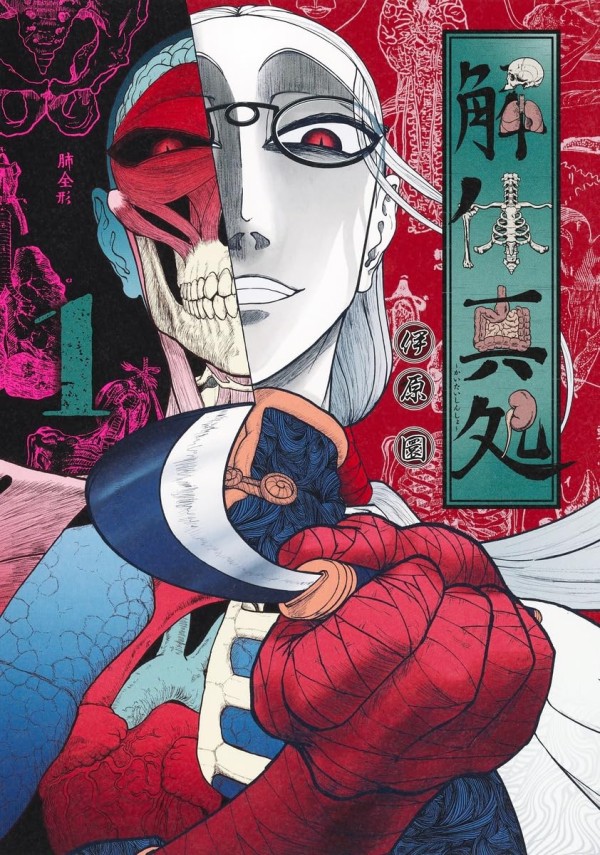
The manga is a historical mystery series that blends dark comedy, forensic science, and period atmosphere. The setting vividly recreates a Japan still grappling with the foundations of medicine, where the very act of looking inside a body is a transgression against nature and society. Shishido Bannai, with his beady eyes behind round glasses and his claw-like gloved hands, is both a monster and a savior—a man who sees the flesh as the only honest witness. Itou Rin, a capable and principled woman in a patriarchal police structure, grows as a character as she comes to accept that the “evil” doctor’s scalpel may be the only tool capable of carving out the truth from a world of lies. The narrative is episodic but threaded with an overarching sense of the changing era, where old beliefs are being challenged by empirical inquiry. The manga is written and illustrated by Ihara Meguru and began serialization in Weekly Young Jump in February 2025, with an ongoing publication of tankobon volumes.
Using his unorthodox knowledge of both Dutch and Chinese medicine, Bannai dissects the supposed drowning victims and points out contradictions: drowned bodies sink and then float later, yet the child’s clothes remained intact, a sign that the deaths were not the work of a kappa water demon as the locals believed. His scrutiny leads to the temple priest, whose calloused hands and hidden axe betray him as the true murderer—a man who killed to “cull the herd” during a famine. The father of one victim kills the priest in revenge, but Bannai shows little emotion, remarking only that humans can be worse than monsters.
The story continues with a second arc involving a landlord’s apparent suicide by hanging. Bannai again notes anomalies: the rope marks around the neck are inconsistent with typical hanging deaths, and the body’s position suggests a staged scene. He and Rin uncover a web of greed and betrayal among the tenement residents, using dissection to reveal the cause of death hidden from the naked eye. Throughout these cases, Bannai’s macabre sense of humor and obsessive need to cut into the dead clash with Rin’s rigid sense of justice, yet she begins to see that his methods—however grotesque—uncover truths that superstition and fear would otherwise bury.
The manga is a historical mystery series that blends dark comedy, forensic science, and period atmosphere. The setting vividly recreates a Japan still grappling with the foundations of medicine, where the very act of looking inside a body is a transgression against nature and society. Shishido Bannai, with his beady eyes behind round glasses and his claw-like gloved hands, is both a monster and a savior—a man who sees the flesh as the only honest witness. Itou Rin, a capable and principled woman in a patriarchal police structure, grows as a character as she comes to accept that the “evil” doctor’s scalpel may be the only tool capable of carving out the truth from a world of lies. The narrative is episodic but threaded with an overarching sense of the changing era, where old beliefs are being challenged by empirical inquiry. The manga is written and illustrated by Ihara Meguru and began serialization in Weekly Young Jump in February 2025, with an ongoing publication of tankobon volumes.
Comment(s)
Staff
- Story & ArtMeguru Ihara
Recommendations
Empfehlungen auf Basis gemeinsamer Kategorien.