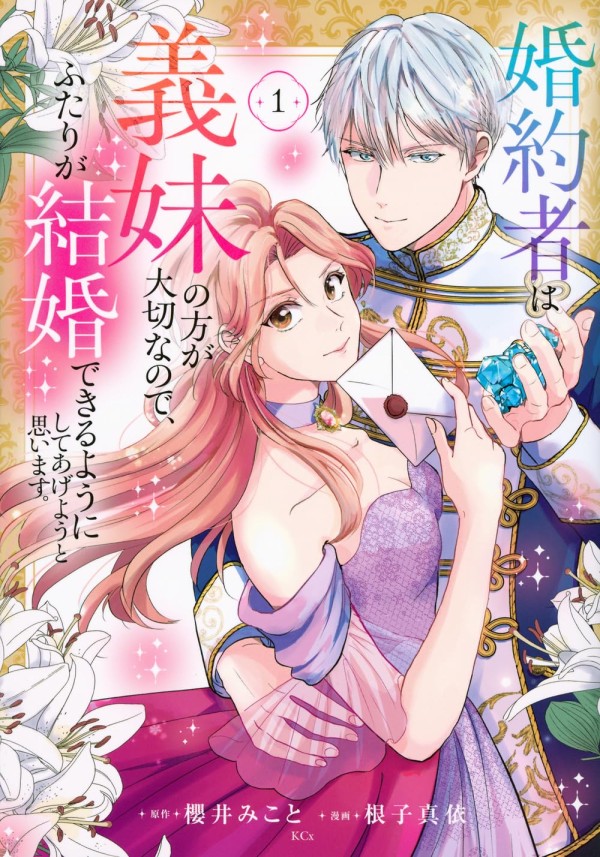
Manga
Description
A noblewoman discovers that her fiancé has developed genuine romantic feelings for her stepsister. Rather than fighting to preserve her engagement or seeking revenge, she makes the quiet but deliberate decision to step aside and help the two of them marry. This is not a story of rage or scheming but one of heartbreak met with extraordinary grace and self-possession.
The heroine is deliberate and dignified, choosing to process her pain privately while actively facilitating the relationship between her fiancé and her stepsister. The story frames this choice not as weakness but as an act of strength, as she refuses to trap anyone in a loveless arrangement simply because social convention demands it. The fiancé is not portrayed as callously cruel; his feelings for the stepsister are real, even if his handling of the situation causes tremendous pain. Likewise, the stepsister is not a ruthless villain but a young woman caught in her own complicated emotional position, torn between her sister and her heart.
The setting is an elegantly rendered aristocratic world where engagements represent not just romance but family honor, social standing, and future security. The conflict arises not from malice but from the messy reality of human emotion refusing to follow social rules. The story explores the tension between selflessness and self-preservation, asking whether giving up what one is owed is an act of love or a failure to value oneself. It also interrogates the limits of arranged marriage as an institution, questioning what a person actually owes to a social contract they never freely entered.
Unlike many similar stories in the villainess or broken engagement genre, this series has no reincarnation twist, no instant revenge arc, and no convenient new love interest introduced immediately to soften the blow. The heroine reconstructs her identity on her own terms after losing not just a partner but her social role, family alliances, and the future she had planned. The emotional resolution is slower and more meaningful, trusting readers with moral complexity. The narrative arcs focus on the heroine’s quiet journey of letting go, the gradual disentangling of the engagement, and the painful but necessary process of redefining who she is when everything she was supposed to become has been taken away.
The heroine is deliberate and dignified, choosing to process her pain privately while actively facilitating the relationship between her fiancé and her stepsister. The story frames this choice not as weakness but as an act of strength, as she refuses to trap anyone in a loveless arrangement simply because social convention demands it. The fiancé is not portrayed as callously cruel; his feelings for the stepsister are real, even if his handling of the situation causes tremendous pain. Likewise, the stepsister is not a ruthless villain but a young woman caught in her own complicated emotional position, torn between her sister and her heart.
The setting is an elegantly rendered aristocratic world where engagements represent not just romance but family honor, social standing, and future security. The conflict arises not from malice but from the messy reality of human emotion refusing to follow social rules. The story explores the tension between selflessness and self-preservation, asking whether giving up what one is owed is an act of love or a failure to value oneself. It also interrogates the limits of arranged marriage as an institution, questioning what a person actually owes to a social contract they never freely entered.
Unlike many similar stories in the villainess or broken engagement genre, this series has no reincarnation twist, no instant revenge arc, and no convenient new love interest introduced immediately to soften the blow. The heroine reconstructs her identity on her own terms after losing not just a partner but her social role, family alliances, and the future she had planned. The emotional resolution is slower and more meaningful, trusting readers with moral complexity. The narrative arcs focus on the heroine’s quiet journey of letting go, the gradual disentangling of the engagement, and the painful but necessary process of redefining who she is when everything she was supposed to become has been taken away.
Comment(s)
Staff
- Original storyMikoto Sakurai
- ArtMai Neko
Recommendations
Empfehlungen auf Basis gemeinsamer Kategorien.