Manga
Description
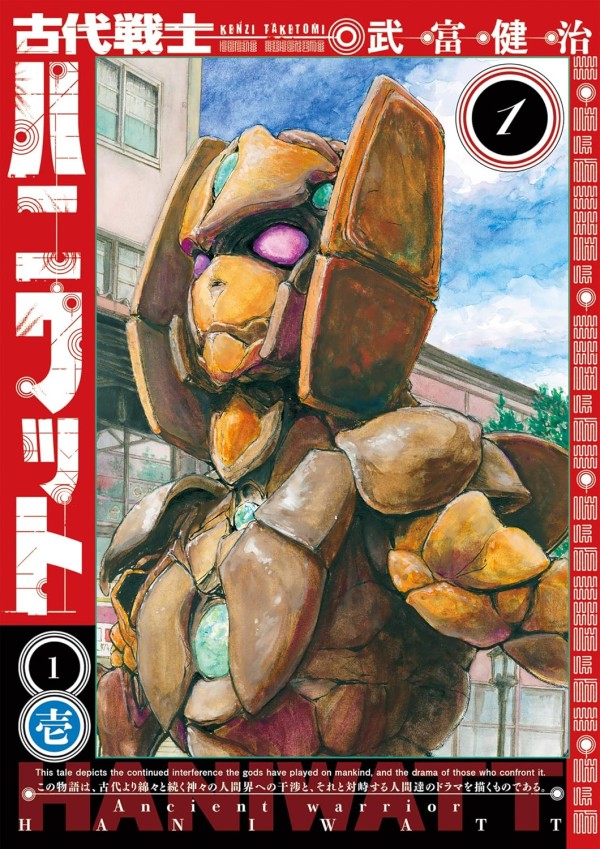
In the modern city of Nagano, specifically around the temple district of Zenkoji, a mysterious and powerful being appears without warning. Resembling an ancient clay idol known as a Dogū, this entity begins a relentless march of destruction, slaughtering anyone who crosses its path. The local police and military are completely powerless against this creature from a bygone era.
However, unknown to the public, certain individuals had foreseen this day and have been preparing for it in secret. This group belongs to an obscure department of Shinto studies at a local university. They are the only hope against this threat. Their method to combat the creature is a specialized Shinto ritual involving ceremonial dances, which allows a human soul to inhabit and animate a clay armor, creating an ancient warrior known as a Haniwatt. The protagonist, a young man named Jin, becomes the first of these warriors to take a stand, transforming to oppose the monster’s onslaught.
The story is an action seinen written and illustrated by Kenji Taketomi. The narrative draws heavily from Japanese history and folklore, with its monsters based on real Dogū and Haniwa statuettes from the prehistoric Jōmon period. The author conceived the initial idea for the story during his elementary school years, later refining it into a tribute to the tokusatsu and mecha anime classics of the 1970s and 1980s. The world-building is deliberately thorough, integrating elements of Shinto philosophy to explain the rules and mechanics of how the Haniwatt operate, distinguishing it from purely science-fiction narratives.
Jin, the initial Haniwatt warrior associated with Kagutsuchi, suffers a complete defeat at the hands of the primary Dogū, referred to as Dogūn. As a result, a priestess named Yuri, who was hospitalized due to severe injuries, is recalled. Simultaneously, another warrior named Yayoi Oguna summons Rin Funato, a Haniwatt of Magatsutsuchi, to Nagano. Together with priests from the Togakushi shrine, they begin preparations for a second decisive battle against the Dogūn.
As the serialized story progresses, the third part titled Wandering Reminiscences begins a new arc called The Chapter of Kofu Fujikawa. This arc shifts focus to a different character, Makio, who is preparing to leave as a Haniwatt. He is tormented by sad memories of a rivalry with his half-brother for power, even as his mother offers him words of encouragement.
However, unknown to the public, certain individuals had foreseen this day and have been preparing for it in secret. This group belongs to an obscure department of Shinto studies at a local university. They are the only hope against this threat. Their method to combat the creature is a specialized Shinto ritual involving ceremonial dances, which allows a human soul to inhabit and animate a clay armor, creating an ancient warrior known as a Haniwatt. The protagonist, a young man named Jin, becomes the first of these warriors to take a stand, transforming to oppose the monster’s onslaught.
The story is an action seinen written and illustrated by Kenji Taketomi. The narrative draws heavily from Japanese history and folklore, with its monsters based on real Dogū and Haniwa statuettes from the prehistoric Jōmon period. The author conceived the initial idea for the story during his elementary school years, later refining it into a tribute to the tokusatsu and mecha anime classics of the 1970s and 1980s. The world-building is deliberately thorough, integrating elements of Shinto philosophy to explain the rules and mechanics of how the Haniwatt operate, distinguishing it from purely science-fiction narratives.
Jin, the initial Haniwatt warrior associated with Kagutsuchi, suffers a complete defeat at the hands of the primary Dogū, referred to as Dogūn. As a result, a priestess named Yuri, who was hospitalized due to severe injuries, is recalled. Simultaneously, another warrior named Yayoi Oguna summons Rin Funato, a Haniwatt of Magatsutsuchi, to Nagano. Together with priests from the Togakushi shrine, they begin preparations for a second decisive battle against the Dogūn.
As the serialized story progresses, the third part titled Wandering Reminiscences begins a new arc called The Chapter of Kofu Fujikawa. This arc shifts focus to a different character, Makio, who is preparing to leave as a Haniwatt. He is tormented by sad memories of a rivalry with his half-brother for power, even as his mother offers him words of encouragement.
Comment(s)
Staff
- Story & ArtKenzi Taketomi
Recommendations
Empfehlungen auf Basis gemeinsamer Kategorien.
Anime overview


Manga overview