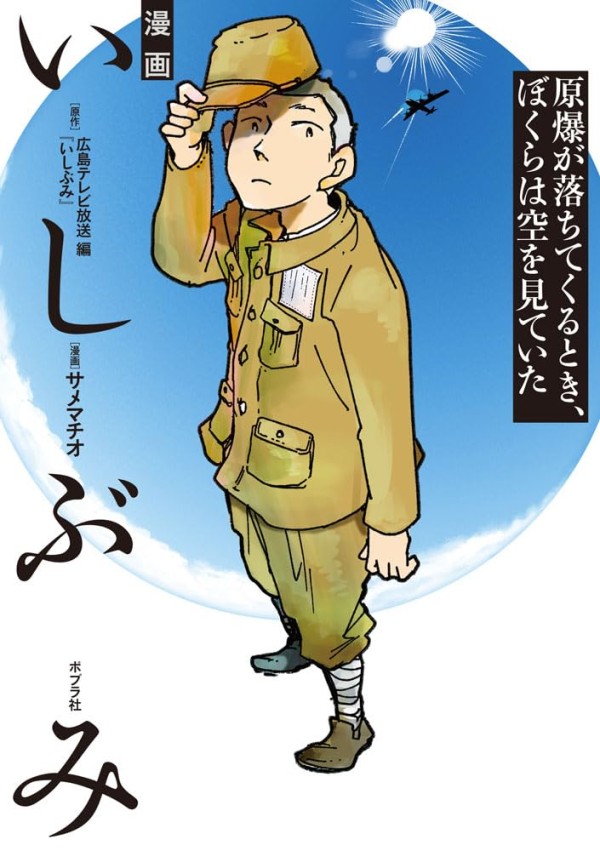
Manga
Description
Premise and setting center on Hiroshima in the final months of the Pacific War, primarily following a group of middle-school students and their teacher. The narrative unfolds on August 6, 1945, as the atomic bomb is dropped, but the core of the story is the hours and moments leading up to that catastrophe. The children are engaged in their daily routines, attending school and performing wartime labor duties, while the adults around them are either in denial, clinging to propaganda, or quietly terrified. The central conflict is the collision between ordinary youthful concerns—friendships, crushes, schoolwork—and the imminent, incomprehensible violence that the sky itself will soon deliver.
The main character is a young boy named Ishibumi, whose name means "stone monument," and he serves as the emotional anchor. Through his eyes, the reader experiences the pervasive hunger, the constant air-raid drills, and the strange, tense quiet that precedes the blast. His teacher, a man struggling to maintain order and hope in the face of certain doom, tries to shield the students from the worst of the military rhetoric while preparing them for what he suspects is coming. Other students include a cynical friend who doubts official reassurances, a girl Ishibumi admires who is obsessed with saving a single fledgling bird, and a younger sibling who still believes in the invincibility of the Japanese spirit.
The narrative arc is not a traditional plot with rising and falling action, but rather a countdown to a fixed point. The first third establishes the daily life of the city, the students' part-time work clearing fire lanes, and the growing sense of dread as American B-29s fly over with increasing impunity. The middle section focuses on the morning of August 6, from sunrise to the moment the Enola Gay appears, as the children argue about whether to take shelter or follow orders to stay outside. The teacher makes a desperate, last-minute decision to have the class look up at the bomber, hoping that seeing the enemy clearly might somehow make it less abstract. The final portion depicts the flash, the shockwave, and the aftermath in fragmented, sensory detail—light, heat, silence, then chaos. The story does not show a long-term recovery but instead freezes on the instant of impact, with Ishibumi’s consciousness fading while he ponders what his name will mean if no one survives to remember it. Notable sub-arcs include the girl’s futile attempt to release the bird seconds before the blast, the teacher’s internal monologue about a failed letter he never sent to his own family, and the cynical friend's final act of pushing Ishibumi behind a stone wall, which serves as a tragic irony given the boy's name. The work is a stark, human-scale meditation on memory, childhood, and the terrible weight of witnessing history from ground zero, with no postwar coda or heroic survival narrative to soften the ending.
The main character is a young boy named Ishibumi, whose name means "stone monument," and he serves as the emotional anchor. Through his eyes, the reader experiences the pervasive hunger, the constant air-raid drills, and the strange, tense quiet that precedes the blast. His teacher, a man struggling to maintain order and hope in the face of certain doom, tries to shield the students from the worst of the military rhetoric while preparing them for what he suspects is coming. Other students include a cynical friend who doubts official reassurances, a girl Ishibumi admires who is obsessed with saving a single fledgling bird, and a younger sibling who still believes in the invincibility of the Japanese spirit.
The narrative arc is not a traditional plot with rising and falling action, but rather a countdown to a fixed point. The first third establishes the daily life of the city, the students' part-time work clearing fire lanes, and the growing sense of dread as American B-29s fly over with increasing impunity. The middle section focuses on the morning of August 6, from sunrise to the moment the Enola Gay appears, as the children argue about whether to take shelter or follow orders to stay outside. The teacher makes a desperate, last-minute decision to have the class look up at the bomber, hoping that seeing the enemy clearly might somehow make it less abstract. The final portion depicts the flash, the shockwave, and the aftermath in fragmented, sensory detail—light, heat, silence, then chaos. The story does not show a long-term recovery but instead freezes on the instant of impact, with Ishibumi’s consciousness fading while he ponders what his name will mean if no one survives to remember it. Notable sub-arcs include the girl’s futile attempt to release the bird seconds before the blast, the teacher’s internal monologue about a failed letter he never sent to his own family, and the cynical friend's final act of pushing Ishibumi behind a stone wall, which serves as a tragic irony given the boy's name. The work is a stark, human-scale meditation on memory, childhood, and the terrible weight of witnessing history from ground zero, with no postwar coda or heroic survival narrative to soften the ending.
Comment(s)
Staff
- Story & ArtMachio Same
Recommendations
Empfehlungen auf Basis gemeinsamer Kategorien.