Manga
Description
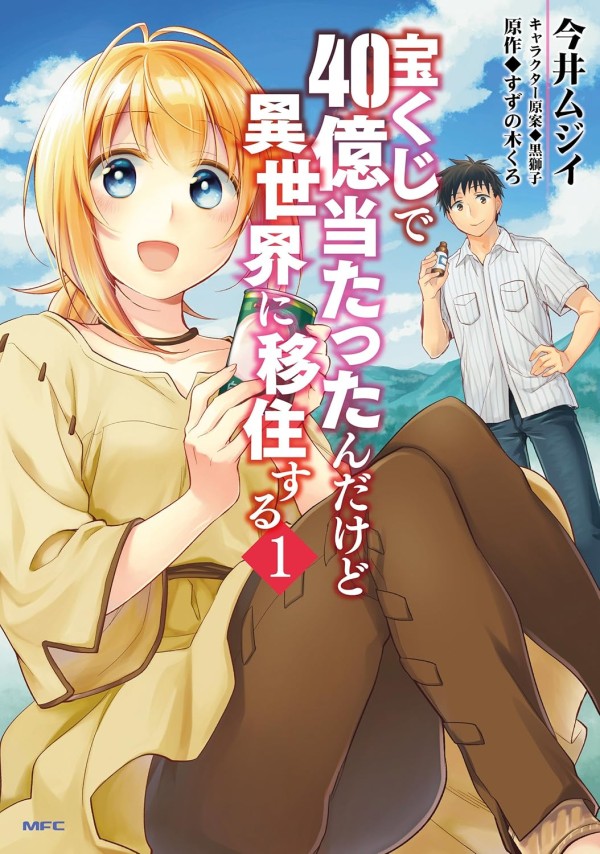
Kazura Shino, an ordinary office worker, buys a lottery ticket on a whim and wins four billion yen. Almost immediately, relatives, journalists, and swindlers swarm him for a share of his fortune. To escape the pressure, he retreats to a dilapidated ancestral house deep in the mountains. While exploring the building, he discovers a secret corridor that leads to a medieval world. He steps out into Grisea, a village ravaged by a recent war and suffering from drought and malnutrition. The villagers are on the verge of starvation.
Using his lottery winnings, Kazura buys food, medicine, and everyday goods from modern Japan and shuttles them through the corridor. He treats sick villagers with energy drinks and painkillers, and introduces basic agricultural improvements such as water wheels, crop rotation, and organic fertilizer. Within a short time, Grisea’s food supply stabilizes and the village begins to thrive. The locals, who worship a lost harvest deity named Greysior, come to believe that Kazura is that god returned to them. The story follows Kazura’s efforts to develop the village further while balancing his life between two worlds.
Kazura is a pragmatic and compassionate protagonist who relies on modern ingenuity rather than magic or combat prowess. The central female character is Valetta, the village chief’s daughter, who becomes his closest companion and romantic interest. Other key figures include the maid Marie, who later stars in a spin‑off about commercial development, and members of the noble Isteria family, who rule the region. As Kazura’s reputation spreads, nobles and merchants from surrounding territories take notice. He becomes entangled in local politics, trade negotiations, and the looming threat of a full‑scale war that could engulf the kingdom.
Narrative arcs progress from simple village aid to regional politics, infrastructure projects (bathhouses, roads, crossbows), and the introduction of more advanced technology. The story emphasizes the gradual, realistic improvement of a pre‑industrial society through knowledge transfer and careful resource management. Despite the presence of romance and light comedy, the focus remains on Kazura’s role as a catalyst for change in a world that lacks both magic and common fantasy races. The manga adaptation, overseen by original author Suzunoki Kuro and illustrated by Imai Mujii, continues to expand these themes as Kazura’s influence grows and new challenges emerge from both the human and natural realms.
Using his lottery winnings, Kazura buys food, medicine, and everyday goods from modern Japan and shuttles them through the corridor. He treats sick villagers with energy drinks and painkillers, and introduces basic agricultural improvements such as water wheels, crop rotation, and organic fertilizer. Within a short time, Grisea’s food supply stabilizes and the village begins to thrive. The locals, who worship a lost harvest deity named Greysior, come to believe that Kazura is that god returned to them. The story follows Kazura’s efforts to develop the village further while balancing his life between two worlds.
Kazura is a pragmatic and compassionate protagonist who relies on modern ingenuity rather than magic or combat prowess. The central female character is Valetta, the village chief’s daughter, who becomes his closest companion and romantic interest. Other key figures include the maid Marie, who later stars in a spin‑off about commercial development, and members of the noble Isteria family, who rule the region. As Kazura’s reputation spreads, nobles and merchants from surrounding territories take notice. He becomes entangled in local politics, trade negotiations, and the looming threat of a full‑scale war that could engulf the kingdom.
Narrative arcs progress from simple village aid to regional politics, infrastructure projects (bathhouses, roads, crossbows), and the introduction of more advanced technology. The story emphasizes the gradual, realistic improvement of a pre‑industrial society through knowledge transfer and careful resource management. Despite the presence of romance and light comedy, the focus remains on Kazura’s role as a catalyst for change in a world that lacks both magic and common fantasy races. The manga adaptation, overseen by original author Suzunoki Kuro and illustrated by Imai Mujii, continues to expand these themes as Kazura’s influence grows and new challenges emerge from both the human and natural realms.
Comment(s)
Staff
- Original storyKuro Suzunoki
- ArtMujii Imai
- Original Character DesignKurojishi
Recommendations
Empfehlungen auf Basis gemeinsamer Kategorien.