Manga
Description
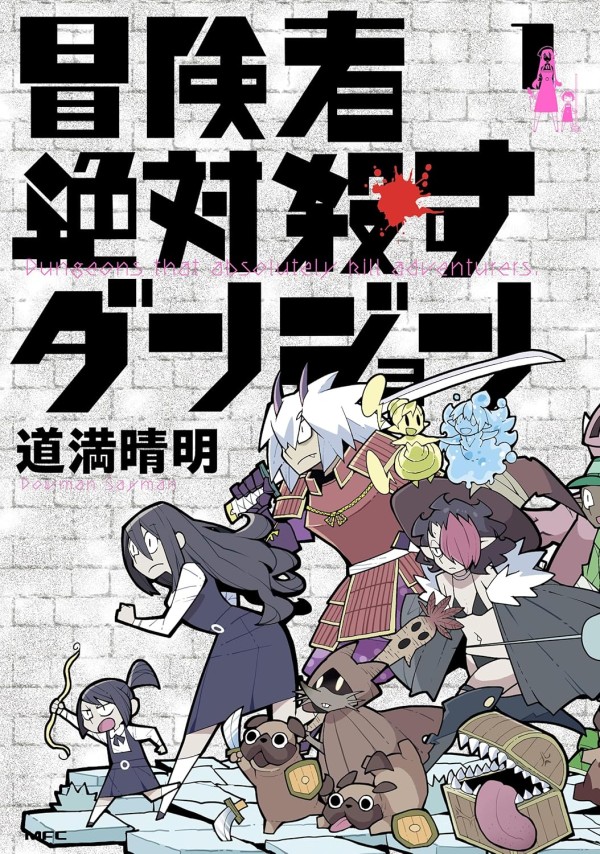
Two young women, Aine and Nacht, die in absurd accidents in the modern world—Nacht crushed by a falling airplane engine—and are reincarnated together in a fantasy realm. They expect the usual isekai adventure, but instead find themselves employed as floor staff in a dungeon that operates on a time-payment system. Their daily work consists of scrubbing bloodstains, restocking supplies, disposing of monster and adventurer corpses, and handling complaints from the very adventurers who treat the dungeon like a playground. Frustrated by the constant mess and entitled behavior, the two decide to take matters into their own hands. They resolve to turn their workplace into a death trap that will slaughter every adventurer who enters, aiming for nothing less than the complete eradication of their inconsiderate clientele.
Aine is the more impulsive and brutally creative of the pair, often proposing shockingly unhinged schemes to deter or kill adventurers. Nacht is taller, calmer, and more methodical, serving as the one who refines Aine’s ideas into practical traps. Though their methods are vicious, the two share a strong, almost familial bond, and their banter provides the story’s emotional core.
The setting is a labyrinthine dungeon filled with quirky monsters who have their own personalities and grievances. The dungeon master and his staff, including monsters like a quick-tempered female oni named Raiko, a shapeshifting mimic, and a lethally aggressive water spirit named Undine, all answer to Aine and Nacht. The dungeon itself operates on video-game logic: reincarnated staff and monsters can respawn after death, but this rule has cruel exceptions—children born in the other world cannot respawn, a fact that leads to one of the story’s darkest episodes.
The narrative unfolds in an episodic structure that gradually reveals deeper layers. Early chapters focus on the pair’s increasingly brutal and darkly comedic schemes: using blood-soaked sanitary pads as bait, devising psychological torture, and engineering elaborate traps. Underlying the humor is a bleak satire of the isekai genre and the often-ignored labor that supports adventurers. As the story progresses, the mystery of the dungeon’s origin and the nature of reincarnation come to the forefront. Around the second volume, Nacht recovers memories of a past life as the dungeon’s original final boss, a demon lord, and undergoes an awakening that changes her relationship with Aine.
The third volume introduces financial hardship, forcing a dungeon renovation that draws in more adventurers. A major turning point occurs when Aine is forced to temporarily cooperate with a group of adventurers after a tragic incident—three close friends enter the dungeon, two of whom cannot respawn, and one dies permanently. The event shakes Aine and drives a wedge between her and Nacht, with Aine reconsidering her methods while Nacht grows more committed to slaughter. The volume ends with the two parting ways, setting up a new direction for the ongoing story.
Aine is the more impulsive and brutally creative of the pair, often proposing shockingly unhinged schemes to deter or kill adventurers. Nacht is taller, calmer, and more methodical, serving as the one who refines Aine’s ideas into practical traps. Though their methods are vicious, the two share a strong, almost familial bond, and their banter provides the story’s emotional core.
The setting is a labyrinthine dungeon filled with quirky monsters who have their own personalities and grievances. The dungeon master and his staff, including monsters like a quick-tempered female oni named Raiko, a shapeshifting mimic, and a lethally aggressive water spirit named Undine, all answer to Aine and Nacht. The dungeon itself operates on video-game logic: reincarnated staff and monsters can respawn after death, but this rule has cruel exceptions—children born in the other world cannot respawn, a fact that leads to one of the story’s darkest episodes.
The narrative unfolds in an episodic structure that gradually reveals deeper layers. Early chapters focus on the pair’s increasingly brutal and darkly comedic schemes: using blood-soaked sanitary pads as bait, devising psychological torture, and engineering elaborate traps. Underlying the humor is a bleak satire of the isekai genre and the often-ignored labor that supports adventurers. As the story progresses, the mystery of the dungeon’s origin and the nature of reincarnation come to the forefront. Around the second volume, Nacht recovers memories of a past life as the dungeon’s original final boss, a demon lord, and undergoes an awakening that changes her relationship with Aine.
The third volume introduces financial hardship, forcing a dungeon renovation that draws in more adventurers. A major turning point occurs when Aine is forced to temporarily cooperate with a group of adventurers after a tragic incident—three close friends enter the dungeon, two of whom cannot respawn, and one dies permanently. The event shakes Aine and drives a wedge between her and Nacht, with Aine reconsidering her methods while Nacht grows more committed to slaughter. The volume ends with the two parting ways, setting up a new direction for the ongoing story.
Comment(s)
Staff
- Story & ArtDowman Sayman
Recommendations
Empfehlungen auf Basis gemeinsamer Kategorien.