Manga
Description
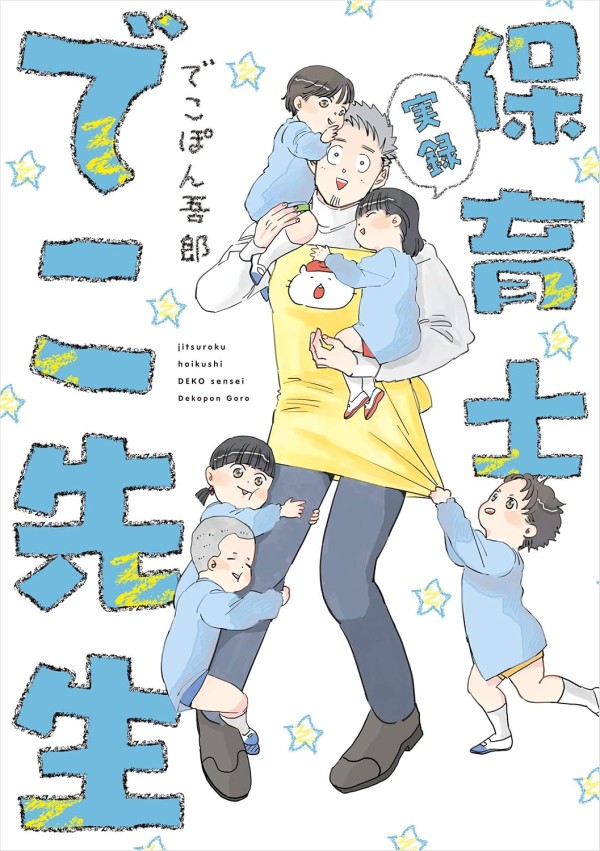
Deko-sensei is a nursery school teacher with a cheerful, slightly clumsy personality who navigates the unpredictable and heartwarming world of early childhood education. The manga is set entirely within the daily routines of a Japanese保育園 (nursery school), where Deko-sensei cares for a group of energetic, unfiltered, and endlessly surprising children. The core conflict is never a single villain or grand crisis but the constant comedy and chaos that arise when a well-meaning adult tries to manage toddlers who refuse to wear pants, announce bodily functions at full volume, or invent baffling new games during lunchtime. Each short episode functions as a slice-of-life vignette drawn directly from the author’s real experiences as a former保育士 (nursery teacher).
The main character, Deko-sensei, is depicted as an爱されキャラ (lovable character) whose enthusiasm is matched only by her tendency to make mistakes, often requiring rescue or advice from her more experienced colleagues. The children are not named individually but are presented as a rotating cast of personalities: the runaway, the crier, the one who repeats everything, the one who gets fixated on a single question. Their pure, unfiltered logic drives most of the humor and tenderness. Supporting characters include Deko-sensei’s fellow teachers, who offer dry commentary or patient guidance, and occasionally the parents, whose own lives are gently mirrored in their children’s behavior.
Narrative arcs are minimal; the structure is episodic rather than serialized. Over the course of six volumes and a sequel series titled Tadaima! Hoikushi Deko-sensei, the manga builds a cumulative portrait of the nursery year: seasonal events like sports day and Christmas parties, the arrival of new students, and the bittersweet graduation of the older ones. A notable shift occurs in the second series, where the author introduces a multi-chapter story about a child showing signs of developmental disability. This arc deliberately addresses the anxieties of parents and the uncertainty of educators, offering a message of reassurance that no one is alone in facing these challenges. The tone throughout remains light and warm, with the laughter never undercutting the genuine respect for the children’s perspectives and the difficulty of the job. The artwork emphasizes expressive faces and physical comedy, and the author has stated a particular focus on capturing the changing expressions of children as if they were jewels shifting in light. The series concludes with a sense of gratitude and closure, affirming the exhausting but rewarding nature of the work.
The main character, Deko-sensei, is depicted as an爱されキャラ (lovable character) whose enthusiasm is matched only by her tendency to make mistakes, often requiring rescue or advice from her more experienced colleagues. The children are not named individually but are presented as a rotating cast of personalities: the runaway, the crier, the one who repeats everything, the one who gets fixated on a single question. Their pure, unfiltered logic drives most of the humor and tenderness. Supporting characters include Deko-sensei’s fellow teachers, who offer dry commentary or patient guidance, and occasionally the parents, whose own lives are gently mirrored in their children’s behavior.
Narrative arcs are minimal; the structure is episodic rather than serialized. Over the course of six volumes and a sequel series titled Tadaima! Hoikushi Deko-sensei, the manga builds a cumulative portrait of the nursery year: seasonal events like sports day and Christmas parties, the arrival of new students, and the bittersweet graduation of the older ones. A notable shift occurs in the second series, where the author introduces a multi-chapter story about a child showing signs of developmental disability. This arc deliberately addresses the anxieties of parents and the uncertainty of educators, offering a message of reassurance that no one is alone in facing these challenges. The tone throughout remains light and warm, with the laughter never undercutting the genuine respect for the children’s perspectives and the difficulty of the job. The artwork emphasizes expressive faces and physical comedy, and the author has stated a particular focus on capturing the changing expressions of children as if they were jewels shifting in light. The series concludes with a sense of gratitude and closure, affirming the exhausting but rewarding nature of the work.
Comment(s)
Staff
- Story & ArtGorō Dekopon
Recommendations
Empfehlungen auf Basis gemeinsamer Kategorien.