Movie
Description
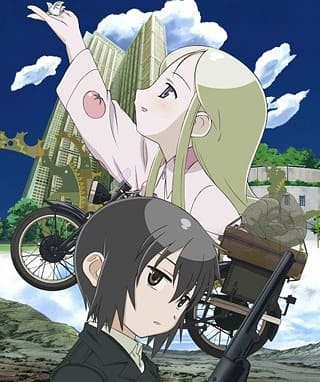
"Kino no Tabi: The Beautiful World" is an episodic anime series that explores philosophical and moral themes through the travels of its protagonist, Kino, a young adventurer who journeys across a diverse and often surreal world. Accompanied by a sentient, talking motorcycle named Hermes, Kino visits various countries, each with its own unique customs, societal structures, and ethical dilemmas. The series is structured as a collection of self-contained stories, with each episode or arc focusing on a different location and its inhabitants.
Kino adheres to a personal rule of staying no more than three days in any one place, ensuring a transient and observational role in the societies encountered. This approach allows Kino to remain an outsider, offering a detached perspective on the often bizarre and thought-provoking scenarios presented. The narrative frequently delves into themes such as human nature, morality, governance, and the consequences of societal choices, often leaving interpretations open-ended for the viewer.
Hermes, the motorcycle, serves as both a companion and a conversational counterpart, providing a grounded and sometimes humorous contrast to Kino’s contemplative nature. The dynamic between Kino and Hermes adds a layer of warmth and relatability to the otherwise introspective and occasionally somber tone of the series.
The countries Kino visits range from utopian to dystopian, with each presenting a unique allegory or philosophical question. For example, one country enforces absolute equality to the point of erasing individuality, while another is governed by a machine that dictates every aspect of life. These settings serve as backdrops for exploring complex ideas, often challenging viewers to reflect on their own values and societal norms.
Kino’s character is enigmatic, with glimpses of their past revealed sparingly throughout the series. This deliberate ambiguity adds depth to the narrative, emphasizing the focus on the world and its inhabitants rather than the protagonist’s personal journey. The series occasionally features other travelers and recurring characters, such as Shizu, a swordsman with his own companion, Riku, a talking dog. These characters provide additional perspectives and enrich the world-building.
The storytelling is marked by its minimalist approach, with a focus on dialogue and atmosphere rather than action or dramatic plot twists. The pacing is deliberate, allowing the philosophical underpinnings of each story to resonate. The series balances moments of quiet introspection with occasional bursts of tension or action, maintaining a consistent tone of curiosity and exploration.
Overall, "Kino no Tabi: The Beautiful World" is a contemplative and thought-provoking series that uses its episodic structure to examine a wide range of human experiences and societal constructs. Through Kino’s travels, the series invites viewers to consider the complexities of the world and the diverse ways in which people navigate their existence.
Kino adheres to a personal rule of staying no more than three days in any one place, ensuring a transient and observational role in the societies encountered. This approach allows Kino to remain an outsider, offering a detached perspective on the often bizarre and thought-provoking scenarios presented. The narrative frequently delves into themes such as human nature, morality, governance, and the consequences of societal choices, often leaving interpretations open-ended for the viewer.
Hermes, the motorcycle, serves as both a companion and a conversational counterpart, providing a grounded and sometimes humorous contrast to Kino’s contemplative nature. The dynamic between Kino and Hermes adds a layer of warmth and relatability to the otherwise introspective and occasionally somber tone of the series.
The countries Kino visits range from utopian to dystopian, with each presenting a unique allegory or philosophical question. For example, one country enforces absolute equality to the point of erasing individuality, while another is governed by a machine that dictates every aspect of life. These settings serve as backdrops for exploring complex ideas, often challenging viewers to reflect on their own values and societal norms.
Kino’s character is enigmatic, with glimpses of their past revealed sparingly throughout the series. This deliberate ambiguity adds depth to the narrative, emphasizing the focus on the world and its inhabitants rather than the protagonist’s personal journey. The series occasionally features other travelers and recurring characters, such as Shizu, a swordsman with his own companion, Riku, a talking dog. These characters provide additional perspectives and enrich the world-building.
The storytelling is marked by its minimalist approach, with a focus on dialogue and atmosphere rather than action or dramatic plot twists. The pacing is deliberate, allowing the philosophical underpinnings of each story to resonate. The series balances moments of quiet introspection with occasional bursts of tension or action, maintaining a consistent tone of curiosity and exploration.
Overall, "Kino no Tabi: The Beautiful World" is a contemplative and thought-provoking series that uses its episodic structure to examine a wide range of human experiences and societal constructs. Through Kino’s travels, the series invites viewers to consider the complexities of the world and the diverse ways in which people navigate their existence.
Cast
Comment(s)
Staff
- ScreenplayChiaki J. Konaka
- Original creator
- Character DesignYoshiaki Itō
- Chief Animation DirectorYoshiaki Itō
- Director of PhotographyNaoyuki Ohba
- DirectorRyūtarō Nakamura
- Sound DirectorYōta Tsuruoka
- MusicRyo Sakai
- Original Character DesignKouhaku Kuroboshi
- Art DirectorHiroshi Katō
- Animation DirectorMinoru TanakaYoshiaki Itō
- ProducerNaoko KoyamaNobuhiro Ōsawa
- StoryboardRyūtarō Nakamura
Production
- ProductionPony CanyonGENCOchara-ani.comMediaWorks Japan
- Animation ProductionSHAFT
Relations
Anime overview