Manga
Description
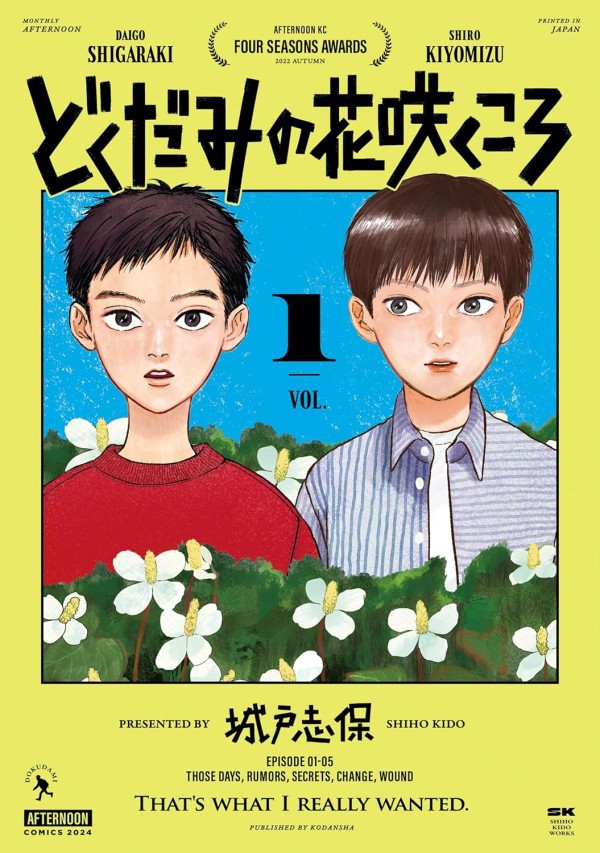
Fifth grader Daigo Shigaraki is an outcast in his class. He has a short temper, throws tantrums, and behaves in ways his classmates find unpredictable and frightening. Fifth grader Shiro Kiyomizu is the opposite: a model student who handles everything smoothly, avoids conflict, and maintains a flawless reputation. Privately, Kiyomizu finds his own carefully managed life tedious.
Everything shifts during an art class. Kiyomizu catches a glimpse of Shigaraki working on a clay sculpture and is stunned by its raw originality. He becomes quietly obsessed, observing Shigaraki from a distance. One day, Kiyomizu spots Shigaraki slipping into a vacant lot near his own home. After Shigaraki leaves, Kiyomizu investigates and finds a bizarre, strikingly imaginative grass doll left behind. The discovery overwhelms him. Soon after, the vacant lot is cleared and the grass dolls begin to disintegrate. In a manic state, Kiyomizu confronts Shigaraki and blurts out an offer to support his creative work in any way possible. Shigaraki, unsettled by Kiyomizu's intensity, nonetheless accepts. An uneasy and oddly compelling friendship begins to form.
The story follows the two boys as they navigate fifth-grade life. Kiyomizu appoints himself Shigaraki's manager, trying to shield him from classmates who misunderstand his behavior and to foster his creative output. Shigaraki, for his part, continues producing strange and captivating art while remaining difficult to predict. Their bond deepens through summer vacation, a return to school where Kiyomizu attempts to repair Shigaraki's reputation, and a two-night forest school trip that includes a workshop where Kiyomizu eagerly hopes to claim one of Shigaraki's handmade creations. Along the way, the manga introduces Shigaraki's complicated home life in a cramped apartment with his mother, aunt, and six cousins, as well as Kiyomizu's own family, including an older sister with art training. Their homeroom teacher observes their odd rapport through a class exchange diary, offering a quiet, amused perspective.
The narrative blends dry humor with genuine psychological insight. Kiyomizu's controlled exterior repeatedly cracks as his fixation on Shigaraki's art drives him to increasingly erratic behavior, while Shigaraki is portrayed not as a simple problem child but as a boy with a distinct and consistent way of experiencing the world. Their friendship is lopsided, edgy, and never quite comfortable, yet it proves resilient as both boys change in small but meaningful ways.
Everything shifts during an art class. Kiyomizu catches a glimpse of Shigaraki working on a clay sculpture and is stunned by its raw originality. He becomes quietly obsessed, observing Shigaraki from a distance. One day, Kiyomizu spots Shigaraki slipping into a vacant lot near his own home. After Shigaraki leaves, Kiyomizu investigates and finds a bizarre, strikingly imaginative grass doll left behind. The discovery overwhelms him. Soon after, the vacant lot is cleared and the grass dolls begin to disintegrate. In a manic state, Kiyomizu confronts Shigaraki and blurts out an offer to support his creative work in any way possible. Shigaraki, unsettled by Kiyomizu's intensity, nonetheless accepts. An uneasy and oddly compelling friendship begins to form.
The story follows the two boys as they navigate fifth-grade life. Kiyomizu appoints himself Shigaraki's manager, trying to shield him from classmates who misunderstand his behavior and to foster his creative output. Shigaraki, for his part, continues producing strange and captivating art while remaining difficult to predict. Their bond deepens through summer vacation, a return to school where Kiyomizu attempts to repair Shigaraki's reputation, and a two-night forest school trip that includes a workshop where Kiyomizu eagerly hopes to claim one of Shigaraki's handmade creations. Along the way, the manga introduces Shigaraki's complicated home life in a cramped apartment with his mother, aunt, and six cousins, as well as Kiyomizu's own family, including an older sister with art training. Their homeroom teacher observes their odd rapport through a class exchange diary, offering a quiet, amused perspective.
The narrative blends dry humor with genuine psychological insight. Kiyomizu's controlled exterior repeatedly cracks as his fixation on Shigaraki's art drives him to increasingly erratic behavior, while Shigaraki is portrayed not as a simple problem child but as a boy with a distinct and consistent way of experiencing the world. Their friendship is lopsided, edgy, and never quite comfortable, yet it proves resilient as both boys change in small but meaningful ways.
Comment(s)
Staff
- Story & ArtShiho Kido
Recommendations
Empfehlungen auf Basis gemeinsamer Kategorien.