Manga
Description
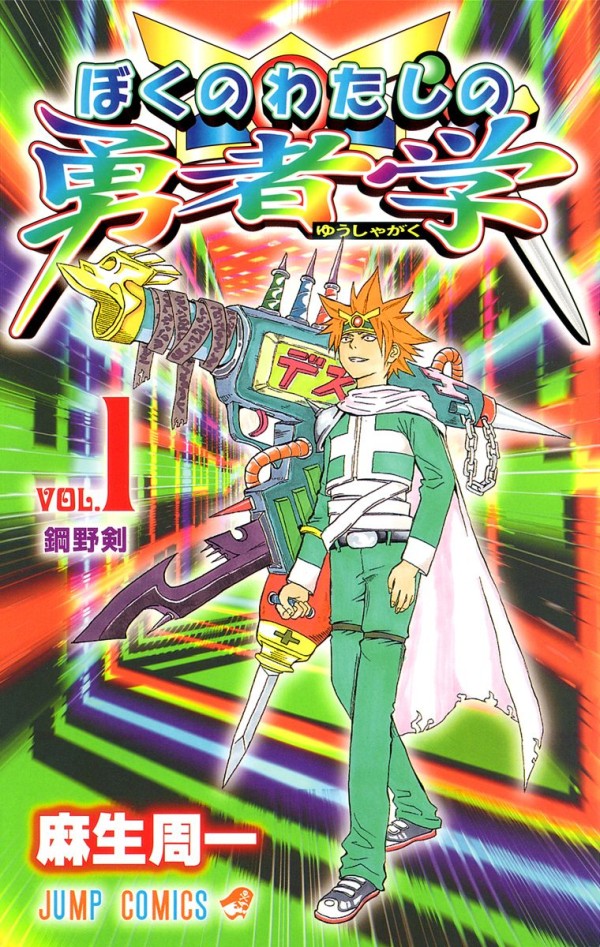
At Holy Lance Academy, the students of class 1-A are startled when their homeroom teacher suddenly quits after winning the summer lottery. In his place walks in a man dressed like a role‑playing‑game hero: spiky blond hair, a sword at his hip, and an unshakable belief that he is a genuine hero. This is Hagane no Ken, who announces he will teach a new subject called hero studies. His stated goal is to instill courage, kindness, and strength in his pupils, but his actual lessons consist of video quizzes, gag tests, and ridiculous stunts that leave the class in chaos.
The student who suffers the most is Kōno Tate, an ordinary boy with a dry sense of humor who becomes Hagane’s favorite target. Tate is constantly dragged into absurd situations, forced to act as the straight man to Hagane’s unpredictable antics. Another teacher, English instructor Ibaraki Muchiko, grows fiercely antagonistic toward Hagane and hatches schemes to drive him out of the school, sometimes crossing into stalkerish behavior.
When the game research club, led by the shrewd Nozomi Hinoki (often in a magician’s costume) and joined by the quiet ace Shinami Ichijō and the obnoxious otaku Ono Isami, asks Hagane to become their faculty advisor, he instead hijacks the club and restructures it as the Hero Club. He makes Tate the reluctant club president. The club’s activities are mostly gaming and adventuring, and it absorbs the former game‑research members along with the tough‑guy delinquent Masayuki Munemura, who develops an intense loyalty to Hagane despite being frequently ignored.
From that point, the story follows the Hero Club through daily school life, including rivalries with other teachers, popularity contests, and seasonal events. The plot is largely episodic, built around Hagane’s over‑the‑top teaching methods and the various weird personalities at the school. In the second year, the characters advance to class 2‑D, and new eccentric figures appear, such as the wise‑looking teacher Yarisaki Hideo, who teaches “sage studies” and is Hagane’s childhood friend.
The final arc takes a sudden turn: the school building burns down, and in the very next chapter the story leaps seventy years into the future, offering a glimpse of the elderly club members and an abrupt, surreal ending. Throughout the series, the narrative balances slapstick comedy with affectionate parody of fantasy‑game tropes, while Tate’s exasperated reactions anchor the wild cast.
The student who suffers the most is Kōno Tate, an ordinary boy with a dry sense of humor who becomes Hagane’s favorite target. Tate is constantly dragged into absurd situations, forced to act as the straight man to Hagane’s unpredictable antics. Another teacher, English instructor Ibaraki Muchiko, grows fiercely antagonistic toward Hagane and hatches schemes to drive him out of the school, sometimes crossing into stalkerish behavior.
When the game research club, led by the shrewd Nozomi Hinoki (often in a magician’s costume) and joined by the quiet ace Shinami Ichijō and the obnoxious otaku Ono Isami, asks Hagane to become their faculty advisor, he instead hijacks the club and restructures it as the Hero Club. He makes Tate the reluctant club president. The club’s activities are mostly gaming and adventuring, and it absorbs the former game‑research members along with the tough‑guy delinquent Masayuki Munemura, who develops an intense loyalty to Hagane despite being frequently ignored.
From that point, the story follows the Hero Club through daily school life, including rivalries with other teachers, popularity contests, and seasonal events. The plot is largely episodic, built around Hagane’s over‑the‑top teaching methods and the various weird personalities at the school. In the second year, the characters advance to class 2‑D, and new eccentric figures appear, such as the wise‑looking teacher Yarisaki Hideo, who teaches “sage studies” and is Hagane’s childhood friend.
The final arc takes a sudden turn: the school building burns down, and in the very next chapter the story leaps seventy years into the future, offering a glimpse of the elderly club members and an abrupt, surreal ending. Throughout the series, the narrative balances slapstick comedy with affectionate parody of fantasy‑game tropes, while Tate’s exasperated reactions anchor the wild cast.
Comment(s)
Staff
- Story & Art
Recommendations
Empfehlungen auf Basis gemeinsamer Kategorien.