Manga
Description
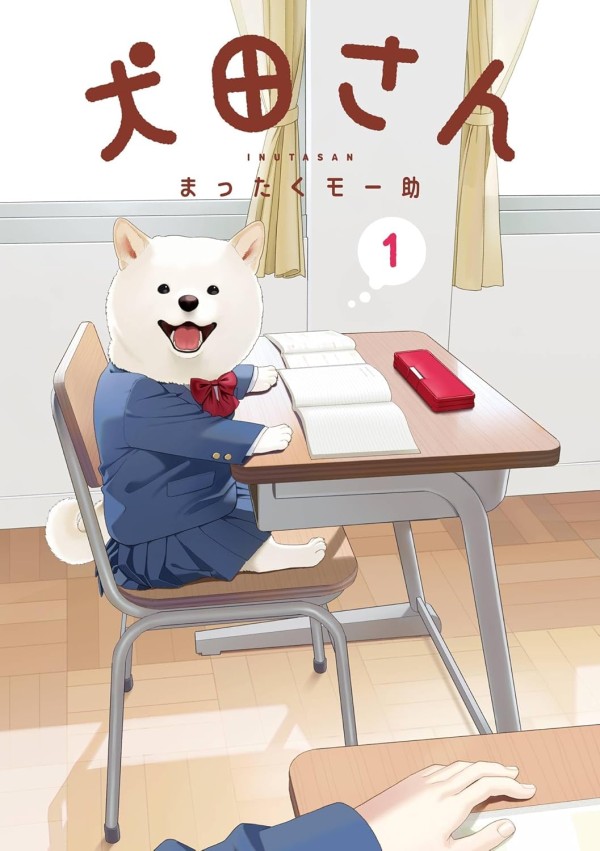
In a high school classroom, a boy named Inukai sits next to the most beautiful girl in his class—Inuta. The catch is that Inuta, despite her human appearance, behaves entirely like a dog. She greets him and her classmates with a cheerful bark-like hello, eats lunch with an eager wag, and accompanies him on walks to and from school. Her every action is pure canine: she loves being petted, gets excited by play tugs, and sometimes struggles with tasks that require fine motor skills, such as descending stairs. Inukai finds himself charmed by her innocent, puppy-like nature, alternating between treating her as a pet and as a regular girl. The story unfolds through their daily school life and its simple, heartwarming moments.
The setting is a typical Japanese high school, but one where anthropomorphic animals coexist with humans. Inuta is not the only such being: there is also Nekoyanagi, a sleek, catlike boy who is the most popular in class, and Saruta, a human boy who is initially skeptical of dogs attending school. Saruta owns a dog named Sasuke and feels a mix of jealousy and rivalry toward Inuta. Another classmate, Sarukami, is a girl with a serious demeanor who secretly adores Inuta and often struggles to control her excitement. The comedy arises from the contrast between human social norms and the characters’ animal instincts.
As the series progresses, the narrative expands beyond the classroom into seasonal events. Inuta and Inukai run into each other at a festival, celebrate Christmas together, and enjoy other annual festivities. Inuta’s family is introduced: her father works a corporate job and her mother is a typical housewife—both are also talking dogs who live like humans. Their presence adds to the charm and further blurs the line between pet and person. A parallel subplot involves Saruta and Nekoyanagi, as Saruta tries to compete with the cat’s effortless popularity. The story remains a lighthearted, episodic comedy centered on the adorable antics of Inuta and the affection she inspires in everyone around her.
The setting is a typical Japanese high school, but one where anthropomorphic animals coexist with humans. Inuta is not the only such being: there is also Nekoyanagi, a sleek, catlike boy who is the most popular in class, and Saruta, a human boy who is initially skeptical of dogs attending school. Saruta owns a dog named Sasuke and feels a mix of jealousy and rivalry toward Inuta. Another classmate, Sarukami, is a girl with a serious demeanor who secretly adores Inuta and often struggles to control her excitement. The comedy arises from the contrast between human social norms and the characters’ animal instincts.
As the series progresses, the narrative expands beyond the classroom into seasonal events. Inuta and Inukai run into each other at a festival, celebrate Christmas together, and enjoy other annual festivities. Inuta’s family is introduced: her father works a corporate job and her mother is a typical housewife—both are also talking dogs who live like humans. Their presence adds to the charm and further blurs the line between pet and person. A parallel subplot involves Saruta and Nekoyanagi, as Saruta tries to compete with the cat’s effortless popularity. The story remains a lighthearted, episodic comedy centered on the adorable antics of Inuta and the affection she inspires in everyone around her.
Comment(s)
Staff
- Story & Art
Recommendations
Empfehlungen auf Basis gemeinsamer Kategorien.