TV Special
Description
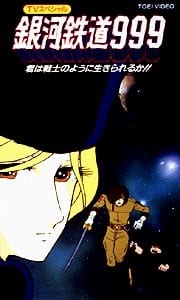
"Galaxy Express 999: Can You Live Like a Warrior?" is a 1979 anime film that serves as a sequel to the original "Galaxy Express 999" series. The story centers on Tetsuro Hoshino, a young boy traveling across the galaxy aboard the Galaxy Express 999, a space train that offers passengers the chance to obtain mechanical bodies and immortality. Tetsuro’s journey is driven by his desire to avenge his mother’s death at the hands of Count Mecha, a ruthless aristocrat who hunts humans for sport. Alongside Tetsuro is Maetel, a mysterious and enigmatic woman who guides him on his quest.
The film begins with Tetsuro and Maetel arriving on the planet Mosaic, a desolate world where humans and machines coexist in a fragile balance. The planet is ruled by a tyrannical leader named Faust, who enforces a brutal regime that pits humans against machines in gladiatorial combat. Tetsuro becomes entangled in the planet’s struggles when he encounters Faust’s daughter, Claire, who seeks to overthrow her father’s oppressive rule. Claire’s ideals clash with Faust’s vision of a mechanized utopia, leading to a conflict that forces Tetsuro to confront the moral complexities of immortality and the cost of abandoning humanity.
As the narrative unfolds, Tetsuro is drawn into a series of battles and philosophical dilemmas. He encounters warriors who have willingly sacrificed their humanity for power, as well as those who resist the allure of mechanization. The film explores themes of identity, freedom, and the consequences of technological advancement, as Tetsuro grapples with his own desires and the lessons he learns from those he meets. Maetel’s role as a guide becomes increasingly significant, as her own mysterious past and connection to the galaxy’s power structures are revealed.
The climax of the story sees Tetsuro and Claire leading a rebellion against Faust, culminating in a confrontation that challenges the very foundations of Mosaic’s society. The resolution of the film underscores the tension between humanity and mechanization, leaving Tetsuro to reflect on the choices he must make as he continues his journey aboard the Galaxy Express 999. The narrative maintains a focus on Tetsuro’s growth as a character, as well as the broader implications of the galaxy’s struggle for freedom and self-determination.
The film begins with Tetsuro and Maetel arriving on the planet Mosaic, a desolate world where humans and machines coexist in a fragile balance. The planet is ruled by a tyrannical leader named Faust, who enforces a brutal regime that pits humans against machines in gladiatorial combat. Tetsuro becomes entangled in the planet’s struggles when he encounters Faust’s daughter, Claire, who seeks to overthrow her father’s oppressive rule. Claire’s ideals clash with Faust’s vision of a mechanized utopia, leading to a conflict that forces Tetsuro to confront the moral complexities of immortality and the cost of abandoning humanity.
As the narrative unfolds, Tetsuro is drawn into a series of battles and philosophical dilemmas. He encounters warriors who have willingly sacrificed their humanity for power, as well as those who resist the allure of mechanization. The film explores themes of identity, freedom, and the consequences of technological advancement, as Tetsuro grapples with his own desires and the lessons he learns from those he meets. Maetel’s role as a guide becomes increasingly significant, as her own mysterious past and connection to the galaxy’s power structures are revealed.
The climax of the story sees Tetsuro and Claire leading a rebellion against Faust, culminating in a confrontation that challenges the very foundations of Mosaic’s society. The resolution of the film underscores the tension between humanity and mechanization, leaving Tetsuro to reflect on the choices he must make as he continues his journey aboard the Galaxy Express 999. The narrative maintains a focus on Tetsuro’s growth as a character, as well as the broader implications of the galaxy’s struggle for freedom and self-determination.
Cast
- Tetsurō Hoshino
- Narration
- Andrea Cotto
- Dr. BanNarciso Busquets
Comment(s)
Staff
- Chief DirectorNobutaka Nishizawa
- Screenplay
- Original creator
- Chief Animation DirectorShigeru Kogawa
- DirectorShuji IuchiMasayuki Akehi
- MusicNozomi Aoki
- Art DirectorHidetoshi KanekoGeki Katsumata
- Animation DirectorYoshinori KanemoriMasamune OchiaiMasayuki Uchiyama
Production
- Animation ProductionToei Animation
- ProductionFuji Television Network
Relations
Recommendations based on shared tags.