TV-Series
Description
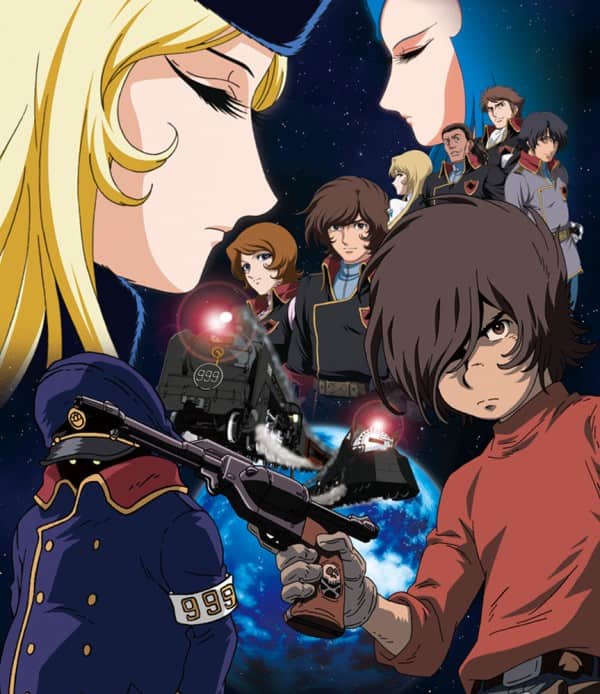
"Ginga Tetsudo Monogatari: Eien e no Bunkiten" is a science fiction anime set in a distant future where humanity has colonized the stars. The narrative centers on a grand interstellar railway system known as the Galactic Railroad, which connects various planets and civilizations across the galaxy. The story unfolds through the journey of a young boy named Giovanni, who embarks on a mysterious and philosophical train ride aboard the Galactic Railroad. Accompanied by his friend Campanella, Giovanni travels through surreal and symbolic landscapes, encountering a series of enigmatic passengers and witnessing extraordinary phenomena.
The train itself serves as a metaphor for life, death, and the passage of time, with each stop representing a different stage or aspect of existence. The journey is deeply introspective, exploring themes of mortality, the afterlife, and the search for meaning. Giovanni and Campanella’s interactions with other passengers, including a grieving mother, a soldier, and a scientist, reveal profound insights into human nature and the universe. The narrative is heavily influenced by the original 1906 novel "Night on the Galactic Railroad" by Kenji Miyazawa, blending poetic imagery with philosophical undertones.
As the train progresses, Giovanni begins to grapple with his own emotions and unresolved feelings, particularly regarding his absent father and the loss of his mother. The story’s climax reveals the true nature of the Galactic Railroad and its connection to the afterlife, culminating in a poignant and bittersweet resolution. The anime maintains a contemplative tone throughout, emphasizing the transient beauty of life and the interconnectedness of all beings. The characters, while not deeply developed in a traditional sense, serve as archetypes that contribute to the series’ overarching themes of existential reflection and cosmic unity.
The train itself serves as a metaphor for life, death, and the passage of time, with each stop representing a different stage or aspect of existence. The journey is deeply introspective, exploring themes of mortality, the afterlife, and the search for meaning. Giovanni and Campanella’s interactions with other passengers, including a grieving mother, a soldier, and a scientist, reveal profound insights into human nature and the universe. The narrative is heavily influenced by the original 1906 novel "Night on the Galactic Railroad" by Kenji Miyazawa, blending poetic imagery with philosophical undertones.
As the train progresses, Giovanni begins to grapple with his own emotions and unresolved feelings, particularly regarding his absent father and the loss of his mother. The story’s climax reveals the true nature of the Galactic Railroad and its connection to the afterlife, culminating in a poignant and bittersweet resolution. The anime maintains a contemplative tone throughout, emphasizing the transient beauty of life and the interconnectedness of all beings. The characters, while not deeply developed in a traditional sense, serve as archetypes that contribute to the series’ overarching themes of existential reflection and cosmic unity.
Episodes
Staffel 1
1New Departure
2The Interval of Composure and Recklessness
3The Flower Which Blooms in Space
4Stardust Blues
5Within the Depths of Hell
6Graduation
7Blue Rose
8Duty For Only Two Persons
9The Way Which Continues to Tomorrow
10The Buried Future
11For The Sake of One's Pride
12Wings of the Spirit
13SDF, Absolute Death (Part I)
14SDF, Absolute Death (Part II)
15Moment of Happiness
16The Uninvited Drifter
17Departure to the Unknown
18The Successor to the Spear
19Misty Reminiscence
20The End of the Journey
21Reunion
22The Labyrinth Named Fate
23Beyond the Storm
24The Far-Off Oath
Cast
Comment(s)
Staff
- DirectorTsuneo Tominaga
- ScriptYasunori YamadaMasashi SuzukiNahoko HasegawaKazuki Yamanobe
- Episode DirectorToshikatsu Tokoro
- Original creator
- Chief Animation DirectorYuji Ushijima
- Executive producerYasutomo Yanagida
- Series CompositionYasunori Yamada
- StoryboardToshikatsu Tokoro
- MusicNozomi Aoki
- Character Design
- Sound Director
- ProducerYoshihiro Iwasa
Production
- Animation ProductionPlanet
- ProductionChubu-Nippon Broadcasting Co., Ltd.
Relations