TV-Series
Description
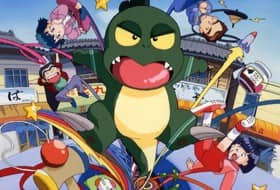
"Mukamuka Paradise" is a comedic anime series that revolves around the daily lives of a group of anthropomorphic animals living in a whimsical, self-contained world. The narrative primarily focuses on the interactions and misadventures of the main characters, who are depicted as animals with human-like traits and behaviors. The central figure is a bear named Kumakichi, who is often portrayed as naive and good-natured but prone to getting into trouble due to his lack of awareness. His best friend, a fox named Konkichi, is more cunning and street-smart, frequently devising schemes that lead to humorous outcomes, though they often backfire.
The series is episodic, with each episode presenting a self-contained story that explores various comedic situations. These situations often arise from the characters' attempts to solve everyday problems or achieve personal goals, which are typically exaggerated for comedic effect. For instance, Kumakichi might attempt to find food or shelter, only to be thwarted by his own clumsiness or the interference of other characters. Konkichi, on the other hand, might try to outsmart others for personal gain, only to find himself in increasingly absurd predicaments.
Other notable characters include a rabbit named Usako, who is often the voice of reason but can be easily swayed by emotions, and a wolf named Ookami, who is portrayed as a tough and intimidating figure but has a soft side that occasionally surfaces. The dynamics between these characters drive much of the humor, as their contrasting personalities and motivations lead to frequent misunderstandings and conflicts.
The setting of "Mukamuka Paradise" is a vibrant, cartoonish world filled with exaggerated landscapes and fantastical elements, which serve as a backdrop for the characters' antics. The series does not delve deeply into overarching plotlines or character development, instead focusing on delivering lighthearted, slapstick comedy. The humor is often derived from physical comedy, wordplay, and the absurdity of the situations the characters find themselves in.
Overall, "Mukamuka Paradise" is a straightforward, episodic comedy that relies on the interactions of its anthropomorphic animal characters to create a series of humorous vignettes. The lack of a continuous narrative allows for easy viewing, with each episode offering a fresh set of comedic scenarios. The series is characterized by its playful tone, exaggerated character traits, and a focus on humor over plot complexity.
The series is episodic, with each episode presenting a self-contained story that explores various comedic situations. These situations often arise from the characters' attempts to solve everyday problems or achieve personal goals, which are typically exaggerated for comedic effect. For instance, Kumakichi might attempt to find food or shelter, only to be thwarted by his own clumsiness or the interference of other characters. Konkichi, on the other hand, might try to outsmart others for personal gain, only to find himself in increasingly absurd predicaments.
Other notable characters include a rabbit named Usako, who is often the voice of reason but can be easily swayed by emotions, and a wolf named Ookami, who is portrayed as a tough and intimidating figure but has a soft side that occasionally surfaces. The dynamics between these characters drive much of the humor, as their contrasting personalities and motivations lead to frequent misunderstandings and conflicts.
The setting of "Mukamuka Paradise" is a vibrant, cartoonish world filled with exaggerated landscapes and fantastical elements, which serve as a backdrop for the characters' antics. The series does not delve deeply into overarching plotlines or character development, instead focusing on delivering lighthearted, slapstick comedy. The humor is often derived from physical comedy, wordplay, and the absurdity of the situations the characters find themselves in.
Overall, "Mukamuka Paradise" is a straightforward, episodic comedy that relies on the interactions of its anthropomorphic animal characters to create a series of humorous vignettes. The lack of a continuous narrative allows for easy viewing, with each episode offering a fresh set of comedic scenarios. The series is characterized by its playful tone, exaggerated character traits, and a focus on humor over plot complexity.
Cast
- Yozu ShikataniEnric Cusí
- YonoXavier Fernández
- HashinosukeOriol de Balle
- Gemma Ibáñez
- Enric Cusí
- Marta Ullod
- Soko ShikataniLourdes López
- Tachiaki Shiberia
- TakakiEnrique Serra Frediani
Comment(s)
Staff
- DirectorKatsuyoshi Yatabe
- StoryboardHiroshi NishikioriKatsuyoshi YatabeKunihisa SugishimaTakayoshi SuzukiTatsuya HirakawaWaruo SuzukiTakeshi UshigusaNakawa UraFūta Morita
- MusicNobuyuki Nakamura
- Character DesignMasayuki Hiraoka
- Animation DirectorHirokazu IshinoMasayuki HiraokaKenichi ImaizumiNoriyoshi YamazakiSeiichi NodateHiromi Katō
- Director of PhotographyKazushi Torigoe
- ProducerYasuo KameyamaYuko SagawaNobuaki TanakaToshihide Kanno
- ScreenplayKatsuyoshi YatabeMiho MaruoYasushi HiranoMie HiranoMayumi KoyamaFumiko ShibaYukiyoshi Ōhashi
- Episode Director
- Original MangaFumiko Shiba
- Art DirectorSatoshi Suzuki
- Sound DirectorHiroyuki Hayase
- Executive producerKōichi Motohashi
- Art designKōichi Kudō
Production
- ProductionMainichi Broadcasting SystemNippon AnimationAsatsu
- Animation ProductionNippon Animation
Relations
Recommendations based on shared tags.