
Movie
Description
"Fables from Hans Christian Andersen" is an anime series that adapts several classic fairy tales written by Hans Christian Andersen, presenting them in an episodic format. Each episode retells a distinct story, preserving the original narratives while incorporating visual and stylistic elements unique to the anime medium. The series captures the timeless themes of Andersen's works, including love, loss, transformation, and morality, often imbued with a sense of melancholy and wonder.
The series begins with "The Little Mermaid," a tale of a young mermaid who sacrifices her voice to gain human legs in pursuit of love and an immortal soul. Her journey is marked by both hope and heartbreak as she navigates the complexities of human emotions and the consequences of her choices. Another notable episode features "The Snow Queen," a story of friendship and resilience, where a young girl named Gerda embarks on a perilous quest to rescue her friend Kay from the clutches of the icy Snow Queen. The narrative explores themes of innocence, loyalty, and the power of love to overcome darkness.
"The Ugly Duckling" is also adapted, focusing on a young bird ostracized for its appearance, only to later discover its true identity as a beautiful swan. This story emphasizes self-discovery and the transformative power of acceptance. Similarly, "The Emperor's New Clothes" is a satirical tale about vanity and deception, where an emperor is tricked into believing he is wearing magnificent garments, only to be revealed as naked in a public procession. The story critiques societal pretensions and the fear of truth.
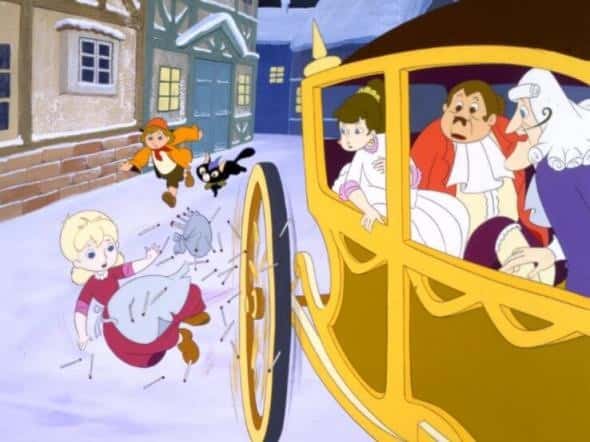
Other episodes include "Thumbelina," the story of a tiny girl born from a flower who faces numerous challenges while searching for her place in the world, and "The Steadfast Tin Soldier," a poignant tale of unrequited love between a one-legged tin soldier and a paper ballerina. Each story is presented with a focus on its moral and emotional core, often highlighting the struggles and triumphs of its characters.
The series maintains a faithful adherence to Andersen's original works, with minimal alterations to the source material. The characters are depicted with a blend of traditional and anime-inspired designs, enhancing their emotional expressiveness while staying true to their literary origins. The episodic structure allows each story to stand independently, making the series accessible to viewers unfamiliar with Andersen's tales while offering a nostalgic experience for those who are. Through its adaptation of these timeless fables, the series serves as a tribute to Andersen's enduring legacy in the realm of storytelling.
The series begins with "The Little Mermaid," a tale of a young mermaid who sacrifices her voice to gain human legs in pursuit of love and an immortal soul. Her journey is marked by both hope and heartbreak as she navigates the complexities of human emotions and the consequences of her choices. Another notable episode features "The Snow Queen," a story of friendship and resilience, where a young girl named Gerda embarks on a perilous quest to rescue her friend Kay from the clutches of the icy Snow Queen. The narrative explores themes of innocence, loyalty, and the power of love to overcome darkness.
"The Ugly Duckling" is also adapted, focusing on a young bird ostracized for its appearance, only to later discover its true identity as a beautiful swan. This story emphasizes self-discovery and the transformative power of acceptance. Similarly, "The Emperor's New Clothes" is a satirical tale about vanity and deception, where an emperor is tricked into believing he is wearing magnificent garments, only to be revealed as naked in a public procession. The story critiques societal pretensions and the fear of truth.
Other episodes include "Thumbelina," the story of a tiny girl born from a flower who faces numerous challenges while searching for her place in the world, and "The Steadfast Tin Soldier," a poignant tale of unrequited love between a one-legged tin soldier and a paper ballerina. Each story is presented with a focus on its moral and emotional core, often highlighting the struggles and triumphs of its characters.
The series maintains a faithful adherence to Andersen's original works, with minimal alterations to the source material. The characters are depicted with a blend of traditional and anime-inspired designs, enhancing their emotional expressiveness while staying true to their literary origins. The episodic structure allows each story to stand independently, making the series accessible to viewers unfamiliar with Andersen's tales while offering a nostalgic experience for those who are. Through its adaptation of these timeless fables, the series serves as a tribute to Andersen's enduring legacy in the realm of storytelling.
Cast
- Hannibal
- Hans Christian Andersen
- Claudi García
- Tadao Takashima
Comment(s)
Staff
- DirectorKimio Yabuki
- Original story
- Animation Director
- MusicSeiichirō Uno
- ScriptHisashi InoueMorihisa Yamamoto
- Art DirectorReiji Koyama
- Executive producerHiroshi Ōkawa
Production
- ProductionToei Animation