TV-Series
Description
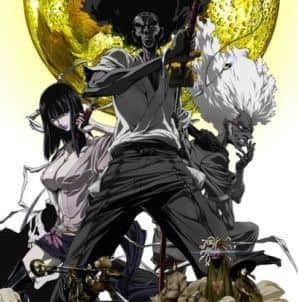
"Afro Samurai" is set in a futuristic, feudal-inspired world where the hierarchy of power is determined by mystical headbands. The Number One headband grants its wearer godlike powers and absolute authority, while the Number Two headband allows its bearer the sole right to challenge the Number One. The story centers on Afro, a stoic and highly skilled swordsman who seeks vengeance for the murder of his father, a former Number One headband holder. The antagonist, a gunslinger named Justice, killed Afro's father to claim the Number One headband, leaving Afro with the Number Two and a lifelong mission to avenge his father's death.
The narrative unfolds as Afro embarks on a perilous journey, facing numerous adversaries and challenges. Along the way, he is accompanied by a talkative, eccentric companion named Ninja Ninja, who serves as both comic relief and a manifestation of Afro's inner thoughts and struggles. The journey is marked by intense battles, philosophical undertones, and a deep exploration of themes such as revenge, identity, and the cyclical nature of violence. Afro's path is fraught with moral ambiguity, as his quest for vengeance often leads to collateral damage and personal loss.
Key characters include Okiku, a young girl who becomes entangled in Afro's journey and serves as a reminder of his humanity, and Kuma, a mysterious figure with a personal vendetta against Afro. The series also delves into Afro's past, revealing his training under a wise mentor and the emotional scars left by his father's death. The climactic confrontation between Afro and Justice is a central focus, culminating in a battle that tests Afro's resolve and forces him to confront the consequences of his actions.
The story is characterized by its blend of traditional samurai elements with futuristic technology and a hip-hop-inspired aesthetic. The narrative is driven by Afro's internal conflict and the external challenges he faces, creating a compelling exploration of the cost of vengeance and the search for meaning in a violent world.
The narrative unfolds as Afro embarks on a perilous journey, facing numerous adversaries and challenges. Along the way, he is accompanied by a talkative, eccentric companion named Ninja Ninja, who serves as both comic relief and a manifestation of Afro's inner thoughts and struggles. The journey is marked by intense battles, philosophical undertones, and a deep exploration of themes such as revenge, identity, and the cyclical nature of violence. Afro's path is fraught with moral ambiguity, as his quest for vengeance often leads to collateral damage and personal loss.
Key characters include Okiku, a young girl who becomes entangled in Afro's journey and serves as a reminder of his humanity, and Kuma, a mysterious figure with a personal vendetta against Afro. The series also delves into Afro's past, revealing his training under a wise mentor and the emotional scars left by his father's death. The climactic confrontation between Afro and Justice is a central focus, culminating in a battle that tests Afro's resolve and forces him to confront the consequences of his actions.
The story is characterized by its blend of traditional samurai elements with futuristic technology and a hip-hop-inspired aesthetic. The narrative is driven by Afro's internal conflict and the external challenges he faces, creating a compelling exploration of the cost of vengeance and the search for meaning in a violent world.
Episodes
Staffel 1
1Revenge
The episode opens with a young Afro witnessing the murder of his father, the holder of the Number One headband, at the hands of a gunslinger named Justice. Justice claims the Number One headband, while the young Afro inherits the Number Two headband, a position that can be challenged by anyone but allows its wearer to challenge the Number One. In the present, an adult Afro Samurai, accompanied by the talkative Ninja Ninja, journeys on his path of vengeance against Justice. He arrives at a village and enters a bar, where he is recognized by the locals who discuss the lore of the headbands with the bartender. After quietly ordering lemonade, Afro is confronted and attacked by a group of men, whom he dispatches with swift and brutal efficiency before leaving the village. His journey is then interrupted by a fighter using a mechanized crossbow, who manages to graze Afro with a poisoned arrow before being killed. While Afro believes the threat is neutralized, a separate, technologically equipped observer, part of a larger syndicate, monitors his condition from a distance. As a weakened Afro continues forward, this observer launches a rocket-propelled grenade at him. Afro manages to slice the explosive in mid-air, but the resulting blast on the cliffside path leads to his collapse and apparent fall, ending the episode on a cliffhanger. The core conflict establishes Afro's relentless pursuit of revenge, which drives him forward and makes him a target for all who covet his headband. The immediate consequence of his journey is his current life-or-death struggle, leaving his fate uncertain.
2The Dream Reader
The episode opens with Afro drifting in and out of consciousness after being blown from a cliff, his body broken and poisoned. He is discovered and cared for by a woman named Okiku, who tends to his wounds in a secluded home. As he lies incapacitated, the narrative delves into extended flashbacks of his past. These visions depict a young Afro being robbed of his father's head by brigands and later being taken in by a sword master, where he trains alongside other orphans, including a young girl named Otsuru. The present-day Okiku is revealed to be this same childhood acquaintance, now grown. Okiku possesses the ability to extract and read memories from a person's dreams, a task she performs on Afro at the behest of the Empty Seven Clan, who seek to replicate his fighting style. Throughout his recovery, Afro remains largely silent and detached, his sole interaction being with his persistent companion, Ninja Ninja. The episode builds toward a turning point where Okiku, tasked with killing Afro, instead shares an intimate moment with him, revealing her true identity as Otsuru. Her confession and her inability to complete her mission lead directly to her death; she is executed by Brother 2 of the Empty Seven for her betrayal. The episode concludes with Afro, now healed, standing over the smoldering ruins of her home, a consequence of the attack, before silently continuing his path of vengeance, accompanied once more by Ninja Ninja. This sequence of events reinforces Afro's isolation, as the last vestiges of his personal history are systematically erased, and clarifies the Empty Seven's intent to use any means necessary to stop him.
3The Empty Seven Clan
Following his recovery, Afro Samurai, accompanied by Ninja Ninja, resumes his journey toward Mount Shumi, the location of Justice, the number-one headband holder. The Empty Seven, a fanatical clan of cultists obsessed with acquiring the number-two headband, becomes aware of Afro's approach through intelligence provided by Okiku. Okiku's information enables the clan to prepare a new and formidable weapon specifically designed to eliminate Afro. As Afro begins his ascent of Mount Shumi, the Empty Seven clan moves to intercept him, positioning themselves as the immediate obstacle on his path. The clan's primary tactic involves deploying their ultimate creation: an android constructed to be an exact physical duplicate of Afro, complete with his fighting prowess. This confrontation forces Afro to face an opponent who mirrors his own skills and appearance, presenting a unique and personal challenge. The Empty Seven's motivation stems from a singular desire to claim the power associated with the number-two headband, viewing Afro solely as a means to that end. Afro's relentless motivation for revenge against Justice drives him forward, compelling him to confront this new enemy directly. The episode establishes the immediate consequence of Afro's public quest: his position as number two makes him a constant target for those seeking to elevate their own status, such as the Empty Seven clan. The introduction of the Afro Droid creates a critical turning point, testing whether Afro can overcome an enemy that is, in essence, himself.
4Duel
Afro reaches the snowy peak of Mt. Shumi, the site of his father's murder, and is immediately confronted by a new opponent: Kuma, a samurai wearing a distinctive teddy bear-shaped helmet. Kuma wields a two-sword technique that proves exceptionally difficult for Afro to penetrate, creating a stalemate between the two combatants. During their fierce battle, it becomes evident that Kuma possesses intimate knowledge of Afro's past, a mystery that drives the conflict beyond a simple physical confrontation. The fight triggers a series of flashbacks for Afro, revealing that Kuma is actually Jinno, his childhood friend from Sword Master's dojo. The narrative returns to the past, depicting the massacre at the dojo where Afro and Jinno lost their friend Sasuke to assassins seeking the Number Two Headband. Following this tragedy, Jinno chose to bury his memories and identity, adopting the Kuma persona, while Afro continued on his path of vengeance. This shared history and their divergent responses to trauma form the core conflict of the duel, as Kuma forces Afro to confront the consequences of choosing vengeance over familial bonds. A critical turning point occurs when Kuma lands a strike that seemingly kills Ninja Ninja, Afro's constant companion, who is revealed to be an imaginary manifestation of Afro's lost friendships and humanity. With Ninja Ninja's death, Afro symbolically sheds the last vestiges of his attachments and fully accepts his solitary path. The episode concludes with Afro mortally wounding Kuma, who dies after acknowledging their past connection. Afro then resumes his ascent up the mountain, leaving his friend behind and moving one step closer to his final confrontation with Justice.
5Justice
Following the emotional conclusion of his battle with Kuma, Afro ascends the final path to confront the man who murdered his father. He enters an eerie, otherworldly throne room where the reclusive gunfighter Justice awaits, having anticipated this confrontation for years. Justice, the holder of the Number One headband, immediately demonstrates the vast gap in their abilities by crippling Afro with a few well-placed bullets. Rather than delivering a finishing blow, Justice takes his time to explain his reasons for killing Afro's father and the nature of the power he holds. The gunfighter elaborates on why Afro's quest for vengeance will ultimately fail against his superior skills. Afro's motivation remains singularly focused on avenging his father's death, driving him to continue fighting despite his severe injuries. Justice, in contrast, fights not merely for survival but to maintain his position as Number One and the supreme power it confers. The episode establishes the philosophical conflict between Afro's personal vendetta and Justice's detached pursuit of godlike status. As the vicious battle unfolds, the narrative makes clear that only one will survive to stand above the dead as Number One. The confrontation represents the culmination of Afro's lifelong journey, with the outcome carrying the weight of his father's death and his own years of relentless training.
Cast
Comment(s)
Staff
- DirectorTakeshi KoikeFuminori Kizaki
- ScreenplayYasuyuki Mutō
- Episode DirectorFuminori KizakiYukio NishimotoYasuhiro Geshi
- Character DesignTakeshi KoikeHiroya Iijima
- Animation DirectorMichinori ChibaHiroya Iijima
- Executive producerChihiro Kameyama
- ScriptTomohiro Yamashita
- StoryboardTakeshi KoikeFuminori KizakiYukio NishimotoKen ŌtsukaChris Prynoski
- Original Manga
- Art DirectorShigemi Ikeda
- Sound DirectorYōta Tsuruoka
- ProducerKoji KajitaTaito OkiuraArthur Smith
Production
- ProductionPony CanyonFuji Television NetworkGONZODentsu Inc.Victor EntertainmentTornado FilmParamount NetworkSpike TVSamurai Project
- Animation ProductionGONZO