TV-Series
Description
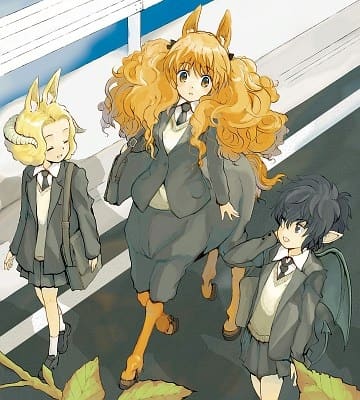
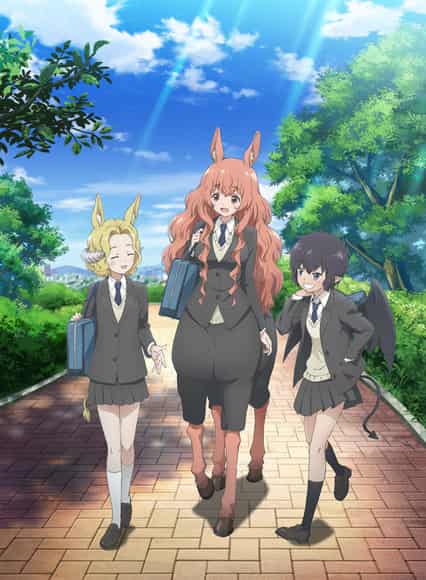
"A Centaur's Life" is set in a world where humans coexist with various humanoid species, including centaurs, angels, demons, and merfolk. The narrative primarily revolves around Himeno Kimihara, a centaur girl navigating the challenges of high school life. The series explores everyday experiences, relationships, and societal norms in a world where interspecies interactions are commonplace. Himeno’s close friends include Nozomi Gokuraku, a demon girl, and Kyoko Naraku, an angel, each representing different species and cultural backgrounds. Together, they tackle typical adolescent issues such as friendship, identity, and societal expectations, but with the added complexity of their unique physical and cultural traits.
The story delves into the intricacies of this alternate society, where historical and political dynamics have shaped interspecies relations. For instance, centaurs face specific regulations, such as wearing specialized clothing to accommodate their equine lower bodies, while demons and angels navigate their own societal stigmas and traditions. The series often highlights the parallels between this fictional world and real-world issues, such as discrimination, cultural assimilation, and the struggle for equality. However, these themes are presented through a lighthearted and slice-of-life lens, focusing on the characters’ personal growth and interactions rather than heavy-handed moralizing.
Himeno’s family plays a significant role in the narrative, providing insight into centaur culture and family dynamics. Her younger sister, Kinu, and her parents offer a grounded perspective on the challenges and joys of living in a diverse society. The series also introduces other classmates and species, such as the mermaid Manami and the dragon girl Shino, further enriching the world-building and exploring the nuances of interspecies relationships.
While the plot is largely episodic, it occasionally delves into deeper lore, such as the history of species segregation and the scientific explanations for the existence of these humanoid beings. These elements add depth to the setting without overshadowing the slice-of-life focus. The series balances humor, heartwarming moments, and occasional social commentary, creating a narrative that is both entertaining and thought-provoking. Through its exploration of a fantastical yet relatable world, "A Centaur's Life" offers a unique perspective on diversity, coexistence, and the universal experiences of growing up.
The story delves into the intricacies of this alternate society, where historical and political dynamics have shaped interspecies relations. For instance, centaurs face specific regulations, such as wearing specialized clothing to accommodate their equine lower bodies, while demons and angels navigate their own societal stigmas and traditions. The series often highlights the parallels between this fictional world and real-world issues, such as discrimination, cultural assimilation, and the struggle for equality. However, these themes are presented through a lighthearted and slice-of-life lens, focusing on the characters’ personal growth and interactions rather than heavy-handed moralizing.
Himeno’s family plays a significant role in the narrative, providing insight into centaur culture and family dynamics. Her younger sister, Kinu, and her parents offer a grounded perspective on the challenges and joys of living in a diverse society. The series also introduces other classmates and species, such as the mermaid Manami and the dragon girl Shino, further enriching the world-building and exploring the nuances of interspecies relationships.
While the plot is largely episodic, it occasionally delves into deeper lore, such as the history of species segregation and the scientific explanations for the existence of these humanoid beings. These elements add depth to the setting without overshadowing the slice-of-life focus. The series balances humor, heartwarming moments, and occasional social commentary, creating a narrative that is both entertaining and thought-provoking. Through its exploration of a fantastical yet relatable world, "A Centaur's Life" offers a unique perspective on diversity, coexistence, and the universal experiences of growing up.
Episodes
Staffel 1
1A Centaur's Life
The episode presents two distinct narrative segments following the daily life of centaur high school student Himeno Kimihara and her classmates in a world populated by various mythological beings. The first half focuses on Himeno's class preparing for a cultural festival play, in which she is cast as the princess. A male student, originally hoping to play the prince, alters the script to include a kissing scene, leading Himeno to inadvertently kiss her draconid friend Nozomi during rehearsal. The student council president subsequently intervenes, prohibiting the two from kissing on the grounds that such an act between girls is "weird," which introduces a layer of societal discomfort regarding their relationship. The segment concludes with the play's performance, where the staged kiss is modified to the cheek, receiving approval from the audience. The second half shifts to a classroom setting where a teacher delivers a lecture on the evolutionary history of the world's subspecies and the historical atrocities committed through discrimination. This history lesson establishes that laws now strictly enforce equality between all races, with prejudice being a punishable offense, and that concepts like civil rights are subordinate to the principle of equality itself. The episode then transitions to a school marathon, where Himeno offers to carry her satyr friend Kyoko, who is struggling to keep pace. Kyoko refuses, explaining that due to historical oppression where centaurs were used as slave mounts, modern laws prohibit her from riding Himeno to avoid any appearance of discrimination, an act that would result in being sent to a "correctional clinic". This consequence highlights the tension between well-intentioned laws and simple acts of friendship. Himeno completes the race but is later shown to have developed blisters from running in shoes not designed for her equine anatomy, a practical outcome of her species' physical characteristics.
2Beauty Is a Double-Edged Sword/Water People Living in Water and Mountain People Living in Mountains Really Are Just That
The episode presents two primary narrative segments connected by the daily lives of the characters. The first plot thread is initiated when Nozomi discovers that Himeno has been modeling for a fashion magazine without her friends' knowledge. This revelation prompts classmates Mitsuyo Akechi and her girlfriend Inukai to intervene. They suggest that Himeno's part-time job could potentially lead to her expulsion, creating a clear conflict and motivating them to involve Nozomi in trying on various outfits as a form of participation in the fashion world. The scenario explores the characters' reactions to the discovery of a friend's secret activity and the potential social and institutional consequences that could arise from it. The immediate consequence of the conflict is that Nozomi is drawn into a new experience with fashion, guided by Mitsuyo and Inukai's initiative. The episode's second half shifts focus to a broader, environmental theme. As colder weather arrives, the narrative examines how students of different races, such as those adapted to water or mountain life, experience the changing seasons differently. The characters engage in discussions that lead to a recollection of a prior visit to the 14th Meervolk Oceanian High School, a field trip to a community of water-dwelling people. This portion of the episode contrasts the personal, social conflict of the first half with a more observational look at the physiological and cultural diversity within their world. The turning point in this segment is the shift in conversation toward these inherent racial differences, prompted by the shared experience of the cold. The episode resolves its social plotline not with a definitive end to the modeling issue, but with a tangible outcome: Nozomi's active participation in trying on different fashions. This action serves to integrate her into the situation that was initially a source of concern, moving the focus from the secret itself to a shared group activity. Throughout both segments, character motivations are driven by friendship, curiosity, and the practical need to navigate a world populated by diverse mythological beings.
3Où les plus petits trouvent-ils autant de vitalité ? / Quelle que soit la génération, les filles magiques sont populaires, hein ?
Himeno spends time with her young cousin Shino, and their outing leads to an encounter with student council president Manami Mitama and her three younger triplet sisters, Chiho, Chinami, and Chigusa. This meeting introduces the central plot thread of the episode, shifting focus to Manami's responsibilities at home. With their parents frequently absent, Manami acts as the primary caretaker for her four younger sisters, a duty that consumes her time and contributes to her isolated demeanor at school. The narrative then follows Manami as she must attend to school business, leaving the sisters at home with permission to invite friends over. The group, including Himeno and Shino, gathers to play at a local shrine. A conflict arises concerning the youngest sister, Sue, who possesses a genetic condition that limits her stamina and physical resilience, making her unable to keep up with the older children's activities. This situation underscores the practical challenges and emotional strain of Manami's caregiving role. Concurrently, a subplot involving the couple Mitsuyo and Inukai provides a moment of social commentary. When the two women share a kiss in front of the children, Manami objects to the public display of affection. Mitsuyo challenges this reaction, advocating for the normalization of their relationship irrespective of gender, which presents a perspective on societal acceptance of same-sex couples. The episode uses these parallel storylines to explore themes of familial duty, individual limitations, and unspoken social rules, contrasting the carefree energy of youth with the burdens shouldered by Manami as a result of her family's circumstances.
4Rabu Reta o Moratte Konwakusuru... Sono Kokoro wa?/Yufo, Yuma no Tagui o Shinjiru ka Shinjinai ka de, Taipu ga Wakareru yo ne.
On her way to school, Himeno is handed a love letter by a boy from another school, an event that triggers a panicked flight rather than joy. Her reaction stems from a deeply rooted complex about her body; she confides in her friends Nozomi and Kyouko that she is worried about how her equine lower half would appear to a potential partner. To alleviate her anxiety and demonstrate that her physique is normal, Nozomi and Kyouko propose that the three of them examine each other's bodies. This candid, private conversation among the girls provides Himeno with the reassurance she needs to overcome her immediate fears. Empowered by this newfound confidence, she decides to accept the boy's feelings and arranges to meet him. The resolution of this conflict takes an ironic turn when the boy confesses that his interest was solely in her upper body, specifically her large bust, leaving the initial love letter's sentiment hollow. Following this personal episode, the narrative shifts to a study session where Nozomi, preparing for make-up exams, becomes convinced she spots a UFO outside the window. Her claims are met with skepticism from Himeno and Kyouko, highlighting a difference in their worldviews regarding the existence of unidentified phenomena. This lighthearted debate is abruptly overshadowed the next day when the girls arrive at school to find it cordoned off by state security agencies. The area is swarming with agents, and the school is inaccessible, creating an atmosphere of tension and unanswered questions. This lockdown serves as a direct and immediate consequence of the earlier, seemingly trivial UFO discussion, grounding the episode's supernatural elements in a concrete, geopolitical conflict. The episode concludes with the introduction of a new transfer student to Himeno's class: Quetzalcoatl Sassassul, an Antarctican girl whose arrival is likely connected to the morning's mysterious events.
5Antarcticans Are Like Walking Rumors / But in the End, the Antarcticans' History and Roots Are a Mystery, Too
A new student, Quetzalcoatl Sassassul (Suu), transfers into the class, immediately becoming an object of fascination due to her heritage as an Antarctican, a lamia-like species. Himeno is assigned the seat next to Suu, but her attempts to welcome the new student are undermined by a visceral, traumatic fear response that causes her to faint. This reaction stems from a childhood experience of watching a low-budget horror film that depicted an Antarctican as a monstrous, man-eating creature. After waking in the infirmary, Himeno's friends, Kyoko and Nozomi, gently confront her about the discriminatory nature of her reaction, prompting her to confront her prejudice. Overhearing Himeno's apology for her behavior, Suu reveals her own anxiety about not fitting in, establishing a mutual desire to overcome the misunderstanding. In an attempt to demystify the source of Himeno's fear, the group watches the offending film, which inadvertently frightens Suu as well. Following the viewing, Suu provides biological context, explaining that the physical capabilities of Antarcticans, such as the inability to unhinge their jaws, make the film's portrayal physically impossible. She clarifies that her primary motivation for transferring is to serve as an informal ambassador, correcting widespread misconceptions about her people. The episode then shifts focus to Suu's integration into the class, where she patiently fields a barrage of rumors and questions from her curious classmates. These inquiries range from Antarctican physiology and their reclusive, technologically advanced society to their asexual, hive-like reproductive structure centered on a single queen. Later, a shopping trip with the girls introduces Suu to the human concept of clothing as casual self-expression, a notion foreign to her culture's uniform monastic robes. The excursion also highlights the strict, high-stakes social norms of their city, where even a perceived slight regarding tail size prompts store employees to fear being sent to a correctional facility. A news report about a UFO attacking an American research vessel near Antarctica leaves Suu cautious and highlights the existing international tensions surrounding her homeland.
6Episode 6
The episode is structured into multiple segments exploring themes of ancestry, work, and family. In the first part, Himeno considers cutting her hair, which prompts a discussion among her friends about her distinctive red color. Akechi suggests ringlets, while Nozomi advocates for a short cut like her own. The conversation reveals that beauticians are generally reluctant to cut centaur hair, though the specific reason is not provided. Himeno's red hair is traced back to a female ancestor who was abducted by foreigners and later rescued, an event that introduced the trait into her family line. This revelation places Himeno's personal characteristic in the context of a historical act of violence. The second segment focuses on the part-time jobs held by the main characters. Kyouko is seen assisting her father, a freelance journalist, by proofreading his work and communicating with his editors. Nozomi is shown concluding a karate class for children, where a parent's gratitude appears to contribute to her internal conflict about her future path. Manami is depicted performing exorcisms as a miko at a shrine, a job she approaches with mundane thoughts, treating it primarily as a source of income. Following her work, Manami returns home to find her father has prepared dinner instead of painting, leading to a confrontation. She presses him to choose between being a committed painter who may neglect his family or giving up painting entirely, arguing that his current half-hearted approach benefits no one. This conflict is rooted in the family's financial struggles and Manami's role as a primary caregiver for her younger siblings following her mother's absence. A later segment follows the group as they take Manami's sisters and Himeno's cousin to a public pool. During this outing, Sassassul reveals that she was responsible for raising a younger sister among her people, the Antarcticans, a species that reproduces via a single queen. The episode concludes with the girls participating in a scary story club to help a classmate. This leads to a discussion of superstition with Sassassul, who, despite hailing from an atheistic society, is delighted to find common ground in such beliefs with her human friends.
7Episode 7
The episode's narrative unfolds through several distinct vignettes during the summer season. The first segment explores Hime's family history, with the girls discussing how a distant ancestor's red hair might be linked to a past act of violence, prompting quiet reflection on the origins of heredity. The focus then shifts to the theme of work and responsibility. Kyoko is shown assisting her father, a writer, by proofreading manuscripts and managing phone calls with his editors, at one point consciously employing a polite "cute girl" voice to smooth over professional interactions. In a parallel scene, Manami performs a Shinto exorcism for hire, her mind wandering to mundane thoughts like dinner preparations before she must awkwardly remind the client to make a donation. The most significant conflict arises from Manami's home life. She confronts her father, an aspiring painter who neglects the family, arguing that if he is going to be absent, he should at least be committed to his art rather than pursuing it half-heartedly. This confrontation underscores the burden she carries as the primary caregiver for her four younger sisters. Seeking respite, the group, including Hime's cousin Shino and Manami's sisters, visits a public pool. Here, the conversation reveals more about Sasa-suli's Antarctic culture, disclosing that she once raised a younger sibling in a communal arrangement and that her species lacks mammary glands. The final segment centers on the occult club's vice president, who devises a plan to use a gathering for sharing ghost stories as a means to get closer to the club's president. The friends participate, leading to a discussion on superstition. Sasa-suli is delighted to discover a commonality with human culture, explaining that her people have their own version of minor superstitious beliefs, a revelation that broadens the group's understanding of her world. The episode concludes with them becoming genuinely frightened after hearing a story about the ghosts of ancient arthropods.
8Episode 8
The episode presents two distinct narrative segments focusing on different characters within the series' world. The first half follows Himeno as she participates in a yabusame competition, a form of traditional Japanese archery performed on horseback. She is confronted by a younger training companion named Ayaka Wakamaki, who approaches her with a declaration of rivalry. Ayaka's motivation stems from her strict and overly serious attitude towards their sport, which creates a tense dynamic between the two competitors. During the event, Himeno's friend Kyoko whispers a suggestion to her, leading Himeno to propose a wager to Ayaka. Rather than focusing solely on the competition's outcome, Himeno offers to go on a date with her underclassman. This proposal serves as a turning point, as it is designed to help Ayaka relax and alleviate her intense demeanor, thereby shifting their conflict from a purely competitive one to a social opportunity. The immediate consequence is a potential change in the nature of their relationship, moving from strained rivalry toward a more personal connection.
The second narrative arc shifts focus to the town of the Merfolk, which is preparing for a local festival. A young mermaid named Eri is set to play the role of the priestess in the upcoming ceremony. As part of her preparation, she swims out to a remote island alongside the town's elder. Upon their arrival at the island, the pair encounters a sight that shocks them both. The exact nature of this discovery is not detailed in the synopsis, but it creates a clear turning point and introduces a new conflict or mystery for the merfolk community. The consequence of their journey is the introduction of an unforeseen element that directly contrasts with the festive atmosphere of the town's preparations, leaving the characters and the audience with a startling revelation.
The second narrative arc shifts focus to the town of the Merfolk, which is preparing for a local festival. A young mermaid named Eri is set to play the role of the priestess in the upcoming ceremony. As part of her preparation, she swims out to a remote island alongside the town's elder. Upon their arrival at the island, the pair encounters a sight that shocks them both. The exact nature of this discovery is not detailed in the synopsis, but it creates a clear turning point and introduces a new conflict or mystery for the merfolk community. The consequence of their journey is the introduction of an unforeseen element that directly contrasts with the festive atmosphere of the town's preparations, leaving the characters and the audience with a startling revelation.
9What Are the Struggles of Someone Known as a Prominent Figure? | What Is the Life of Someone Known as a Prominent Figure Like?
Jean Rousseau, an amphibianfolk businessman raised in France, arrives at the girls' school to give a lecture. His background as an adopted orphan who succeeded in mammalfolk society is discussed among the students. The narrative follows Rousseau on a visit to an amphibianfolk village in the jungle, where he confronts the realities of his native people's exploitation and habitat loss due to mammalfolk encroachment. A village leader displays modern weapons, claiming they are for self-defense and were provided by a 'god'—implied to be the Antarctican reptilian people. Rousseau warns that armed conflict would lead to the amphibianfolk's annihilation, highlighting a tension between traditional life and colonial influence. The episode then shifts to the past of an elderly angel businessman who meets with Rousseau. As a child, this angel was imprisoned in a concentration camp during a war, where prisoners of various races, including centaurs and fauns, were starved and forced into labor. In the camp, a fellow prisoner expressed a nihilistic view that inter-group conflict is inevitable, but the young angel maintained a belief in the possibility of change. A centaur who befriended him was killed by other prisoners just as Allied forces arrived to liberate the camp, a act that puzzled the liberating soldiers. The angel was subsequently raised by the centaur who saved him. In the present, this elderly angel deliberately shakes Rousseau's bare hand, rejecting an assistant's offer of a sanitizing wipe and stating the assistant has 'much to learn,' thus demonstrating a personal commitment to the tolerance he learned through his past suffering.
10When You Choose to Look for Contemporary Art For a Date
The episode follows two concurrent storylines centered on visits to a contemporary art museum. Himeno, Nozomi, and Kyouko decide to secretly tail their classmate Sassassul, who is going on a date with a boy named Nakafumi. Unbeknownst to the trio, multiple government organizations are also surveilling Sassassul during her outing. At the museum, Sassassul and Nakafumi engage in a discussion about the purpose and historical development of art, with Nakafumi providing an explanation of its evolution leading to contemporary forms. The couple's walk later causes a brief panic among the surveillance teams when they appear to head toward a love hotel, but they instead enter a nearby bookstore. The surveillance plot concludes with Sassassul revealing she was aware of Himeno's presence all along.
The second half shifts focus to student council president Manami Mitama, who is also on a date at the same museum with a girl named Oomaki. Their conversation centers on Manami's father, an artist whose work consists primarily of painting his daughters. Oomaki offers Manami perspective on her father's choices, distinguishing between "art" intended for the high-stakes contemporary art world and "illustration" created as personal or sentimental objects. Oomaki suggests that Manami's father finds genuine value in his chosen approach and that Manami should not bear responsibility for his life decisions. This advice allows Manami to adopt a more supportive stance toward her father's artistic ambitions. The episode connects the two dates through their shared museum setting and parallel explorations of how individuals find meaning in art and personal relationships.
The second half shifts focus to student council president Manami Mitama, who is also on a date at the same museum with a girl named Oomaki. Their conversation centers on Manami's father, an artist whose work consists primarily of painting his daughters. Oomaki offers Manami perspective on her father's choices, distinguishing between "art" intended for the high-stakes contemporary art world and "illustration" created as personal or sentimental objects. Oomaki suggests that Manami's father finds genuine value in his chosen approach and that Manami should not bear responsibility for his life decisions. This advice allows Manami to adopt a more supportive stance toward her father's artistic ambitions. The episode connects the two dates through their shared museum setting and parallel explorations of how individuals find meaning in art and personal relationships.
11There Are As Many Names of Flowers... As There Are People, But That's Totally a Lie!/There Are As Many Types of Beauty As There Are People, Which Is Probably True If Used in a Broad Sense?
The episode focuses on the younger generation of characters, exploring their early encounters with complex concepts. It opens with a brief incident where Sue-chan, the youngest Mitama sister, attracts the attention of a neighbor's six-legged dog, prompting the Chi-chans to keep a watchful eye on her. The narrative then shifts to Himeno spending time with her young cousin, Shino. During a walk, Himeno identifies various plants and flowers for Shino, an act of knowledge transfer that sparks a realization in the child about the passing of information between generations. Shino's immediate motivation is to replicate this experience; upon arriving at kindergarten, she eagerly takes on the role of teacher, reciting the names of flowers and later expanding her impromptu lesson to include shapes for her attentive classmates. Concurrently, the Mitama triplets, Chiho, Chinami, and Chigusa, grapple with a more abstract idea. Inspired by something they saw on television, they become determined to find a woman more beautiful than their elder sister, Manami. Their quest takes them through the neighborhood, but their repeated failure to find anyone who surpasses their sister forces them to confront the limits of their own experience. The search concludes with them learning that absolute concepts like 'most beautiful' are difficult to apply within their small world. The episode concludes with a brief segment dedicated to world-building, showing how the characters' clothing is practically adapted to accommodate tails and wings, offering a glimpse into the everyday material culture of their society. The script for this episode was written by Tōko Machida.
12We Tried Making a Fantasy Story in RPG Style. / Fierce Fights! Arm Wrestling! How Will the Battle of the Heroines End?
The twelfth episode serves as the finale of the series and is structured into two distinct segments. The first half presents a fantasy RPG-style narrative featuring the main characters. Hime, Nozomi, Kyouko, and Sassasul are cast as adventurers exploring a dungeon, encountering monsters, and confronting a boss character resembling Manami in a dominatrix outfit. This sequence includes elements of fan service, such as characters in minimal attire and a scene where Hime loses her top to a slime monster. At the conclusion of this segment, it is revealed that the entire fantasy scenario is a story written by the character Akechi, framed as a form of fan fiction about her classmates. The second half of the episode shifts to a school setting, where the female students organize an arm-wrestling tournament. The motivation for the tournament is never explicitly stated, a point that Hime repeatedly questions on behalf of the audience. Sassasul competes but loses in the first round after being advised to read her opponent. The competition progresses through several characters, including Manami, Nozomi, and Michi, until the final match is between Hime and Manami. Hime ultimately wins the tournament, despite her persistent confusion about the event's purpose. The episode concludes without any larger narrative resolution, instead offering two self-contained vignettes that focus on the core cast of characters engaging in atypical activities: a fictional adventure and a competitive school event.
Cast
- Inukai
- Chiho Mitama
- Chidori Hyappo
- Yū Ayase
- Yutaka Nekomi
- Philip Annarella
- Suetsumi MitamaMei Kanna
Comment(s)
Staff
- Series DirectorFumitoshi Oizaki
- Series CompositionTōko Machida
- Storyboard
- MusicTak Miyazawa
- Character DesignSakae Shibuya
- Chief Animation DirectorYukiyo KomitoTomoe NishioSakae Shibuya
- 3D DirectorYoji Nagasawa
- Director of PhotographyGenki Hoshino
- DirectorNaoyuki Konno
- ScriptShigeru MoritaTōko Machida
- Episode DirectorNaoyuki KonnoFumitoshi OizakiDaisuke TsukushiNaoki MurataTakahiro MajimaMakoto NakataShigehisa IidaMasatoyo TakadaKazuya FujishiroHikaru MurataTakahiro TamanoNatsumi SuzumotoYuka ImaizumiHirotaka Kugenuma
- Original creator
- Art DirectorYukihiro Saitō
- Animation DirectorToshimitsu KobayashiEtsushi MoriHideaki ShimadaFumitoshi OizakiChūji NakajimaKazuhiro FukuchiFuyumi ToriyamaMiyuki HondaHong RongYukiyo KomitoMin Ki HanTomoe NishioJung Woo KimAyumi SōgawaSakae ShibuyaSunao ChikaokaEmi SatōSeiji HagiwaraSeong Beom KimMutsuki KawanishiFumiaki SatōMyoung Sim KimJung Hoon LeeMayumi Sugiyama
- Sound DirectorHiroto Morishita
- ProducerNaruhito YamazakiAtsushi AitaniTakahiro IshiyamaAtsushi YoshikawaYunkang TangShinji TadokoroNatsuko KawasakiNana ChenyinD.Lulu. Fei MengYutaka GojoKoji Akio
Production
- Animation ProductionEmon Animation CompanyHaoliners Animation League
- ProductionOchikata-shi Shisou Kyouiku Iinkai
Relations
Manga overview