
ONA
Description
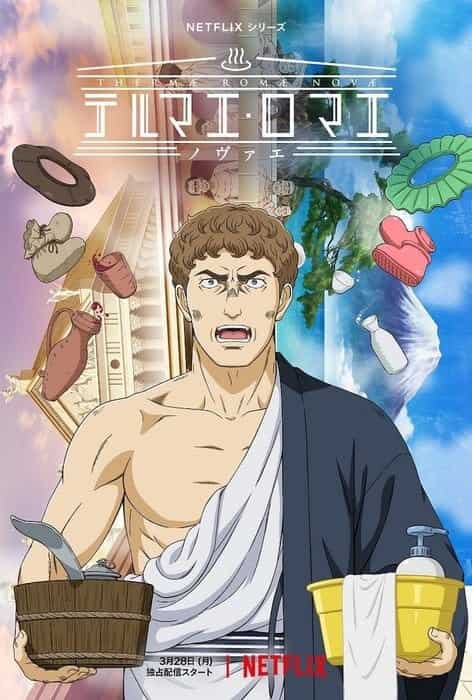
"Thermae Romae Novae" is an anime adaptation of Mari Yamazaki's manga, blending historical fiction with comedic and cultural exploration. The narrative centers on Lucius Modestus, a Roman architect specializing in bathhouse design during the reign of Emperor Hadrian. Struggling with creative stagnation, Lucius finds himself transported through time to modern-day Japan whenever he encounters a crisis. These sudden time slips occur as he drowns in a bath, leading him to discover Japan's advanced bathing culture, which he then adapts to improve Roman bathhouses upon his return.
The series alternates between Lucius's experiences in ancient Rome and his encounters in contemporary Japan. In Rome, Lucius faces professional challenges, including competition from Greek architects and the need to innovate to satisfy the emperor's demands. His time in Japan exposes him to a variety of bathing traditions, from public sento baths to high-tech onsen resorts. Each visit provides him with inspiration, which he creatively reinterprets to enhance Roman bathhouse designs, often with humorous results due to the cultural and technological disparities.
Lucius's character is defined by his earnest dedication to his craft and his initial bewilderment at Japan's modern advancements. His interactions with Japanese people, though limited by the language barrier, highlight the universality of bathing as a communal and therapeutic practice. The series also introduces recurring characters, such as Lucius's loyal apprentice Marcus and various Japanese individuals who assist him during his visits, though their roles are secondary to the central premise.
The episodic structure of the series allows for a diverse exploration of both Roman and Japanese bathing cultures, with each episode presenting a new challenge or discovery for Lucius. The narrative balances humor with educational elements, offering insights into historical Roman engineering and contemporary Japanese traditions. The time-travel mechanism serves as a vehicle for cultural exchange, emphasizing the shared human appreciation for relaxation and innovation.
"Thermae Romae Novae" maintains a lighthearted tone while celebrating the ingenuity of both ancient and modern societies. Its focus on the intersection of history, culture, and technology provides a unique perspective on the enduring significance of communal bathing practices across time and geography.
The series alternates between Lucius's experiences in ancient Rome and his encounters in contemporary Japan. In Rome, Lucius faces professional challenges, including competition from Greek architects and the need to innovate to satisfy the emperor's demands. His time in Japan exposes him to a variety of bathing traditions, from public sento baths to high-tech onsen resorts. Each visit provides him with inspiration, which he creatively reinterprets to enhance Roman bathhouse designs, often with humorous results due to the cultural and technological disparities.
Lucius's character is defined by his earnest dedication to his craft and his initial bewilderment at Japan's modern advancements. His interactions with Japanese people, though limited by the language barrier, highlight the universality of bathing as a communal and therapeutic practice. The series also introduces recurring characters, such as Lucius's loyal apprentice Marcus and various Japanese individuals who assist him during his visits, though their roles are secondary to the central premise.
The episodic structure of the series allows for a diverse exploration of both Roman and Japanese bathing cultures, with each episode presenting a new challenge or discovery for Lucius. The narrative balances humor with educational elements, offering insights into historical Roman engineering and contemporary Japanese traditions. The time-travel mechanism serves as a vehicle for cultural exchange, emphasizing the shared human appreciation for relaxation and innovation.
"Thermae Romae Novae" maintains a lighthearted tone while celebrating the ingenuity of both ancient and modern societies. Its focus on the intersection of history, culture, and technology provides a unique perspective on the enduring significance of communal bathing practices across time and geography.
Cast
- Kuniyoshi Utagawa
Comment(s)
Staff
- DirectorTetsuya Tatamitani
- ScriptYūichirō Momose
- Original creator
- Art DirectorMasakazu Miyake
- Cgi DirectorKunihiko Mita
- Executive producerLiu Yi Xu
- Series Composition
- MusicRyo Kawasaki
- Character DesignFumihiro Nagata
- Sound DirectorRyō Tanaka
- Director of PhotographyToshikazu Kuno
- ProducerYasuo Suda
Production
- Animation ProductionNAZ
- ProductionNetflix