TV-Series
Description
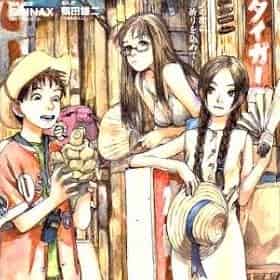
"Abenobashi Mahô Shôtengai" is a surreal and genre-blending series that combines comedy, fantasy, and science fiction elements. The narrative centers on two childhood friends, Sasshi Imamiya and Arumi Asahina, who live in the Abenobashi shopping district of Osaka. After a mysterious incident involving a falling air conditioner, the duo finds themselves transported to alternate versions of their familiar shopping arcade, each reflecting a different genre or theme, such as fantasy, sci-fi, or post-apocalyptic worlds. These parallel realities are bizarre and often satirical, parodying popular media tropes and cultural references.
As Sasshi and Arumi navigate these strange worlds, they encounter exaggerated versions of people from their real lives, including family members and acquaintances, who often play pivotal roles in the alternate realities. The series explores their attempts to return to their original world while uncovering the truth behind the phenomenon. The narrative gradually reveals that the alternate realities are tied to Arumi's unresolved emotions and a deeper connection to the Abenobashi district itself.
Sasshi is characterized as a brash, perverted, and resourceful boy with a strong attachment to Arumi, while Arumi is more level-headed and pragmatic, often serving as the voice of reason. Their dynamic shifts as they confront personal insecurities and the complexities of their friendship. The series balances its comedic and absurd moments with emotional depth, particularly as it delves into themes of nostalgia, growing up, and the impact of change on personal relationships.
The plot progresses through episodic adventures in various genres, each with its own self-contained story, while maintaining an overarching narrative that ties the worlds together. The series culminates in a resolution that addresses the origins of the alternate realities and the characters' emotional growth, providing closure to their journey.
As Sasshi and Arumi navigate these strange worlds, they encounter exaggerated versions of people from their real lives, including family members and acquaintances, who often play pivotal roles in the alternate realities. The series explores their attempts to return to their original world while uncovering the truth behind the phenomenon. The narrative gradually reveals that the alternate realities are tied to Arumi's unresolved emotions and a deeper connection to the Abenobashi district itself.
Sasshi is characterized as a brash, perverted, and resourceful boy with a strong attachment to Arumi, while Arumi is more level-headed and pragmatic, often serving as the voice of reason. Their dynamic shifts as they confront personal insecurities and the complexities of their friendship. The series balances its comedic and absurd moments with emotional depth, particularly as it delves into themes of nostalgia, growing up, and the impact of change on personal relationships.
The plot progresses through episodic adventures in various genres, each with its own self-contained story, while maintaining an overarching narrative that ties the worlds together. The series culminates in a resolution that addresses the origins of the alternate realities and the characters' emotional growth, providing closure to their journey.
Episodes
Staffel 1
1Abenobashi Mahō Shōtengai
The episode establishes the ordinary life of childhood friends Satoshi "Sasshi" Imamiya and Arumi Asahina in the Abenobashi shopping arcade of Osaka. A central conflict is introduced when Arumi reveals her family is closing their restaurant, Grill Pelican, and moving to Hokkaido, a consequence of a redevelopment plan that is forcing many local shops to close. Sasshi's family has already been displaced by this project. The inciting incident occurs when Arumi's stubborn grandfather, Masayuki "Masa", falls from the roof of the Grill Pelican while trying to shoo a cat away from the restaurant's ornamental pelican statue; the statue breaks upon impact, and Masa is hospitalized. The following day, Arumi informs Sasshi that her grandfather has conceded to the move. At that moment, the neighborhood residents inexplicably transform into mushrooms, and the familiar urban landscape collapses to reveal a fantastical castle, transporting the two protagonists to a parallel world resembling a sword-and-sorcery role-playing game. In this new reality, familiar faces occupy archetypal fantasy roles, such as Arumi's father as a king and Sasshi's father as a scientist. A recurring voluptuous woman, Mune-Mune, appears as various enemies they must fight. With no choice but to participate, the duo embarks on a quest to defeat a demon, following the world's RPG logic where Sasshi is repeatedly killed and revived due to a lack of proper equipment. Arumi's purchase of a magical amulet proves decisive, causing the demon to explode and revert into a small, imp-like oni. The oni grants their wish to return home, but the magic instead transports them to a science-fiction version of the arcade, establishing that their journey through disparate genres has only just begun. Sasshi's reluctance to face the dissolution of his home and Arumi's impending departure is implicitly established as the underlying motivation for their inability to return to reality.
2冒険! アベノ橋☆剣と魔法商店街
Sasshi and Arumi find themselves in a new iteration of the shopping arcade, this time modeled after a Western-style fantasy role-playing game. Arumi's father, Papan, is established as the king of a castle, while the neighborhood's Ms. Aki serves as the queen. They task the two children with slaying a demon that terrorizes the land, providing them with gold coins to purchase equipment for the quest. Arumi uses all of the coins to buy a single protective amulet, a decision that leaves Sasshi without any weapons or armor. Consequently, Sasshi is killed repeatedly and revived by the local temple as he attempts to confront minor monsters. The amulet's purpose becomes clear during the final battle with the demon, as it causes the creature to grotesquely expand and explode. From the demon's remains emerges a small, horned oni, whom the children implore to send them home. The oni instead transports them to yet another version of Abenobashi, this time a science fiction setting. The primary conflict arises from the children's divergent approaches to the fantasy world's rules, with Arumi prioritizing defense and Sasshi seeking offensive capability. The episode establishes a pattern of the pair navigating parodic genre conventions while their core motivation—returning to their original reality—remains unfulfilled. The oni's refusal to grant their wish and the subsequent transition to a new world serves as the episode's turning point, reinforcing the series' premise of an endless journey through dimensional recreations of their hometown.
3Hook Up! [Abenobashi Great Milky Way Shopping Arcade]
The third transformation of the shopping arcade casts the characters into a space opera setting heavily influenced by mecha anime. Sasshi and Arumi find themselves aboard a starship where the familiar faces of the arcade have been assigned new roles. Mune-Mune, Sayaka, and Aki-chan form a trio of space heroines known as the Abeno Angels, while Masa is portrayed as a lethargic professor. The central conflict is initiated when a transformed Eutus, depicted as a goblin-like creature, steals Arumi's underwear and escapes in a giant robotic vessel. This theft provides the motivation for Sasshi and Arumi to become pilots of a large humanoid robot, the Abeno-bot, to pursue the antagonist. The episode follows the structure of a super robot anime, featuring a detailed launch sequence and a combat that escalates through multiple stages of combining robots. The mecha battle parodies the genre's tropes, incorporating increasingly absurd combinations, including the fusion of the entire city into a single massive robot. Throughout the fight, the characters' motivations remain superficially focused on recovering the stolen item. Arumi expresses frustration with being continually trapped in these new realities, highlighting her desire to return to their normal lives. However, the immediate consequence of their victory is not a return home, but another transition, propelling them into the next unfamiliar version of Abenobashi. The episode relies on its dense network of allusions to classic science fiction and mecha series, utilizing visual and auditory references to establish its genre parody.
4Fire It Up! Abenobashi Hong Kong Combat Shopping Arcade
The episode places Sasshi and Arumi in a version of the shopping arcade modeled after Hong Kong martial arts cinema. Upon arriving in this world, the pair encounter the goblin-like creature they believe has the power to send them home, but his attempt to do so fails once more. The goblin's intervention results in them remaining trapped within the arcade's alternate dimensions. Sasshi is quickly drawn into the central conflict of this world, a rivalry between the Pelican and Turtle families that is to be settled through a martial arts tournament. Mune-Mune, appearing in this reality, deceives Sasshi into becoming a participant in the competition, convincing him that victory will provide a way back to his own world. Despite having no training in martial arts, Sasshi agrees to fight, motivated by the prospect of returning home. The tournament's structure is revealed to be minimal, with Sasshi's opponent being the sole other contestant: Papan, Arumi's father, who is cast as the champion of the competition. A significant portion of the episode depicts Sasshi undergoing rapid and parodic training to prepare for the fight. The confrontation between Sasshi and Papan serves as the episode's climax, with the fight choreographed in the style of the genre being parodied. Throughout these events, Arumi remains a largely reluctant participant, her primary motivation continuing to be finding a way back to their original reality. The episode concludes with the tournament's conclusion, yet the pair find themselves no closer to escaping, as they are subsequently transported to yet another new reality. The core motivation for the characters remains the desire to return home, a goal that continues to be frustrated by the unexplained mechanics of the worlds they inhabit.
5Extinction! [Abenobashi Ancient Dinosaur Shopping Arcade]
The setting shifts to a prehistoric version of the shopping arcade, populated by dinosaurs and cavemen. Arumi and Sasshi find themselves in this world after the conclusion of the previous episode's martial arts tournament. Their primary motivation becomes returning a lost baby triceratops to its herd, a goal that structures much of the episode's action. The familiar cast of characters appears in period-appropriate roles, with Masa-Jii as a tribal elder and Mune-Mune as a caveman's mate. A significant portion of the episode involves the protagonists evading hostile cavemen who are attempting to capture them. The conflict escalates when a comet is shown on a collision course with the planet, threatening all life. In a departure from the genre parodies of previous worlds, Sasshi and Arumi, along with the baby dinosaur, must find a way to avert this catastrophe. Their solution involves physically punching the comet to alter its path, a feat accomplished with assistance from the baby dinosaur. Following the resolution of the prehistoric crisis, the pair are transported once again, this time emerging into a foggy, nocturnal version of the arcade. The immediate consequence of their departure from the dinosaur world is their arrival in a hard-boiled 1930s gangster setting. This episode continues the pattern of the protagonists being pulled through various dimensions without their conscious control. Unlike prior worlds that were primarily parodic, this prehistoric setting introduces a more direct life-or-death threat with the comet. The episode also subtly advances the underlying mystery, as the transitions between worlds become a point of focus, setting the stage for the subsequent noir-themed installment.
6In the Night Fog! [Abenobashi Hard Boiled Shopping Arcade]
The episode transports Arumi and Sasshi into a nocturnal, fog-ridden version of the shopping arcade styled after 1930s hard-boiled detective and gangster films. The setting is defined by a territorial conflict between the police force, led by Sasshi's grandfather, and a mafia organization run by Masayuki, who controls the Pelican Grill and smuggles snails. Sasshi is mistaken for a legendary assassin and is forcibly recruited into the mafia, while Arumi joins the police department, serving alongside Mune-Mune and Sayaka. The real legendary sniper, Papan, eventually appears and publicly challenges Sasshi's claim, leading to a confrontation that proves Sasshi an impostor. After losing the challenge, Sasshi is shot, but the episode establishes that characters in this world do not die; instead, they transform into super-deformed versions of themselves. The conflict escalates into a large-scale shootout between the police and the mafia, bringing all characters into direct opposition. During the chaos, Mune-Mune confronts Yutas about his persistent indifference toward her, and he is subsequently shot, becoming a small, childlike version of himself. In this diminished state, Yutas offers to perform the spell that would send Arumi and Sasshi home. However, the ritual fails to return them, and it becomes explicitly clear that they cannot go back because Sasshi, on a subconscious level, does not wish to leave. This revelation marks a turning point, shifting the narrative focus from the external parodic worlds to the internal, unresolved motivation of the protagonist as the primary obstacle to their return.
7回想!魔法商店街誕生
This episode departs from the pattern of parallel world parodies to present a flashback narrative set approximately fifty years prior to the main storyline. The setting shifts to the immediate post-World War II era, focusing on the construction and establishment of the Abenobashi shopping arcade itself. The narrative centers on the younger versions of Mune-Mune, Sasshi's grandmother, and Masa, Arumi's grandfather, depicting their interactions with a man named Abeno Seimei, also known as Yutas. The episode details how Seimei, a mystic or onmyōji, conceptualized and designed the arcade based on spiritual principles and the flow of chi. The plot follows the efforts to build the arcade, highlighting the challenges of the era and the relationships between the three key individuals. A central conflict emerges from the unspoken romantic tension between Mune and Seimei, which is complicated by her existing bond with Masa. The turning point arrives as the arcade nears completion and Seimei prepares to depart, revealing that his involvement in the project was his purpose. The immediate consequence is the establishment of the arcade as a lasting community, but also the creation of a deep, unresolved personal history for Mune and Masa that will echo into the future. This historical context directly informs the magical circumstances affecting Sasshi and Arumi in the present, as the arcade's very foundation is shown to be intrinsically linked to supernatural forces. The episode concludes by returning to the present-day narrative framework, where Yutas explains to a distraught Arumi the karmic connections that bind the key characters across generations.
8Tokimeke! Abenobashi gakuen shoutengai
The episode transitions into a world styled after a dating simulation video game, set within Abenobashi Gakuen, a school version of the shopping arcade. Sasshi finds himself as a student in this environment, which is populated by the familiar characters in roles appropriate to a school setting. Arumi, however, has become completely exasperated with their ongoing situation and leaves Sasshi out of pure frustration. Her appearance in this world is altered, first resembling a goblin, and she subsequently grows to an enormous size of over fifty feet tall, physically representing her emotional distance and anger. Following Arumi's departure, the character Eutus intervenes and agrees to help Sasshi. Eutus reveals the truth about their circumstances and explains the karmic connection that binds Sasshi and Arumi together. He offers Sasshi a path forward by deciding to take him on as an apprentice in the ways of the Onmyou, a form of mystical spiritual practice. Eutus makes it clear that the assistance he will provide to Sasshi will be minimal, placing the burden of action on Sasshi himself. Motivated by the revelations and his desire to resolve the conflict, Sasshi becomes determined to find a world that will make Arumi happy. A key motivation for this quest is Sasshi's desire to escape dealing with the reality of his grandfather's death, which he hopes to avoid by creating a perfect alternate reality. Sasshi uses his newfound understanding to transport them into a fairy tale world of his own making. However, this world fails to please Arumi, as her unhappiness persists despite Sasshi's intentions. The situation escalates when a giant teddy bear attacks this fabricated land, forcing an unwilling Arumi to assume the guise of a magical girl, complete with a transformation baton and an irritating animal sidekick, to combat the threat. The immediate consequence is a further deterioration of their relationship, leaving them at odds within a world that was meant to solve their problems.
9It Cries! [The Bush Warbler Heiankyo]
The episode departs from the parallel-world formula by transporting Sasshi and Arumi to the Heian period of Japan, specifically to a version of the Abenobashi shopping arcade re-imagined as the ancient capital of Heiankyo. This is not merely another parody world but a setting tied to the series' core mythology, where the characters confront the roots of their predicament. Eutus, revealing his identity as the onmyoji Abeno Seimei, explains the karmic connection that binds him to Sasshi and Arumi, which stems from events a thousand years in the past. The narrative focus shifts from comedic genre pastiche to exposition and character development, as Eutus discloses that their inability to return home is fundamentally linked to Sasshi's own desires. Arumi, frustrated by the endless and increasingly personal detours, confronts Sasshi about his refusal to face reality, leading to a rift between them. In a significant turning point, Eutus agrees to train Sasshi in the ways of onmyoudo, the mystical arts of yin and yang, equipping him with the potential to control the world-hopping. Sasshi, however, misuses this nascent power not to return home, but to will into existence a new, fairy-tale world he believes will make Arumi happy, demonstrating his continued escapism. This action creates a new conflict and sets the stage for the ensuing episodes, as Sasshi's attempt to create a perfect world for Arumi instead leads to unforeseen consequences, including the emergence of a giant teddy bear menace. The episode establishes a more somber and plot-driven tone, directly addressing the central mystery and the protagonists' conflicting motivations for the first time.
10ぽわぽわ?アベノ橋☆メルヘン商店街
Following the revelations about his latent power, Sasshi takes active control of the reality-shifting. He deliberately creates a new world, attempting to construct a Fairy Tale-themed Abenobashi specifically tailored to please Arumi. This world is populated by familiar characters in storybook roles, including a giant rampaging teddy bear as the primary antagonist. Arumi, however, is not pleased with the saccharine and childish world Sasshi has built for her. Her frustration with his continued refusal to confront reality comes to a head, and she abandons him within the narrative to deal with the consequences alone. Faced with the crisis of the teddy bear's attack and Arumi's absence, the situation forces Arumi into a new role. She is compelled to take on the persona of a magical girl, complete with a transforming wand and an annoying animal mascot, to combat the threat. This turn of events underscores Arumi's active, if unwilling, participation in the fantasy scenarios. The episode highlights the growing rift between the two protagonists, driven by Sasshi's escapism and Arumi's desire to return home. The fairy tale setting ultimately fails to provide comfort or resolution, instead amplifying their conflicting motivations. The core conflict shifts from external genre parody to an internal struggle between Sasshi's desire to avoid change and Arumi's rejection of his fabricated realities. The immediate consequence is a deepening of their emotional divide, leaving Sasshi's plan in ruins and Arumi more determined than ever to find a way back.
11Resolution! Abenobashi Battlefield Shopping Arcade
The episode places Satoshi "Sasshi" Imamiya and Arumi Asahina in a world transformed by large-scale armed conflict, directly following the events of the previous amusement park-themed world. The familiar Abenobashi Shopping Arcade is now a war zone, with the protagonists finding themselves on opposing sides of a military campaign. This new reality parodies various war film clichés and tropes, incorporating elements from movies such as "All Quiet on the Western Front" and "Patton". Sasshi is portrayed as a low-ranking private who experiences the absurdities and dangers of frontline combat, often serving as the recipient of relentless orders. Arumi's position in the conflict contrasts with his, placing her on the other side of the battlefield. The episode focuses on the mechanics of their struggle to navigate the chaotic environment and the escalating stakes of the conflict. Their individual motivations become centered on survival and finding a resolution to the war that engulfs their transformed home. The strategic confrontations and camaraderie formed with other characters highlight the importance of teamwork under extreme pressure. As the penultimate episode, it advances the overarching narrative by raising the tension to its highest point, setting the stage for the series' conclusion. The immediate consequence of this world's events is a heightened sense of urgency for Sasshi and Arumi to understand and resolve the reality-shifting phenomenon. The episode concludes with their fates hanging in the balance, directly leading into the final two installments of the series.
12大逆転!アベノ橋☆ハリウッド商店街 (Daigyakuten! Abenobashi Hollywood Shōtengai)
The episode transports Sasshi and Arumi into a universe constructed from pastiches of Hollywood adventure and science fiction films. This world is characterized by its artificial, stage-like quality, complete with cardboard set pieces, excessive fake blood, and unconvincing plastic alien creatures. The narrative structure mimics the rapid pacing and escalating stakes of summer blockbuster movies, moving from one action sequence to the next. Arumi's primary motivation throughout the episode is her deep-seated desire to return to her real world and, crucially, to prevent her grandfather's death, a tragedy she knows awaits her. Sasshi, in contrast, actively perpetuates this cinematic illusion, driven by his own refusal to accept his grandfather's passing and the impending changes in their lives. The central conflict arises not from an external villain but from the collision between Arumi's urgent need for reality and Sasshi's desperate creation of fantasy. A significant turning point occurs when Arumi confronts Sasshi, rejecting the artificiality of the world he has helped sustain and forcing him to acknowledge the limits of his escapism. This confrontation directly challenges Sasshi's motivation, revealing that their predicament is sustained by his unwillingness to face reality. The immediate consequence of this realization is the collapse of the Hollywood pastiche world, setting the stage for the final resolution.
13Yomigaere! Densetsu no Onmyōji
The final episode resolves the central conflict of the series by returning Sasshi and Arumi to their original, non-magical Abenobashi. However, the relief of being home is immediately undercut by the reality that Arumi's grandfather, Masayuki, remains deceased from his earlier accident. Sasshi is unable to accept this outcome and, against Arumi's wishes, uses his power to initiate another dimensional jump to a world where Masayuki is still alive. This act forces a confrontation with Eutus, who reveals that Sasshi's refusal to face reality is the force that has been creating the alternate worlds. Eutus explains that he is the legendary onmyoji Abe no Seimei, and his own past inability to accept the deaths of his friend Masayuki and lover Mune led to the creation of the Abenobashi shopping arcade in another dimension. Sasshi is thus presented with a choice: continue to flee from grief or accept the loss. In the climax, Sasshi ultimately acknowledges that he cannot change reality through escapism. By accepting his grandfather's death, he breaks the cycle, and the alternate dimensions collapse. The episode concludes with the world seemingly reset; the shopping arcade is not slated for demolition, and Arumi's family is not moving to Hokkaido. The final scene shows the children and their families continuing their daily lives as if the entire journey never occurred, though the implication is that Sasshi's acceptance has reshaped their reality to one without the immediate pains he sought to escape.
Cast
- Satoshi Imamiya
- Ayako Asahina
- Sasshi
- SatoshiGabriele Patriarca
Comment(s)
1
Staff
- Series DirectorMasayuki Kojima
- Series CompositionHiroyuki Yamaga
- StoryboardAtsushi TakahashiMasayuki KojimaTadashi HiramatsuKiyotaka OhataMitsuyuki MasuharaSayo Yamamoto
- MusicShirō Sagisu
- Character DesignTadashi HiramatsuKazuhiro Takamura
- ArtHiroshi KatōShunichirō YoshiharaTakafumi Nishima
- Mecha designTakeshi Takakura
- Director of PhotographyHitoshi YamaguchiKazuhiro Yamada
- DirectorHiroyuki Yamaga
- Script
- Episode DirectorAtsushi TakahashiHiroyuki OchiMasayuki KojimaMasahiko ŌtsukaTadashi HiramatsuMitsuyuki MasuharaShiro EbisuKentaro Nakamura
- Original Character DesignKenji Tsuruta
- Art DirectorHiroshi Katō
- Animation DirectorHiroyuki OchiFumie MuroiMasaaki SakuraiNoriyuki FukudaTadashi HiramatsuShinji TakeuchiRyu KaseGi Du KimFumie Mutoi
- Sound DirectorKazuya Tanaka
- ProducerHiroyuki YamagaToshimichi ŌtsukiMasafumi FukuiTaiji Suinou
Production
- ProductionKing RecordsDentsu Inc.GAINAXImagicaAbenobashi Project
- Animation ProductionMadhouseGAINAX