Movie
Description
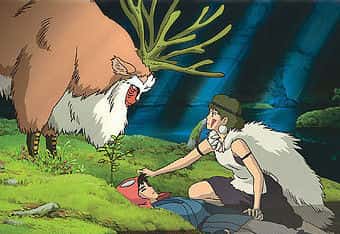
"Princess Mononoke" is set in the late Muromachi period of Japan, blending historical elements with fantasy. The narrative centers on Ashitaka, a young prince from the Emishi tribe, who becomes cursed after defending his village from a demonic boar god. The curse grants him superhuman strength but will eventually kill him. Seeking a cure and understanding of the curse, Ashitaka journeys to the western lands where the boar originated.
In the western forests, Ashitaka encounters a conflict between the industrialized human settlement of Iron Town, led by the ambitious Lady Eboshi, and the forest gods, including the wolf goddess Moro and her adopted human daughter, San, known as Princess Mononoke. Lady Eboshi seeks to exploit the forest's resources, leading to deforestation and the displacement of its inhabitants. San, raised by wolves, fiercely opposes Eboshi and fights to protect the forest and its deities.
Ashitaka becomes entangled in the struggle, attempting to mediate between the humans and the forest spirits. He learns that the demonic boar god was once a benevolent forest spirit corrupted by an iron ball lodged in its body, a product of human industry. This revelation underscores the destructive impact of human encroachment on nature. The conflict escalates as Eboshi's actions provoke the wrath of the Great Forest Spirit, a powerful and enigmatic deity capable of both creation and destruction.
The climax involves a battle between Iron Town and the forest creatures, culminating in the decapitation of the Great Forest Spirit by Eboshi. This act unleashes chaos, as the Spirit's headless body transforms into a destructive force, spreading death and decay. Ashitaka and San recover the Spirit's head, restoring balance and allowing the forest to begin healing. The resolution sees Eboshi acknowledging the consequences of her actions, while Ashitaka and San part ways, with Ashitaka remaining in Iron Town to help rebuild and San returning to the forest.
The story explores themes of environmentalism, the clash between tradition and progress, and the complexity of human and nature relationships. Ashitaka serves as a bridge between opposing forces, embodying the possibility of coexistence. San represents the untamed spirit of nature, while Eboshi embodies human ambition and the drive for survival and progress. The narrative presents a nuanced portrayal of its characters, avoiding clear-cut distinctions between good and evil, and instead highlighting the moral ambiguities inherent in their actions and motivations.
In the western forests, Ashitaka encounters a conflict between the industrialized human settlement of Iron Town, led by the ambitious Lady Eboshi, and the forest gods, including the wolf goddess Moro and her adopted human daughter, San, known as Princess Mononoke. Lady Eboshi seeks to exploit the forest's resources, leading to deforestation and the displacement of its inhabitants. San, raised by wolves, fiercely opposes Eboshi and fights to protect the forest and its deities.
Ashitaka becomes entangled in the struggle, attempting to mediate between the humans and the forest spirits. He learns that the demonic boar god was once a benevolent forest spirit corrupted by an iron ball lodged in its body, a product of human industry. This revelation underscores the destructive impact of human encroachment on nature. The conflict escalates as Eboshi's actions provoke the wrath of the Great Forest Spirit, a powerful and enigmatic deity capable of both creation and destruction.
The climax involves a battle between Iron Town and the forest creatures, culminating in the decapitation of the Great Forest Spirit by Eboshi. This act unleashes chaos, as the Spirit's headless body transforms into a destructive force, spreading death and decay. Ashitaka and San recover the Spirit's head, restoring balance and allowing the forest to begin healing. The resolution sees Eboshi acknowledging the consequences of her actions, while Ashitaka and San part ways, with Ashitaka remaining in Iron Town to help rebuild and San returning to the forest.
The story explores themes of environmentalism, the clash between tradition and progress, and the complexity of human and nature relationships. Ashitaka serves as a bridge between opposing forces, embodying the possibility of coexistence. San represents the untamed spirit of nature, while Eboshi embodies human ambition and the drive for survival and progress. The narrative presents a nuanced portrayal of its characters, avoiding clear-cut distinctions between good and evil, and instead highlighting the moral ambiguities inherent in their actions and motivations.
Cast
- SanClaire DanesEva DíezAngélica Rodríguez OvalleFé van Kessel
- Germán José
- Patrona Moro
- Hui-Seon Gang
- Maria Lindes
- Fé van Kessel
- Roberto Cuenca Martínez
- Reinder van der Naalt
- Kichi
Comment(s)
Staff
- DirectorHayao Miyazaki
- MusicJoe Hisaishi
- Character DesignMasashi AndōYoshifumi Kondō
- Sound DirectorKazuhiro Wakabayashi
- ProducerToshio Suzuki
- ScreenplayHayao Miyazaki
- Original storyHayao Miyazaki
- Art DirectorNizo YamamotoNaoya TanakaSatoshi KurodaKazuo OgaYōji Takeshige
- Executive producerSeiichirō UjiieYutaka Narita
Production
- ProductionNippon Television NetworkDentsu Inc.Tokuma ShotenStudio Ghibli
Relations
Recommendations based on shared tags.