Movie
Description
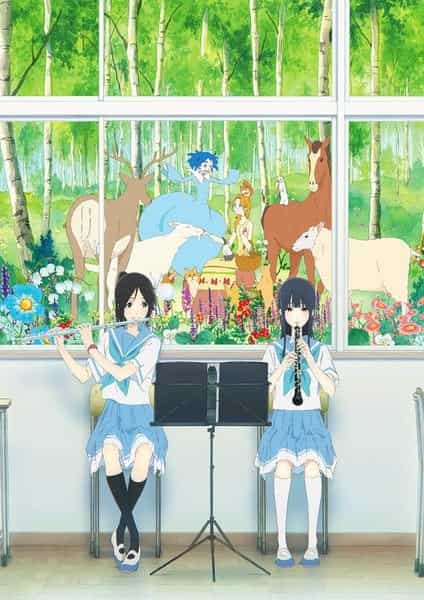
"Liz and the Blue Bird" is a poignant and introspective anime film that explores the nuanced relationship between two high school girls, Mizore Yoroizuka and Nozomi Kasaki, who are members of their school’s concert band. The narrative intertwines their personal struggles with the performance of a piece titled "Liz and the Blue Bird," a musical composition based on a fairy tale about a girl named Liz and her bond with a mystical blue bird. The fairy tale serves as a metaphor for the evolving dynamics between Mizore and Nozomi, reflecting themes of connection, separation, and self-discovery.
Mizore, an introverted and reserved oboe player, harbors deep admiration and dependency on Nozomi, her outgoing and cheerful best friend who plays the flute. Their relationship, once harmonious, begins to show cracks as they prepare for their final high school performance. Mizore’s quiet longing and fear of losing Nozomi contrast with Nozomi’s apparent ease and readiness to move on, creating a subtle tension that permeates their interactions. The fairy tale of Liz and the blue bird mirrors their situation, with Liz representing Nozomi and the blue bird symbolizing Mizore, highlighting the emotional distance growing between them.
As the story progresses, Mizore’s insecurities and Nozomi’s internal conflicts come to the forefront. Mizore struggles to express her feelings, fearing that her attachment to Nozomi might be one-sided, while Nozomi grapples with her own sense of identity and the pressure to conform to expectations. Their performances of the musical piece become a medium through which they confront these emotions, culminating in a deeply personal and cathartic resolution. The film’s narrative is driven by its focus on the quiet, often unspoken moments that define their relationship, emphasizing the complexity of human connections and the bittersweet nature of growing apart.
The supporting characters, including their bandmates and the band director, provide context for Mizore and Nozomi’s journey, though the story remains firmly centered on the two protagonists. The film’s pacing is deliberate, allowing the emotional weight of their interactions to resonate fully. Through its exploration of friendship, individuality, and the inevitability of change, "Liz and the Blue Bird" offers a thoughtful and intimate portrayal of adolescence and the delicate balance between holding on and letting go.
Mizore, an introverted and reserved oboe player, harbors deep admiration and dependency on Nozomi, her outgoing and cheerful best friend who plays the flute. Their relationship, once harmonious, begins to show cracks as they prepare for their final high school performance. Mizore’s quiet longing and fear of losing Nozomi contrast with Nozomi’s apparent ease and readiness to move on, creating a subtle tension that permeates their interactions. The fairy tale of Liz and the blue bird mirrors their situation, with Liz representing Nozomi and the blue bird symbolizing Mizore, highlighting the emotional distance growing between them.
As the story progresses, Mizore’s insecurities and Nozomi’s internal conflicts come to the forefront. Mizore struggles to express her feelings, fearing that her attachment to Nozomi might be one-sided, while Nozomi grapples with her own sense of identity and the pressure to conform to expectations. Their performances of the musical piece become a medium through which they confront these emotions, culminating in a deeply personal and cathartic resolution. The film’s narrative is driven by its focus on the quiet, often unspoken moments that define their relationship, emphasizing the complexity of human connections and the bittersweet nature of growing apart.
The supporting characters, including their bandmates and the band director, provide context for Mizore and Nozomi’s journey, though the story remains firmly centered on the two protagonists. The film’s pacing is deliberate, allowing the emotional weight of their interactions to resonate fully. Through its exploration of friendship, individuality, and the inevitability of change, "Liz and the Blue Bird" offers a thoughtful and intimate portrayal of adolescence and the delicate balance between holding on and letting go.
Cast
- Ririka Kenzaki
- Reina Kousaka
- Sapphire Kawashima
- Reina Kōsaka
- Julie Claude
- Beatrice Maruffa
- Eleni Möller
- Yuko Yoshikawa
- Satomi Niiyama
- Kumiko Ōmae
Comment(s)
Staff
- DirectorNaoko Yamada
- StoryboardNaoko Yamada
- MusicAkito Matsudakensuke ushio
- Character DesignFutoshi Nishiya
- Chief Animation DirectorFutoshi Nishiya
- 3D DirectorTetsuo Umetsu
- Executive producerShunji InoueYoko FurukawaYōta TsuruokaYōko Hatta
- Sound DirectorYōta Tsuruoka
- ScriptReiko Yoshida
- Unit DirectorTatsuya IshiharaYasuhiro TakemotoNaoko YamadaShinpei SawaTaichi Ogawa
- Original Work
- Art DirectorMutsuo Shinohara
- Animation DirectorHiroyuki TakahashiKazumi IkedaFutoshi NishiyaChiyoko UenoMiku KadowakiNobuaki MarukiYuki TsunodaKohei OkamuraYuko MyoukenTatsunari Maruko
- Director of PhotographyKazuya Takao
- ProducerShinichi NakamuraRiri SenamiShigeru SaitōYoshifumi YarimizuNagaharu Ohashi
Production
- ProductionPony CanyonBandai Namco ArtsKyoto AnimationRakuonsha
- Animation ProductionKyoto Animation
Relations
Recommendations based on shared tags.